8 Voice Over Script Examples You Can Practice for Free
 Lauren Mercer · October 6, 2026 · 10 min read
A voice over script is only useful for practice if it reads like real work. Casting sites, coaching sessions, and demo reels all ask for the same thing: short, believable copy in a recognizable style, read at the right length. Below are eight voice over script examples written for exactly that, covering the jobs that make up most paid voice work, from a 15-second radio spot to an audiobook scene with dialogue. Each comes with a target length, a word count, and the direction a producer would give you.
A voice over script is the written copy a narrator reads aloud, marked with timing and delivery notes. At a natural pace of about 150 words per minute, a 30-second spot runs roughly 75 words and a 60-second read about 150. The eight samples below are free to practice with and cover ads, explainers, e-learning, documentary, phone systems, YouTube, and audiobooks.
In every voice over script sample below, bracketed words like [beat] or [slower] are directions, not lines to read. They aren't counted in the word totals.
1. 15-second radio spot (retail)
Length: 15 seconds · Words: 32 · Pace: Brisk and bright, about 2.5 words per second
Direction: Friendly local announcer. Lift the question, land the store name twice, and keep the address slow enough to remember.
Rain's coming this weekend. [beat] Is your basement ready? Corner Hardware has gutter guards, sump pumps, and wet-vacs at fifteen percent off, through Sunday only. [slower] Corner Hardware, Fifth and Maple. Open till nine.
Short spots punish extra words. Read it once against a stopwatch: if you run past 15 seconds, the fix is cutting words, not talking faster.
2. 30-second commercial (warm, conversational)
Length: 30 seconds · Words: 67 · Pace: Relaxed, with real pauses
Direction: Talk to one tired parent, not a crowd. The list of morning chaos should sound like you're living it; the product line can smile.
Mornings don't wait for anyone. [beat] The alarm. The lunch boxes. The keys that were right there a minute ago. Bright Bean cold brew is ready when you are. No brewing, no measuring. Just pour and go. [slower] Smooth, never bitter, made from beans grown on one family farm in Huila (WEE-lah), Colombia. [smile] Bright Bean. Pour it, pack it, get out the door. Find us in the dairy aisle.
The fragments ("The alarm. The lunch boxes.") are where beginners rush. Give each one its own breath; the pauses are part of the 30 seconds.
3. 60-second explainer video (software)
Length: 60 seconds · Words: 139 · Pace: Clear and upbeat, close to 150 words per minute
Direction: Helpful colleague, not salesperson. Slight frustration in the opening problem, relief once the product arrives.
Every week, your team loses hours to the same question: where's the latest version? [beat] It's in someone's inbox. Or a chat thread. Or a folder called FINAL-final-v3. Shelfwise fixes that. Drop any file into Shelfwise, and it becomes the one version everyone sees. Edit it, and the old copy steps aside automatically, with its history saved underneath. [slower] No more guessing. No more "did you get my changes?" Need sign-off? Tag a teammate, and they get a single link that always opens the current file, on their phone or their laptop. When they approve, everyone knows. [lift] Shelfwise works with the tools you already use, so there's nothing new to learn and nothing to migrate on day one. Setup takes about ten minutes. Try Shelfwise free for thirty days, and give your team back the hours they spend hunting for files.
Explainer voice over scripts are usually cut to animation after the read, so keep each sentence a clean, editable unit. Don't run two sentences together on one breath.
4. E-learning module introduction
Length: About 40 seconds · Words: 85 · Pace: Measured, a little slower than conversation
Direction: Patient instructor. Number each objective clearly so a learner taking notes can follow along.
Welcome to Module Two: Handling Customer Complaints. [pause] By the end of this module, you'll be able to do three things. First, recognize the difference between a complaint and a request for information. Second, use the LEARN method to respond: listen, empathize, apologize, resolve, and notify. And third, know when a complaint needs to go to a supervisor. [pause] This module takes about twelve minutes. You can pause at any time, and there's a short knowledge check at the end. When you're ready, select Next to begin.
E-learning reads run slower than ads because learners are absorbing instructions, not hearing a pitch. Keep the energy even from first sentence to last; modules are often recorded in many sessions and edited together.
5. Documentary narration (nature)
Length: About 45 seconds · Words: 78 · Pace: Slow and low, with long pauses
Direction: Quiet authority. Let the images carry the scene; the voice only guides attention.
At first light, the estuary is almost silent. [long pause] The tide has pulled back, leaving a mile of mud that glints like hammered metal. To us, it looks empty. To the dunlin, it's a feast. [pause] Each bird probes the mud again and again, searching for worms no longer than a fingernail. [slower] They have flown here from the Arctic, and in a few weeks they'll leave again. The estuary doesn't know they're coming. It simply waits, as it always has.
Documentary voice over scripts are written to picture. The long pauses are where the footage breathes, so a 45-second slot holds far fewer words than a 45-second ad.
6. Phone system greeting (IVR)
Length: About 30 seconds · Words: 67 · Pace: Crisp, even, unhurried
Direction: Calm and neutral with a slight smile. Every menu option gets identical rhythm so callers can predict the pattern.
Thank you for calling Northside Dental. [pause] If this is a medical emergency, please hang up and dial nine-one-one. [pause] To book or change an appointment, press one. For billing and insurance questions, press two. For directions and opening hours, press three. To speak with our front desk, press zero, or stay on the line. [pause] Our office is open Monday through Friday, eight a.m. to six p.m.
IVR voice over scripts are often recorded as separate files and stitched together by the phone system, so match your pitch on every line. Read numbers exactly as written.
7. YouTube channel intro
Length: About 20 seconds · Words: 56 · Pace: Fast and energetic, then a beat before the hook
Direction: Excited host talking to regular viewers. Big smile on the greeting, then lean in for the hook.
What's up, everyone, and welcome back to Weekend Workshop! [quick] Today we're turning a forty-dollar thrift-store dresser into something you'd actually want in your living room. [beat] It's a two-day project, you need zero power tools, and we'll show you the one mistake that ruined our first three paint jobs. Grab a coffee, and let's get into it.
Creators often record intros last, after the video is edited, so the hook matches what's actually in the episode.
8. Audiobook excerpt with dialogue
Length: About 40 seconds · Words: 76 · Pace: Narration at an easy pace, characters faster or slower
Direction: Practice switching between a dry narrator and two characters without turning either into a cartoon.
The rain had followed Mara all the way from the station. [pause] She stood in the doorway, dripping onto the bookshop's worn rug, until the old man behind the counter finally looked up. He did not seem pleased to see her. [old man, gravelly, slow] "We're closed." [Mara, quick, out of breath] "The sign says open." [old man] "The sign," he said, folding his newspaper with great care, "is an optimist." [beat] Mara laughed before she could stop herself, and for the first time all day, she felt warm.
Mark every speaker change in the margin before you record. Audiobook narrators lose more takes to switching voices too late than to any mispronunciation.
How many words is a 1-minute voice over script?
A 1-minute voice over script holds about 150 words. Voicebooking puts natural English voice over delivery at about 150 words a minute, dropping toward 120 for a voice working in the lower part of its range. That rate scales down cleanly for shorter spots:
| Spot length | Words at a natural pace | Draft to |
|---|---|---|
| 15 seconds | 35–40 | about 35 |
| 30 seconds | about 75 | 65–70 |
| 60 seconds | about 150 | 140 |
The 15- and 30-second figures come from Killerspots' radio script timing guide, which works from an average of 2.5 words per second and notes that energetic reads run faster while warm, reflective reads run slower. That's why the documentary and e-learning samples above sit well under 150 words a minute: their pauses are part of the performance.
To time a script of your own before recording, paste it into the speech time calculator and set the pace that matches the style.
Professional English voice over averages about 150 words per minute, or 2.5 words per second, according to Voicebooking and Killerspots. That puts a 30-second spot at roughly 75 words and a 60-second read near 150, but slower styles such as documentary narration and e-learning fit fewer words into the same length.
How to format a voice over script so it reads cleanly
Every voice over script example on this page follows the same conventions, and they're worth copying when you write your own:
- Directions go in brackets. [beat] is a short pause, [pause] a full breath, [slower] or [smile] a change in delivery. Brackets keep notes visually separate from lines, so they never get read aloud by accident.
- Write numbers the way they're spoken. "Fifteen percent" and "nine-one-one" leave no room for doubt. "$1,499" could become "one thousand four hundred ninety-nine" or "fourteen ninety-nine," and the reader has to stop and decide mid-sentence.
- Spell out tricky pronunciations once. Huila (WEE-lah) in sample 2 is the pattern: phonetic spelling in parentheses the first time a name appears.
- Mark emphasis sparingly. Bold or underline one word per sentence at most. When everything is stressed, nothing is.
- Number the lines in longer scripts. A producer can then ask for "line 6 again, warmer" instead of describing where it is.
Voice over scripts write numbers out as words because figures are ambiguous aloud. A price like $1,499 can be read several ways, and a reader who has to choose mid-sentence hesitates on the recording. Spelling out the intended reading, and putting directions in brackets, removes every decision that isn't about the performance itself.
How to practice with these scripts
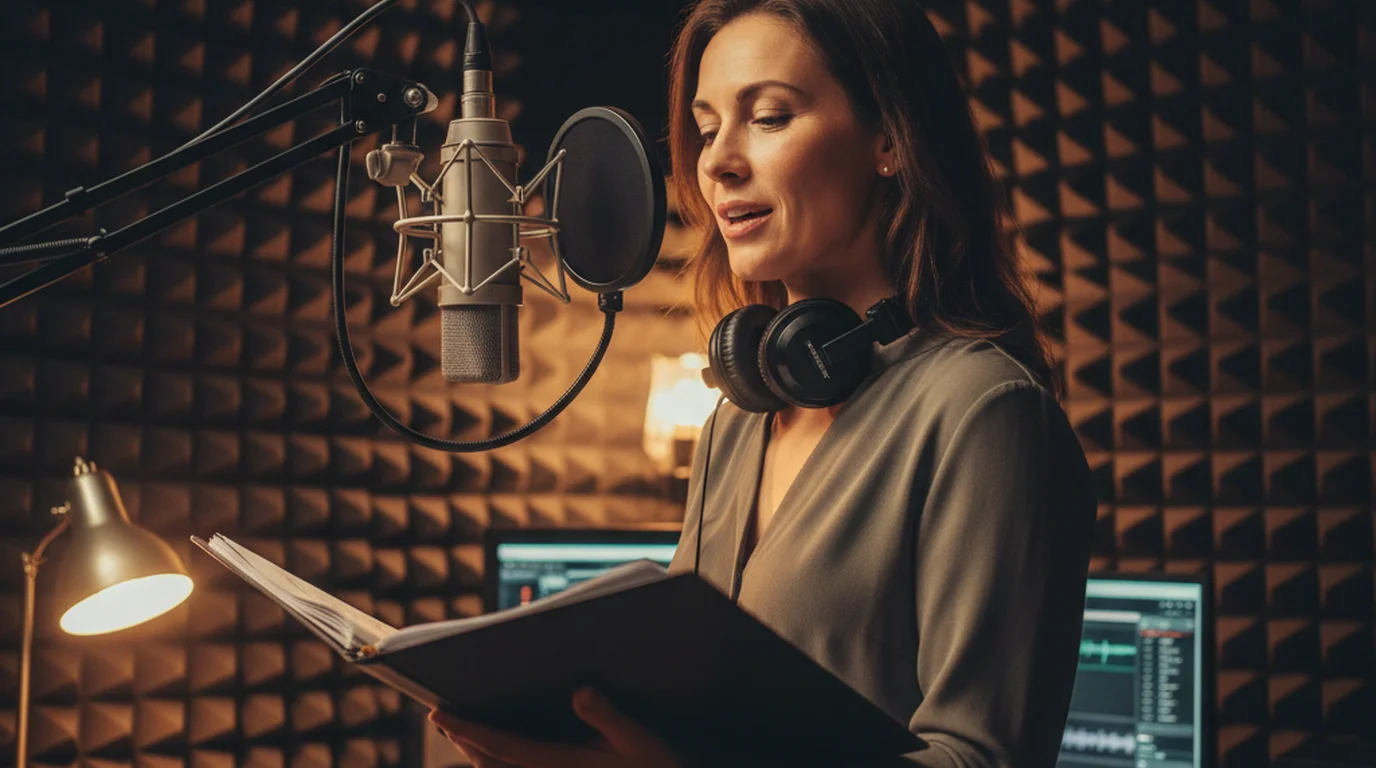
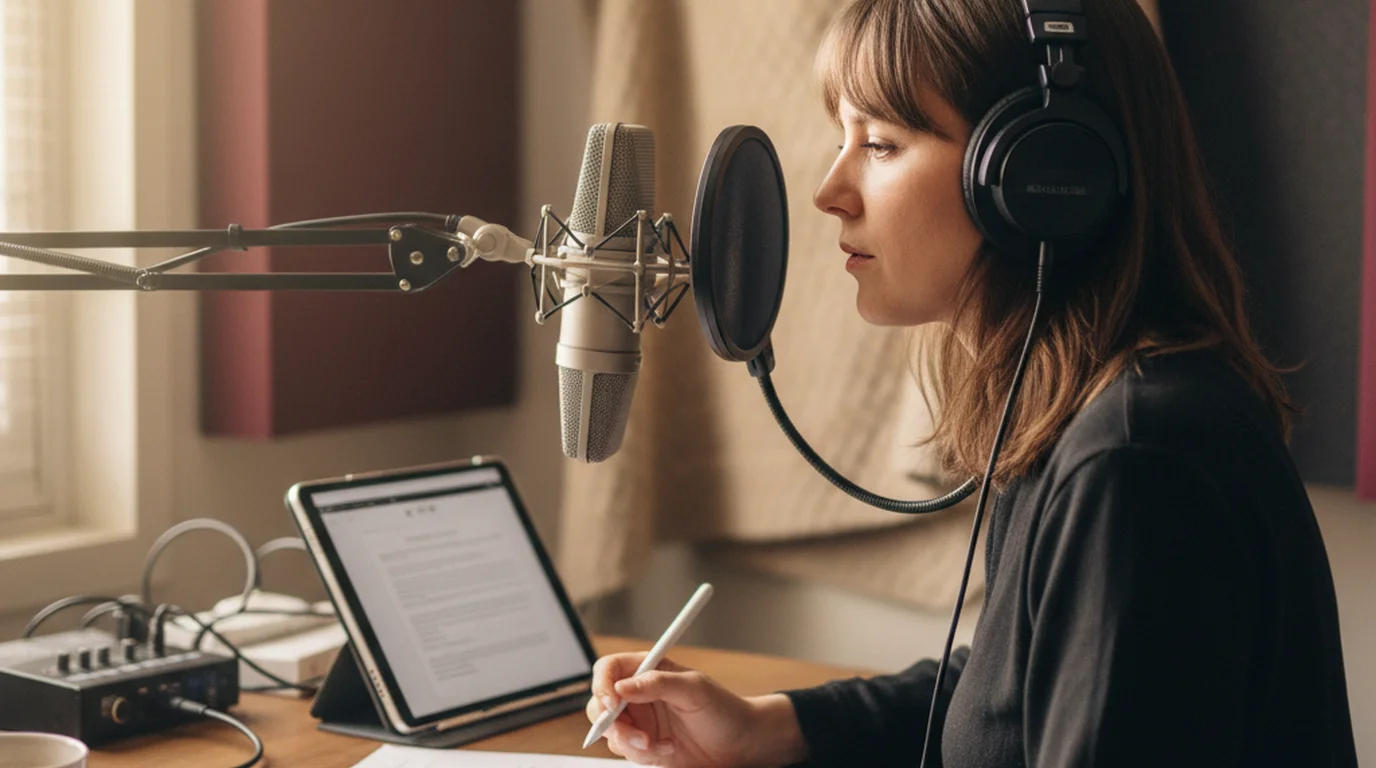
Print the script or put it on a screen at eye level, but don't hold it: paper rustle and a lowered chin both end up on the recording. Read each voice over script sample cold once, then mark it up with your own brackets, then record three takes and listen to them back to back. Most people find the third take is the first one that sounds like talking rather than reading.
Reading from a screen is where a teleprompter helps. In Teleprompter-Scrolling Scripts, a free teleprompter app for iPhone, iPad, and Mac, Voice mode records audio only while the script scrolls in front of you, so you can paste in any of these samples, set the scroll speed to the pace in the notes, and keep your eyes up instead of tracking lines on a page. If you lose your place, the up and down buttons move the script three lines at a time. Recording and cleaning up the take is its own skill, covered step by step in how to do a voiceover.
Once a few of these feel natural, put your two strongest contrasting reads, say the commercial and the audiobook scene, at the front of a demo. The guide to voice acting for beginners at home covers building a first reel and where to audition with it.
Frequently Asked Questions
How to voice over a script?
Read the script aloud twice before recording, mark pauses and emphasis in brackets, and time one full read. Then record in a quiet, soft-furnished room, about a hand's width from the mic, and do at least three takes. Keep the best take whole rather than stitching words together, and listen back on headphones before you send it.
Where can I find free voice over scripts?
The eight samples on this page are free to read, record, and use for practice or a demo reel. Public-domain books on Project Gutenberg work for audiobook practice, and the ads and explainers you see every day are good models: transcribe one, time it, and read it at the same pace as the original.
How much does a 1 minute voice over cost?
It depends on usage more than length: where the audio airs, for how long, and whether the talent is union. A one-minute internal training read and a one-minute national TV spot are priced very differently. The GVAA Rate Guide publishes the market ranges that many non-union voice actors quote from.
Can Chatgpt do voice overs?
ChatGPT can draft a voice over script, tighten it to a word count, and suggest delivery notes. The audio itself is a separate job: OpenAI offers synthetic text-to-speech voices through its API, but a synthetic read is not a human performance, so check the licensing terms before using one commercially.
How many words is a 30-second voice over script?
About 75 words at a natural pace of roughly 2.5 words per second. Draft to 65 or 70 so the reader has room for pauses and emphasis. Slower reads such as documentary narration or e-learning fit noticeably fewer words into the same 30 seconds.
What should a voice over script include?
The words to be read, the target length, and delivery notes: who the speaker is talking to, the tone, and where to pause or slow down. Add pronunciations for names and brand terms, write numbers the way they should be spoken, and number each line so the producer can ask for a pickup by line.
Pick one sample and record it today
Start with the voice over script example closest to the work you'd most like to be hired for, time it against the word counts above, and record three takes. The script formatting habits, brackets for direction, numbers written as spoken, and phonetic spellings, carry over to every script you'll ever be handed. When you're ready to turn practice into paid work, the path from first recordings to auditions is laid out in how to become a voice actor.
Lauren MercerLauren Mercer builds and sells online courses on scriptwriting, on-camera delivery, and video production workflows. She writes about the full path from script to screen — AI writing tools, recording setups, and the friction points that slow down solo educators.
Read your voice over script without losing your place
Paste a script, set the pace, and record audio while the words scroll in front of you, on iPhone, iPad, or Mac. No account needed.
Use Free Online Teleprompter Get the Free App