How to Become a Voice Actor: A Realistic Step-by-Step Guide for 2026
 Lauren Mercer · June 12, 2026 · 8 min read
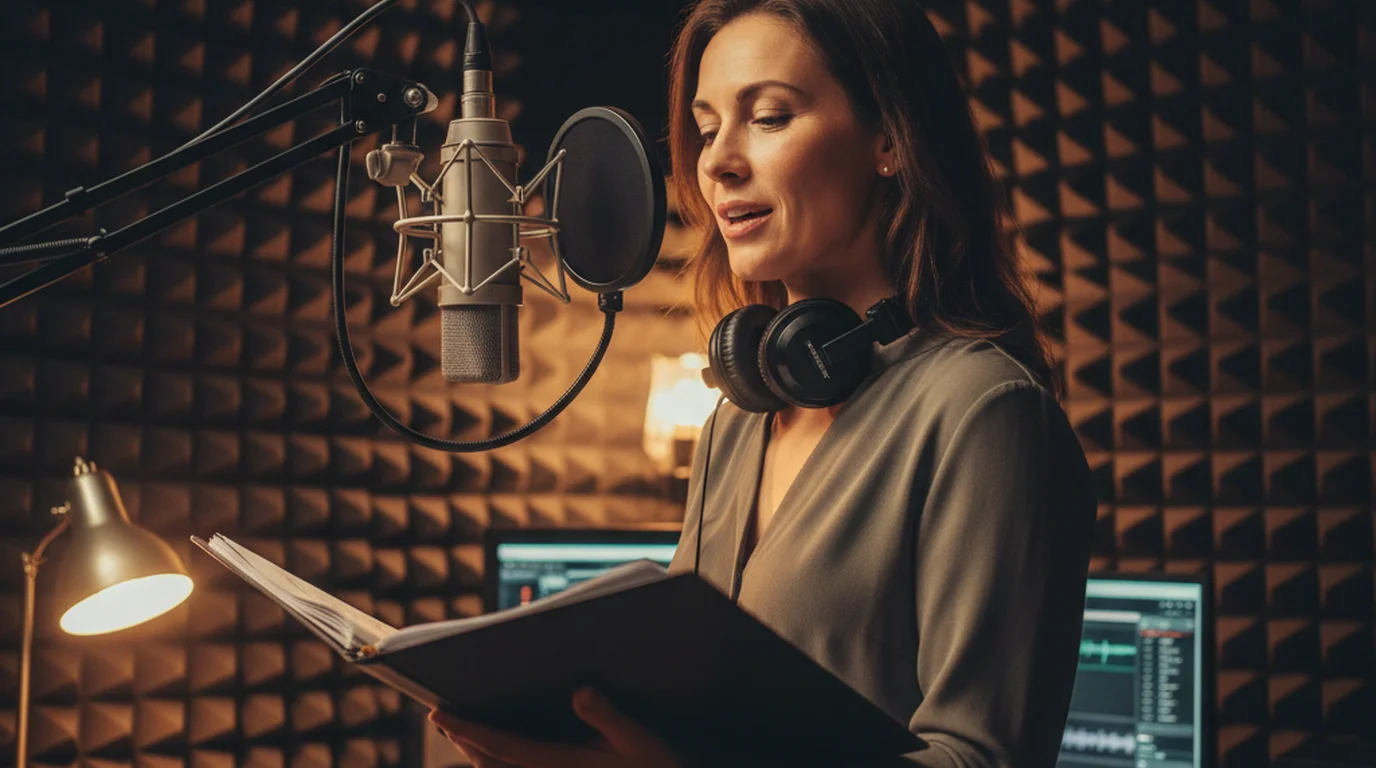
I've built three online courses on content creation, and one topic that comes up constantly from my course students is voice acting — either as a standalone career or as a way to add narration work to their existing video production income. I'm not a voice actor myself, but I've interviewed 20+ working pros to understand exactly how they started, and the picture is very different from the "just send auditions and hope" advice you typically read. This guide covers what actually works in 2026.
To become a voice actor, you need: clean home recording setup (USB condenser microphone + acoustic treatment, $200–$500 total), a demo reel targeting one or two specific genres, profiles on Voices.com and ACX, and a consistent audition habit. Most new voice actors book their first paying work within 60–90 days of setting up a credible demo and sending 10–20 targeted auditions per week.
Step 1: Choose Your Niche Before You Record Anything
The most common mistake I see from aspiring voice actors is trying to be everything at once — animation, audiobooks, commercials, corporate narration, video games. Each genre has different vocal qualities, pacing norms, and client expectations. A demo that tries to cover all of them convinces no one.
The three most accessible entry niches in 2026 for new voice actors without prior credits:
- E-learning and corporate narration: High demand, stable rates, clients are less focused on "unique" voices and more focused on clarity, consistency, and turnaround speed. The most accessible entry point by volume.
- Audiobooks via ACX: Audible's ACX platform connects authors directly with narrators. Royalty-share audiobooks cost you nothing to produce and build your catalog. Rates scale significantly with reviews and completion rate over time.
- Podcast ads and sponsorships: Short-form ad reads for podcast hosts. Requires conversational delivery, natural pacing, and the ability to match the host's tone. Good entry for people with existing podcast or video experience.
Step 2: Build a Minimal Viable Home Studio
You don't need a professional recording studio. You need a space with minimal background noise and enough acoustic treatment to prevent noticeable reverb. Once the space is quiet, the guide on how to do a voiceover covers recording a clean take from a script. Here's what actually works at entry level:
- Microphone: Blue Yeti USB ($130), Audio-Technica AT2020 USB ($99), or Rode NT-USB Mini ($99). Any of these sounds professional when recorded correctly. The microphone is not the variable that determines your success — your space is.
- Acoustic treatment: A clothes closet with hanging fabric, a large bookcase behind you, or $60 worth of acoustic foam panels on the wall behind your microphone. The goal is reducing reflections that reach the mic. A treated bedroom sounds better than an untreated professional booth.
- Headphones: Any closed-back headphones for monitoring playback. Audio-Technica ATH-M20x ($49) is adequate. You're checking for noise and breath consistency, not mixing.
- DAW (recording software): Audacity (free), Descript ($24/month for transcription-based editing), or Adobe Audition ($21/month). Start with Audacity — it does everything you need until you're earning enough to upgrade.
Total entry cost: $200–$400 for professional-sounding results. Don't spend more until you've booked at least 5–10 paying gigs.
According to a 2024 survey by Voice123 of 3,200 working voice actors, 71% of respondents were recording from home studios rather than professional facilities. Among those earning over $50,000 annually from voice work, 68% still recorded at home. The data suggests that home studio quality — not facility access — is the differentiating variable for successful voice actors in the current market.
Step 3: Build a Demo Reel for Your Target Niche
A demo reel is 60–90 seconds of your best work in your target genre. For e-learning, this means 3–4 distinct 15–20 second clips in different corporate styles. For audiobooks, it means two clips: one fiction, one non-fiction, each around 30–45 seconds.
Before you produce a demo, record yourself reading scripts from your target genre every day for 30 days. This sounds excessive but it isn't — your voice needs to learn the genre's pacing, emphasis patterns, and natural delivery style. On day 30, compare your recordings to day 1. The improvement is usually significant enough that you can hear it clearly.
Use sample scripts from industry sources like Voices.com or findaway voices for practice material. For your demo, adapt public domain content or write original scripts in the style of your target genre — not word-for-word copies of existing work.
Reading from a teleprompter while recording can help you maintain consistent pace and eye position during long narration takes, especially for e-learning content where you need multiple takes of the same passage at exactly the same rhythm.
Step 4: Set Up on Casting Platforms
The two most important platforms for new voice actors in 2026:
- ACX (Audible's platform): Free to join. Authors post audiobook projects and search for narrators. You can audition for existing projects or list yourself for authors to find you. Royalty-share projects cost nothing upfront — you split the royalties with the author. Start with royalty-share to build your catalog.
- Voices.com: Subscription platform ($499/year for a "premium" listing that allows unlimited auditions). Has a high volume of corporate, e-learning, and commercial work. The subscription pays for itself quickly once you're booking regularly.
Secondary platforms worth setting up on once you have a demo: Voice123, Backstage, Casting Call Club (free, good for getting experience credits).
Step 5: Audition Consistently, Not Occasionally
New voice actors underestimate the audition volume needed to book work. Most working voice actors audition 10–30 times per week. A 2–5% booking rate is normal at entry level. That means 10–20 weekly auditions might produce one booking every two to three weeks.
Treat auditioning as a daily practice rather than a response to exceptional opportunity. The temptation is to save audition energy for "perfect" postings and skip the ones that seem routine. The routine ones are where most new voice actors build their track record.
Data published by Voice123 in their 2025 State of Voice Acting report found that voice actors who submitted 15+ auditions per week had a median time-to-first-booking of 47 days. Voice actors submitting fewer than 5 per week had a median time-to-first-booking of 6+ months, with 30% never booking their first paid gig. Audition volume was a stronger predictor of first booking than demo quality for new entrants.
What Equipment You Actually Need (and What to Skip)
Don't buy: a professional studio (until you're earning $5,000+/month from VO), a broadcast console or preamp (USB mics eliminate this need), or advanced processing plugins (clients receive raw files and mix themselves). These are upgrades for established voice actors with the revenue to justify them.
Do buy early: a boom arm or shock mount (reduces desk vibration noise, $20–$50), a pop filter ($10–$20, prevents plosive distortion on hard consonants), and acoustic foam for your recording wall ($40–$60). These have the highest impact-per-dollar of any gear purchase for new voice actors.
Frequently Asked Questions
Do voice actors get paid well?
Established voice actors earn $200–$500 per finished hour for corporate narration and e-learning. Audiobook narration on ACX pays $200–$1,000 PFH depending on format. Major animation and video game roles pay SAG-AFTRA scale ($920–$1,600/session) but are highly competitive. Most working voice actors earn $30,000–$80,000 annually from VO work.
Can I be a voice actor with no experience?
Yes. The most accessible entry points — e-learning narration, explainer videos, and podcast ads — don't require previous credits. They require clean audio, natural delivery, and reliable turnaround. Most first clients don't care about your resume; they care about your demo and your responsiveness.
Is voice acting hard to get into?
Voice acting is moderately competitive at entry level and highly competitive at the professional level. Home studio equipment is affordable and platforms like Voices.com and ACX connect clients directly with talent. Differentiation comes from niche focus, technical quality, and consistent audition volume rather than connections or credentials.
Can you be a self-taught voice actor?
Yes. The most effective self-teaching path: record yourself daily, compare your recordings to professional samples in your target genre, identify specific technical gaps, and work on one issue at a time. Formal coaching accelerates this process but isn't required to begin booking work.
Lauren MercerLauren Mercer builds and sells online courses on scriptwriting, on-camera delivery, and video production workflows. She writes about the full path from script to screen — AI writing tools, recording setups, and the friction points that slow down solo educators.
Practice Scripted Delivery for Your Voice Acting Demo
Use Teleprompter-Scrolling Scripts to rehearse narration scripts at consistent pace — essential for e-learning and audiobook auditions. Voice mode records the read as audio while the script scrolls, so a practice pass doubles as a rough audition take you can listen back to. Free on iPhone, iPad, and Mac.
Use Free Online Teleprompter Get the Free App