5 Best CuePrompter Alternatives in 2026 (Free and Paid)
 Wendy Zhang · May 20, 2026 · 9 min read

CuePrompter has run in browsers since the early 2000s and is still "100% free for both commercial and non-commercial projects. No watermarks, no limits." What it does not do is record, work offline, or save your scripts. These five each fix a different one of those.
By what they add: Teleprompter-Scrolling Scripts records in-app at 1080p and stores scripts on the device — still free, still no account. Teleprompter.com covers iOS, Android, macOS and Web. Elegant Teleprompter floats over the camera app on Android. Speakflow follows your voice. EasyPrompter pushes the script to a second screen for studio desks.
1. Teleprompter-Scrolling Scripts — same free, plus recording
Account: none · Records: yes, in-app · Free tier: 1080p, no watermark, no ads · Platforms: iPhone, iPad, Mac, any browser
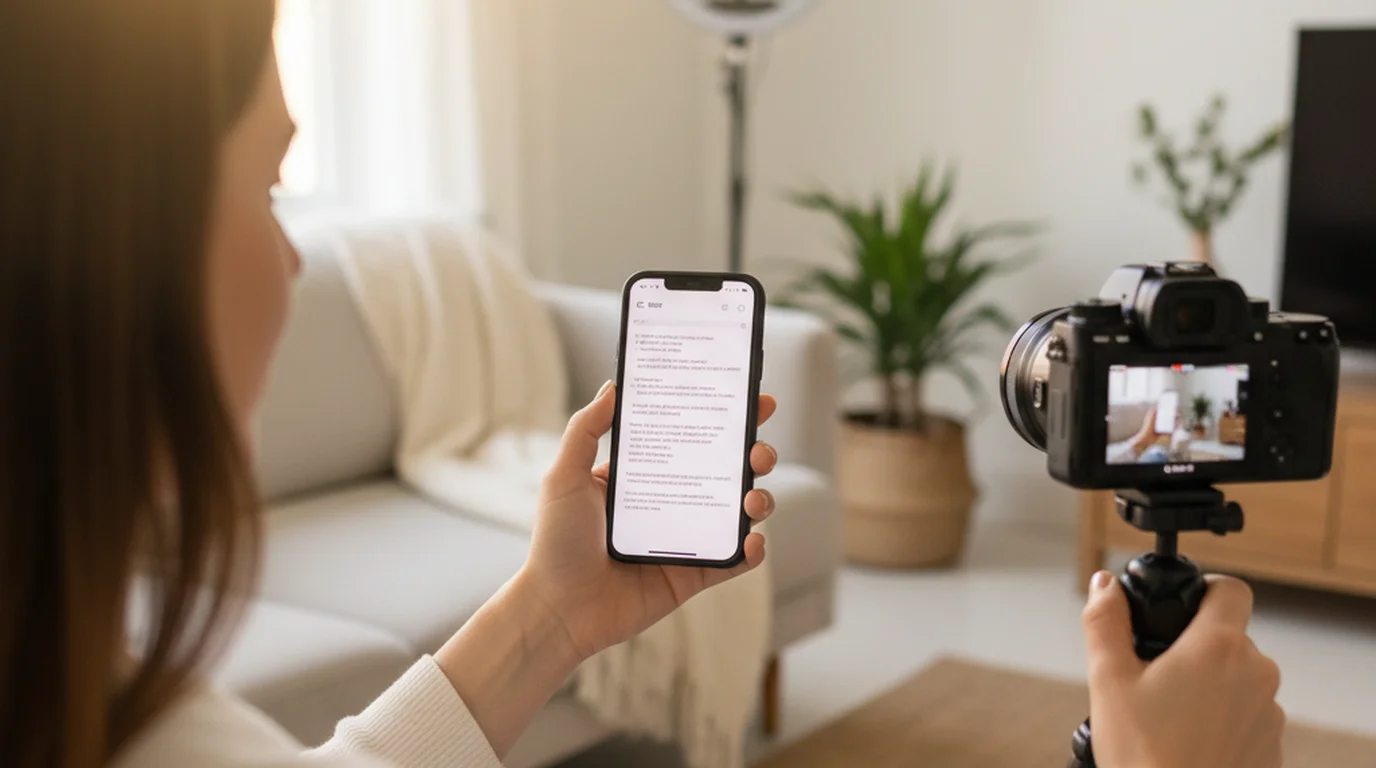
The browser version keeps what makes CuePrompter work — open a URL, paste, read, no sign-up — and adds a Recording mode that overlays the script on the webcam feed in the same tab. No second device pointed at you.
On iPhone and iPad the native app goes further: Camera mode records with the text at the lens, scripts save on the device so they survive a closed tab, and Voice mode advances the text as you speak. Free tier records 1080p clean; paying unlocks 4K.
Where it stops: no native Android app, and no AI scripting or captioning. On Android it is the browser version, which does not float over other apps.
2. Teleprompter.com — best platform coverage
Account: required · Records: yes · Free tier: watermarked exports · Paid: $19.99/mo, or $7.50/mo billed annually · Platforms: iOS, Android, macOS, Web
Native apps on both mobile platforms plus macOS and web, with scripts synced across all of them — the script library CuePrompter deliberately does not keep.
Teleprompter.com's pricing page states the free Starter plan records with a watermark and includes cloud script storage, custom fonts and colours, and remote control across iOS, Android, macOS and Web. Removing the watermark requires Pro at $19.99 per seat monthly, or $7.50 per month billed annually, which also adds 4K capture, mirroring and subtitle generation.
Where it stops: every free-tier recording carries a watermark, and an account is required — two things CuePrompter users specifically avoid.
3. Elegant Teleprompter — best on Android
Account: none for local use · Records: floats over your camera app · Free tier: ad-supported · Platforms: Android (5M+ Google Play downloads)
Uses Android's draw-over-other-apps permission to put a resizable script window on top of the camera app, Zoom, or a live stream. On a single Android phone it solves the recording gap without the app needing a camera of its own.
Where it stops: ads on the free tier, and the floating window cannot exist on iOS — Apple reserves cross-app overlay for system features. The Elegant Teleprompter comparison covers the Apple side.
4. Speakflow — best for unscripted delivery
Account: required · Records: no · Free tier: auto-scroll, limited voice-following, 7-day history · Paid: Plus $19/mo
Flow follows your voice rather than a fixed WPM. If CuePrompter's constant-speed scroll keeps leaving you behind on pauses or ad-libs, this is the feature that fixes it.
Where it stops: unlimited voice-following is a paid feature, the free plan keeps only 7 days of script history, and like CuePrompter it does not record.
5. EasyPrompter — best for a studio desk
Account: required · Records: no · Free tier: yes, with a paid tier above it · Platforms: any browser, desktop or mobile
Sends the prompter to a local or remote display — a tablet, a TV, a studio monitor — and works as an OBS and vMix browser source. That is the multi-screen production setup CuePrompter never addressed.
Where it stops: it needs an account, does not record, and the second-screen model assumes you already have a camera and a desk. See the EasyPrompter comparison for details.
Side by side
| Account | Records in-app | Saves scripts | Free tier limit | |
|---|---|---|---|---|
| Teleprompter-Scrolling Scripts | None | Yes, 1080p clean | Yes, on device | 4K is paid |
| Teleprompter.com | Required | Yes | Yes, cloud | Watermark |
| Elegant Teleprompter | None locally | Floats over camera app | Yes | Ads |
| Speakflow | Required | No | 7 days on free | Limited voice scroll |
| EasyPrompter | Required | No | Yes | Paid tier above |
| CuePrompter | None | No | No | None — fully free |
When CuePrompter is still the right answer
Nothing above beats it on the thing it was built for: reading a script in a browser, right now, with no account and no cost, on whatever device is in front of you. For a one-off read toward a camera someone else is operating, the rest of this list is overhead.
The case for switching is narrower than it looks. You need recording in the same app, scripts that persist between sessions, or a scroll that waits for you. If none of those is a problem you actually have, staying put is the cheaper answer.
Frequently Asked Questions
Is CuePrompter free?
Yes. CuePrompter is free at cueprompter.com with no download, no account, and no subscription required. You paste your script directly into the browser and it scrolls on screen.
What is a free alternative to CuePrompter that works offline?
Teleprompter-Scrolling Scripts includes a free browser teleprompter at teleprompter.works/online — a direct CuePrompter-style alternative with no account. For offline use, the native iPhone, iPad, and Mac app stores scripts locally without an internet connection.
Can I record video with a CuePrompter alternative?
Yes. Use Recording mode at teleprompter.works/online in the browser, or Camera mode in the native app. Both overlay the script on the live camera view. CuePrompter has no camera integration at all.
Does a CuePrompter alternative work on iPhone?
Yes. Teleprompter-Scrolling Scripts runs free in the browser at teleprompter.works/online on any device, and as a native app on iPhone, iPad, and Mac with Camera mode, offline scripts, and voice commands.
Is there a CuePrompter alternative with no account?
Teleprompter-Scrolling Scripts needs no account at all — the browser version opens like CuePrompter, and the native app stores scripts on the device. Elegant Teleprompter also runs locally on Android without signing in. Teleprompter.com, Speakflow and EasyPrompter all require an account.
Why does CuePrompter not save my scripts?
It keeps nothing between sessions by design, which is part of why it needs no account. That makes it excellent for a one-off read and awkward for a script you return to. Any alternative with saved scripts stores them either on your device or in a cloud account.
What is the closest free CuePrompter replacement?
For the same browser workflow with recording added, the browser version at teleprompter.works/online opens without an install or an account and overlays the script on your webcam feed in the same tab. For reading only, CuePrompter itself remains free with no limits.
Wendy ZhangWendy Zhang is the indie developer behind Teleprompter-Scrolling Scripts, which she built after cycling through teleprompter apps that were too heavy, too expensive, or dependent on a network connection to open. She writes about the mechanics of recording yourself — scroll pacing, script formatting, and the app decisions that decide whether a take survives.
Try a free CuePrompter alternative
Free browser teleprompter at teleprompter.works/online, or native app for iPhone, iPad, and Mac — Camera mode, offline scripts, voice commands, no account required.
Open the CuePrompter Alternative Get the Free App