Video Interview Practice A free mock video interview on your webcam

Rehearse one-way video interviews such as HireVue: a random question, 30 seconds to think, then a timed answer recorded on your webcam. Watch it back, retake it, or move to the next question.

Woman in a blazer practicing an interview answer to her laptop webcam at home

Your browser asks for the camera and microphone. Choose Allow.

Runs locally in your browser. Nothing is uploaded.

How to practice a video interview

Treat each round like the real thing: one question, a short think, one answer under the clock. Then watch it back.

  1. Choose a category. Match the job: general, behavioral, student and internship, sales, customer service or tech. Mixed draws from all of them.
  2. Set the timers. Employers set their own times; 30 seconds to think and 2 minutes to answer is a good starting point.
  3. Press Start practice. A random question appears and the think timer runs. Recording starts on its own when it reaches zero, or press Start answering now.
  4. Answer to the lens. Look at the camera, not at your own picture. Press Finish answer when you are done.
  5. Review and repeat. Play the answer back, retake it, download it, or go to the next question.

HireVue practice: how one-way video interviews work

In a one-way video interview there is nobody on the other end. Platforms such as HireVue show a question, give you a set time to prepare, then record your answer within a time limit. The hiring company sets the prep time, the answer time and how many attempts you get at each question, and once an answer is submitted you can't go back to it. A recruiter watches the recordings later.

One-way video interview practice takes the surprise out of the format, because what makes it hard is the silence and the clock rather than the questions. This page gives you the same rhythm: question, think timer, recorded answer. It is an independent practice tool, separate from HireVue and from any employer.

Question appearsRead it once, slowly
Think time, 30 secondsPick one example and your opening line
Recording, 1 to 3 minutesAnswer to the lens, finish with the result
Next questionOn the real platform, the employer sets the number of attempts
The rhythm of a one-way video interview, which the practice tool repeats.

Practice interview questions on camera

Set up for practice exactly as you will on the day, so the recording shows what a recruiter will see.

  • Camera at eye level. Raise the laptop on books so the lens is level with your eyes, about an arm's length away.
  • Light in front of you. Face a window, or use a screen light after dark. Avoid a bright window behind you.
  • A calm background. A plain wall or a tidy shelf works; see what makes a good background for a video interview.
  • Sound check. Run the mic test and the webcam test before you start.
  • Notes off-camera. Keep three or four keywords per story right beside the lens. The online teleprompter can hold them in a narrow window just under your webcam.
Laptop raised on a stack of books to eye level, facing a window, with a sticky note beside the webcam

Answer behavioral questions with the STAR method

Questions that start with "Tell me about a time" want a short story with an outcome. STAR keeps it in order: Situation, Task, Action, Result.

Use about one sentence each for Situation and Task, then spend most of your time on what you did and what changed. Switch on Show STAR prompts in the panel and the four steps stay on screen while you think and answer.

Prepare five or six stories before the interview, such as a deadline, a conflict, a mistake, a win and a time you learned fast. Most behavioral questions fit one of them. For "Tell me about yourself", an elevator pitch template gives you a ready 30-second opening.

  • SSituation. "In my second year, our team's group project lost a member two weeks before the deadline."
  • TTask. "I had to take over the data analysis on top of my own part."
  • AAction. "I split the work into daily goals, asked the lecturer for the original data notes, and checked in with the team every evening."
  • RResult. "We submitted a day early and got the top mark in the class. I still plan big tasks the same way."
A two-minute STAR answer, in outline.

Mock video interview: what to look for in the playback

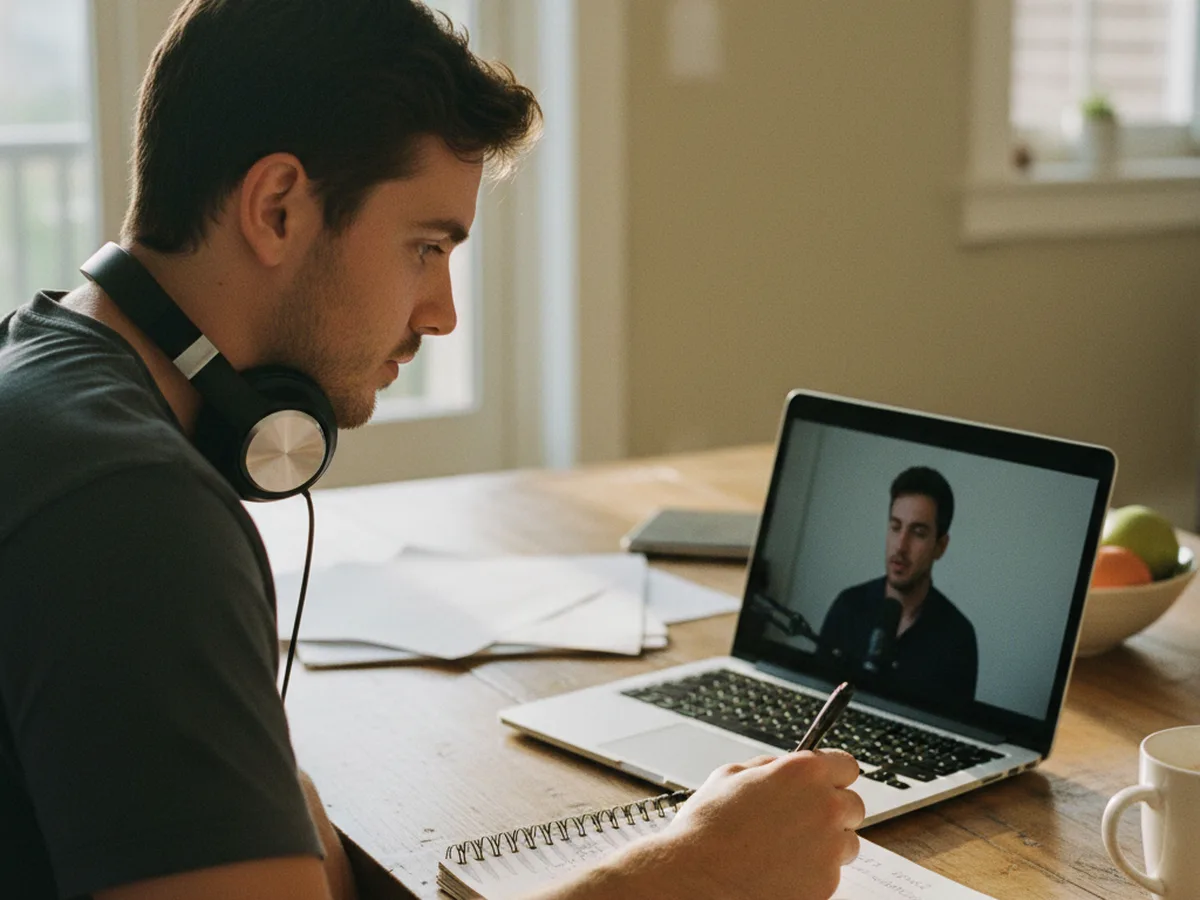
Watching yourself is the fastest way to improve, and the most uncomfortable. Check one thing per playback:

  • The first 10 seconds. Do you answer the question straight away, or warm up for a while?
  • Eye contact. Your eyes should sit on the lens most of the time, not on the screen below it.
  • Pace and fillers. Count the "um"s and "so"s. A short pause sounds better than a filler.
  • The ending. Finish on the result, then stop. Press Finish answer rather than talking out the clock.

Then press Retake and answer the same question again with one change.

Young man watching a playback of his recorded answer on a laptop and taking notes

Practice interview questions by category

All 64 questions in the tool. Read them, pick your stories, then let the tool ask them in random order.

General interview questions

  1. Tell me about yourself.
  2. Walk me through your resume in two minutes.
  3. Why do you want to work for this company?
  4. What interests you about this role?
  5. What are your greatest strengths?
  6. What is one skill you are working to improve right now?
  7. Where do you see yourself in five years?
  8. Why are you looking to leave your current job?
  9. What makes you a good fit for this team?
  10. What kind of work environment helps you do your best work?
  11. How would a former manager describe you?
  12. What achievement are you most proud of so far?

Behavioral interview questions

  1. Tell me about a time you had to meet a tight deadline.
  2. Describe a time you disagreed with a coworker. How did you handle it?
  3. Tell me about a mistake you made and what you learned from it.
  4. Give an example of a time you showed leadership without having the title.
  5. Describe a time you had to learn something new very quickly.
  6. Tell me about a time you received critical feedback. What did you do with it?
  7. Describe a situation where you had to juggle several priorities at once.
  8. Tell me about a goal you set for yourself and how you reached it.
  9. Describe a time you did more than what was expected of you.
  10. Tell me about a time you had to persuade someone to see things your way.
  11. Describe a project that did not go as planned. What did you do?
  12. Tell me about a time you worked with someone whose style was very different from yours.

Student and internship interview questions

  1. Why did you choose your major?
  2. Tell me about a class project you are proud of.
  3. How do you balance your coursework with other commitments?
  4. What do you hope to learn during this internship?
  5. Describe a group project where one person was not pulling their weight.
  6. Which skills from your studies will you bring to this role?
  7. Tell me about a part-time job, club or volunteer role and what it taught you.
  8. How do you approach a task when you are not sure where to start?
  9. What has been your biggest challenge at school, and how did you handle it?
  10. Why should we choose you over other students who applied?

Sales interview questions

  1. Sell me something on your desk right now.
  2. How do you handle rejection?
  3. Walk me through how you prepare for a first call with a new prospect.
  4. Tell me about a deal you closed that you are proud of.
  5. Describe a sale you lost. What did you learn?
  6. A customer says your price is too high. What do you say?
  7. How do you stay motivated when you are behind your target?
  8. How do you build trust with a customer you have just met?
  9. Which habits keep your pipeline and follow-ups organized?
  10. How would you research a new account before reaching out?

Customer service interview questions

  1. Tell me about a time you turned an unhappy customer around.
  2. How do you stay calm with a customer who is rude or shouting?
  3. What does great customer service mean to you?
  4. Describe a time you had to say no to a customer. How did you do it?
  5. What do you do when a customer asks something you do not know?
  6. Tell me about a time you went out of your way for a customer.
  7. A queue is building up while one customer needs extra help. What do you do?
  8. How do you make sure you understand what a customer really needs?
  9. How would you handle a customer complaint about one of your coworkers?
  10. How do you keep a positive attitude through a long, difficult shift?

Tech interview questions (general)

  1. Explain a technical topic you know well to someone with no technical background.
  2. Tell me about a project you built or worked on. What was your part?
  3. Describe a bug or technical problem that took you a long time to solve.
  4. How do you keep your technical skills up to date?
  5. How do you decide between a quick fix and a cleaner long-term solution?
  6. Tell me about a time you had to work from unclear or incomplete requirements.
  7. How do you give feedback on someone else's work?
  8. Describe a time you had to learn a new tool or language for a project.
  9. How do you check that your work does what it is supposed to do?
  10. Tell me about a technical decision you would make differently today.
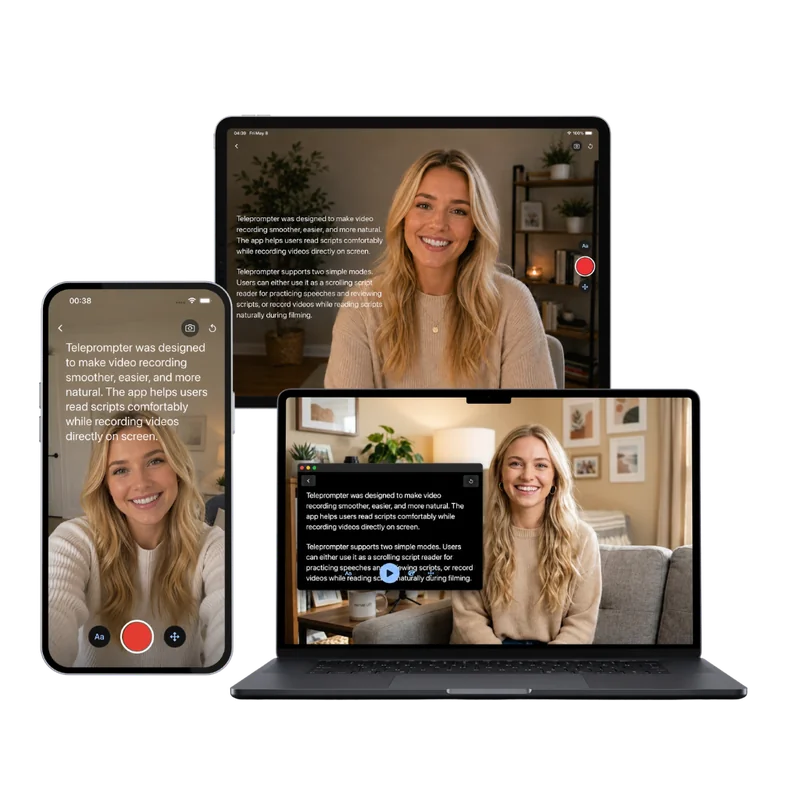
Teleprompter Scrolling Scripts on iPhone, iPad and Mac, with the script scrolling over the camera

Next step

Keep your talking points beside the lens

The free online teleprompter scrolls your notes in a window right under your webcam, so you glance at a keyword and your eyes stay on the camera. On iPhone, iPad and Mac, Teleprompter Scrolling Scripts records you while your notes scroll next to the lens, ready for a self-intro video or a recorded application. Free to download, no account needed, and no watermark.

Frequently Asked Questions

How do I practice for a video interview?

Set up the way you will on the day: camera at eye level, light in front of you, a tidy background. Then press Start practice, answer a few random questions under the timers, and watch each recording back. Check one thing per playback, such as eye contact, pace or how you open your answer, and retake the question once you know what to change.

What is a one-way video interview?

A one-way, or asynchronous, video interview has no interviewer on the call. A platform such as HireVue shows a written or recorded question, gives you time to prepare, then records your answer within a time limit set by the employer. Recruiters watch the recordings later. Many employers use them as a first screening round.

Is this the same as a HireVue practice test?

It follows the same format: a question on screen, preparation time, then a timed recorded answer. It is an independent practice tool, separate from HireVue and from any employer. If your invitation includes a practice question on the official platform, use that too to get used to its exact screens.

How long should a video interview answer be?

The employer sets the answer time, and the interview shows it before you record. Aim for about 60 to 90 seconds for a simple question and up to 2 minutes for a behavioral story. Finishing a little early with a clear result reads better than running into the cut-off mid-sentence.

What is the STAR method?

STAR is a structure for behavioral questions such as Tell me about a time you. Situation sets the scene, Task says what you were responsible for, Action explains what you did, and Result gives the outcome and what you learned. Spend most of your time on Action and Result.

Are my practice recordings uploaded anywhere?

No. The camera, the recording and the playback all run locally in your browser. Nothing is uploaded, and a recording is saved to your computer only when you press Download. Closing the page clears the session.

Can I look at notes during a video interview?

Short notes help you remember your examples, as long as they sit right beside the camera so your eyes stay near the lens. Keep them to a few keywords per story rather than full sentences, because reading a script word for word shows on camera.