Why Softbox Lighting Makes Such a Difference on Camera — and How to Set One Up
 Natalie Brooks · Jul 4, 2026 · 8 min read
I've been designing home video studios professionally since 2019 — for YouTubers, online course creators, corporate communications teams, and journalists recording from home. The lighting upgrade that produces the most visible improvement in video quality, for the least cost, is replacing a ring light or bare overhead bulb with a properly positioned softbox. Understanding why that's true makes it easier to use one correctly.
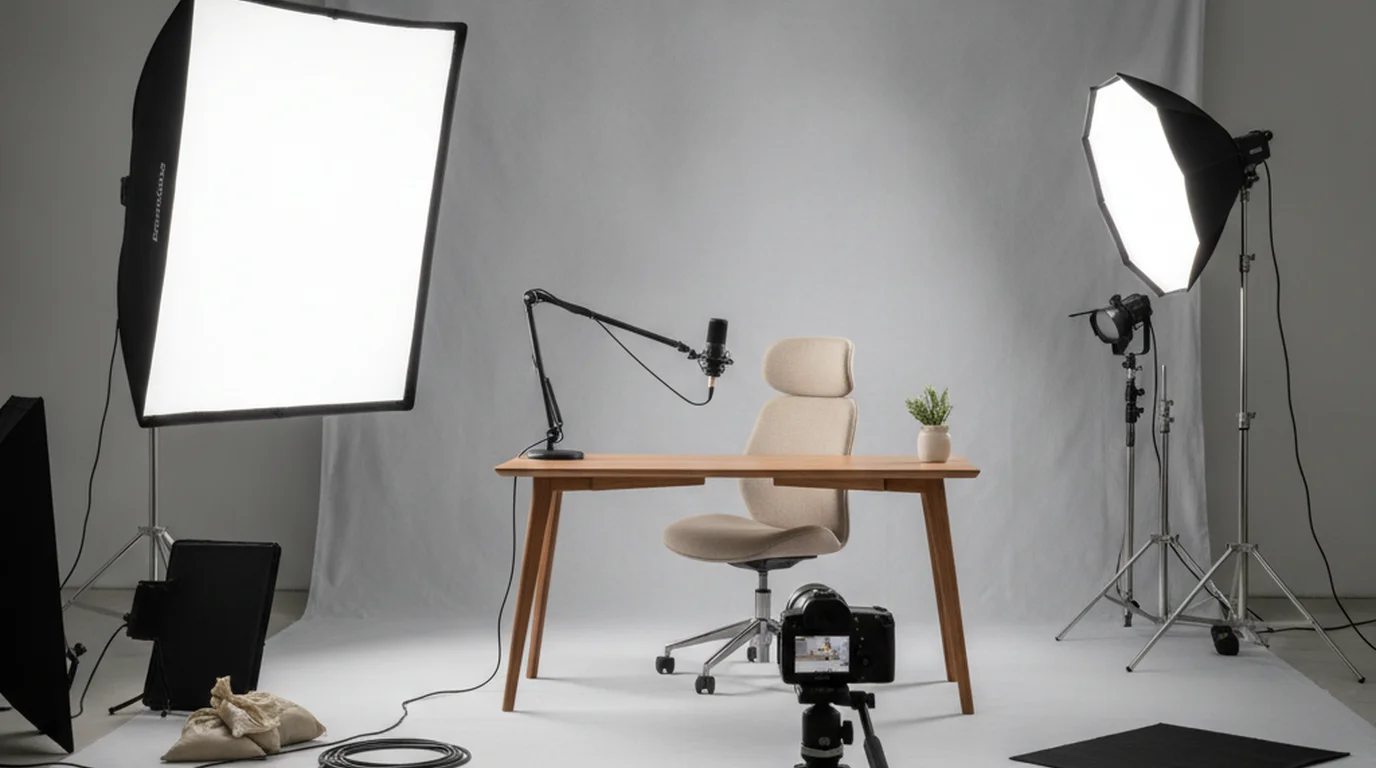
A softbox is a light modifier. It takes a concentrated light source — an LED bulb, a continuous LED panel, a strobe — and diffuses it through a frosted white fabric front panel, spreading the light over a much larger surface area. The fundamental principle: the larger the light source relative to the subject, the softer the light it produces.
That principle explains everything about how softboxes work, why they produce the light quality they do, and how to position one for video.
What Is the Purpose of a Softbox? The Physics in Plain Terms
Light hardness is determined by source size relative to subject distance. A small source (bare bulb, direct sun) produces hard light — defined, dark shadows with sharp edges, high contrast, visible skin texture. A large source (overcast sky, large window, large softbox close to subject) produces soft light — gradual shadow transitions, lower contrast, flatter skin texture rendering.
A softbox replicates a large, soft source artificially. The frosted diffusion panel on the front transforms the small, concentrated LED or bulb behind it into a much larger, more even source. The light reaching the subject comes from the full surface area of the panel, not from a point.
For video, soft light is almost always preferable for faces. It reduces the visual emphasis on skin texture, under-eye shadows, and asymmetries. It's forgiving when the subject moves slightly out of the ideal position — the light quality doesn't change dramatically with small position changes the way hard light does. It produces catchlights (reflections visible in the subject's eyes) that look like natural window light rather than artificial sources.
The one scenario where hard light is preferable for video: dramatic, high-contrast visual storytelling. Crime dramas, thriller content, and deliberately stylized visual work use hard light for effect. For the vast majority of tutorial videos, talking-head recordings, and direct-to-camera content, soft light is the right tool.
Softbox vs. Ring Light: The Practical Differences for Video
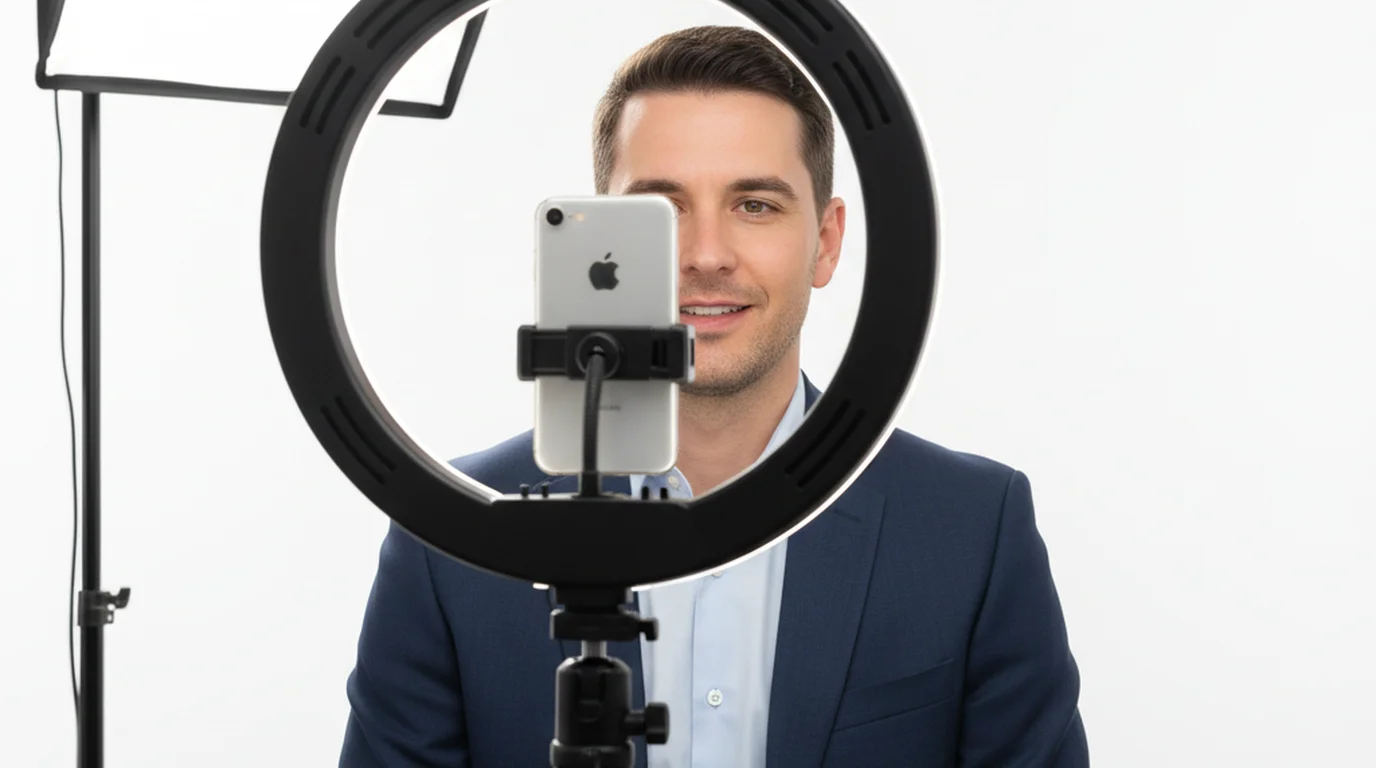
Ring lights became the default "content creator" lighting option partly because they're easy to use, partly because they became a recognisable signal of production value in the mid-2010s. They produce a distinctive circular catchlight in the subject's eyes. For video, this look is now saturated — it signals "creator recording" rather than anything more specific.
The structural constraint ring lights impose: the camera must be positioned in the centre ring of the light to achieve the characteristic even illumination. This is a hard constraint. When you're using a teleprompter setup — where the camera, the script, and the light each need specific positions — a ring light forces the camera to one fixed location. A softbox places no constraint on camera position at all.
The catchlight difference: Ring lights produce a circular ring reflection in both eyes. Softboxes produce a rectangular or octagonal shape. The rectangular catchlight reads as natural light reflected in the eye — it's what you'd see from a window. Most viewers can't articulate why the softbox-lit video looks more "natural," but the mechanism is this catchlight difference.
Light quality: Both ring lights and softboxes produce soft light. The softbox produces softer light for the same physical size because the diffusion panel spreads light more evenly than the LED ring arrangement. At equivalent cost, a large softbox typically outperforms a ring light on measured light softness.
According to analysis published in the American Cinematographer (2024), broadcast news lighting setups use large diffused sources — softboxes, fresnels with diffusion panels, or large LED panels — in approximately 89% of professional configurations, specifically for the shadow quality and flexibility they provide compared to ring-based setups.
Basic Three-Point Setup for Talking-Head Video
The standard configuration for single-presenter video:
Key light (your main softbox): Position at approximately 45 degrees to the side of the camera and 45 degrees above eye level, aimed at the face. This replicates the direction of natural daylight from a window positioned above and to the side — the shadow direction most people read as natural and flattering. The key light produces the primary illumination and the visible shadow on the opposite side of the face.
Fill light (second light or reflector on the opposite side): Set at roughly equal distance from the subject as the key light, on the side opposite the key. If using a second softbox, set it to 50–70% of the key light's output — enough to reduce (not eliminate) the key-side shadow without flattening the image to complete shadow-free uniformity. A white foam board or collapsible reflector positioned on the fill side achieves similar results at no additional cost.
Background light (optional, adds depth): A separate light aimed at the background creates depth — it separates the subject from the background visually. Without a background light, a solid-color background behind a person lit with softboxes can appear flat and two-dimensional. A single LED pointed at the background wall, or a coloured gel over a background light for colour-specific setups, adds the depth that makes home setups look like studio setups.
For most home studio configurations, a single large softbox as the key light and a white foam board as the fill produces results that are difficult to distinguish from two-softbox setups in standard viewing conditions.
Softbox Size, Distance, and Light Quality
Softbox size and distance together determine how soft the light is. The relationship: moving a softbox further from the subject makes it smaller relative to the subject, which makes the light harder. To maintain the same softness at greater distance, you need a larger softbox.
| Softbox Size | Effective Distance | Light Quality |
|---|---|---|
| 30×30 cm | 50–70 cm | Moderate soft, some shadow definition |
| 60×60 cm | 80–120 cm | Soft, flattering for most subjects |
| 90×60 cm (rectangular) | 80–130 cm | Very soft, minimal harsh shadow |
| 120 cm Octobox | 100–200 cm | Extremely soft, beauty-light quality |
For a typical home studio talking-head setup, a 60×60 cm or 90×60 cm rectangular softbox at approximately 1 metre from the subject is the most practical starting point. It's large enough to produce genuinely soft light, small enough to position in a standard room without dominating the space.
The rectangular shape of most softboxes is intentional for video: it produces a rectangular catchlight in the eyes that reads as natural light, and the horizontal orientation matches the 16:9 frame aspect ratio better than a square or circular source.
Colour Temperature: Matching Your Softbox to Your Environment
Softboxes using daylight-balanced bulbs or LED panels (5500–6000K) match the colour temperature of natural window light. This means you can mix softbox light with window light without creating the colour shift that occurs when warm (tungsten-balanced, 3200K) light mixes with cool daylight.
For a home setup where natural light enters the room:
- Daylight-balanced softboxes let you use window light and softbox light together without colour correction
- Tungsten-balanced softboxes will create orange skin tones when mixed with daylight — the window must be blocked or the colour must be corrected in post
For recordings that need to look consistent across multiple sessions at different times of day, daylight-balanced LED softboxes with the window blinds closed produce stable, repeatable results. The colour doesn't shift between a morning session and an afternoon session because the softbox, not the window, is the dominant light source.
A practical LED softbox kit for home video use starts around $60–80 for a 60×90 cm two-light set with stands and bulbs. At that price point, the visual quality improvement relative to no lighting or ring-light setups is dramatic and immediately visible.
What a Softbox Won't Fix
A poor background. Good lighting draws attention to the subject, which means it also makes the background more visible. If the background behind the subject is cluttered, unflattering, or distracting, better lighting makes that problem more apparent, not less. Address the background independently — virtual backgrounds, a clean wall, or a physical backdrop — before optimising lighting.
Camera placement that breaks eye contact. If you're recording to camera but reading from a script on a second screen positioned off-camera, no lighting setup repairs the eye-contact problem. The script and camera need to be on the same device, or the script needs to be positioned directly below or above the camera lens so that reading angle approximates direct camera contact. The talking-head video guide covers this positioning problem in detail for iPhone-specific setups.
Audio problems. Viewers tolerate imperfect video quality more readily than imperfect audio. Lighting improvements are visually dramatic and satisfying; they don't change the listening experience. If you're upgrading your studio setup, audio quality (microphone and acoustic treatment) should be addressed alongside lighting, not after it.
Frequently Asked Questions
What is the purpose of a softbox?
A softbox spreads light from a concentrated source (a bulb or LED panel) over a larger surface area — the frosted white front diffusion panel. Larger light sources relative to the subject produce softer light with more gradual shadow transitions. For video and photography, soft light is more flattering on faces because it reduces the visual emphasis on skin texture, wrinkles, and under-eye shadows compared to hard light from a bare bulb or direct sun.
What can I use instead of a softbox?
Natural window light from a large window (particularly north-facing, which avoids direct sun) produces similar soft, diffused light at no cost. A white bedsheet or shower curtain stretched in front of a bright light source approximates the diffusion. A shoot-through photography umbrella (white interior) produces comparable quality light at lower cost than a softbox, with slightly less directional control. For controlled studio use, a softbox is usually preferable; for run-and-gun use, an umbrella sets up faster.
Is a softbox better than a soft umbrella?
For controlled home studio and video setups, yes. A softbox directs light in a defined shape — rectangular, square, or octagonal — and limits spill onto the background and walls. A shoot-through umbrella spreads light in a wider arc that's harder to control, which creates unwanted light spill in smaller spaces. If you're working in a room where background spill matters (most home studios), a softbox gives you more control. For quick portable setups, umbrellas win on setup speed.
Is a softbox better than a ring light?
For talking-head video, a softbox and a ring light produce different results and have different structural constraints. A ring light creates a circular catchlight in the subject's eyes — the characteristic 'creator' look. A softbox creates a rectangular or octagonal catchlight that reads as more natural, closer to window light. More practically: a ring light requires the camera to be positioned in its centre, constraining camera placement. A softbox places no constraint on camera position, which matters when using a teleprompter setup where the script, camera, and light each need independent positioning.
How many softboxes do I need for YouTube videos?
One softbox is enough to get professional results for most talking-head YouTube content. Position it as your key light at 45 degrees to the side of the camera, above eye level. Add a white foam board on the opposite side as a reflector to fill in shadows without the cost of a second light. Two softboxes (key and fill) give more control over shadow depth. A third softbox as a background or hair light adds a broadcast-studio look. Most YouTube creators see the biggest quality jump going from no dedicated lighting to one well-positioned softbox.
What wattage softbox do I need for home video recording?
For a typical 2–3 metre home studio distance, a 45–85W LED softbox produces sufficient light for most camera sensors at ISO 400–800. Lower wattage (20–30W) works for very close shooting distances (1m or less) but may be insufficient at typical desk-to-camera distances. Actual lux output varies by LED efficiency and reflector design, so wattage is an imperfect guide — look for softboxes that specify lux output at a given distance. Daylight-balanced 5500K LED panels are preferred over fluorescent bulbs for consistent colour temperature and flicker-free performance at all camera shutter speeds.
Natalie BrooksNatalie Brooks is a video producer who works as a one-person crew for independent creators, corporate teams, and online educators. She writes about home studio setups, creator gear, and the production decisions that never come up in sponsored unboxings.
Good Lighting. Scripted Delivery. One Device.
Pair your softbox setup with Teleprompter-Scrolling Scripts — your script on the iPhone camera, your eyes on the lens.
Use Free Online Teleprompter Get the Free App