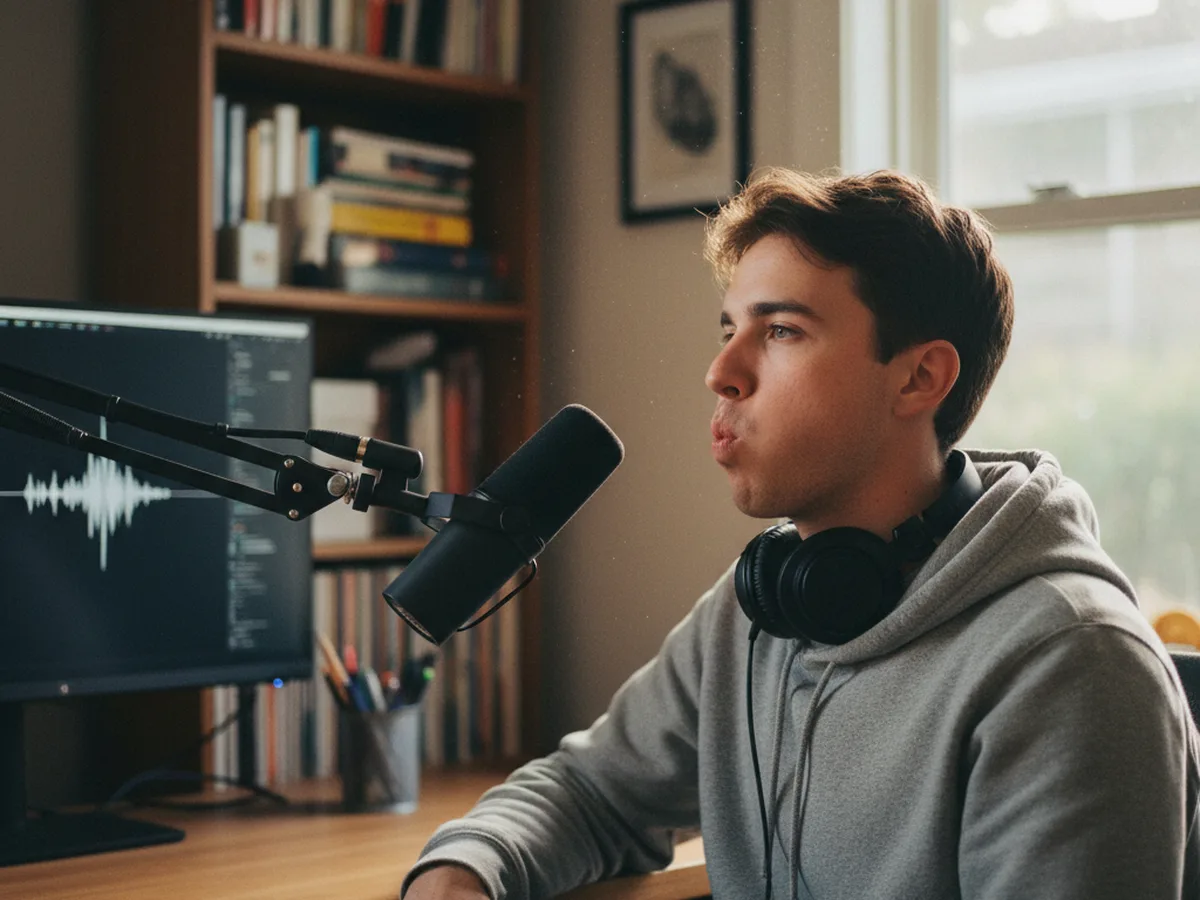
Voice warm up exercises, step by step
These are the ten exercises inside the player above, with the how-to for each. Do them in this order: body and breath first, then resonance and range, then the words.
Belly (diaphragmatic) breathing
30–60 seconds
Every other exercise rides on the breath, so start here. Stand with your weight even and one hand on your belly.
- Breathe in through your nose for 4 counts. Your hand moves out; your shoulders stay down.
- Breathe out on a thin, steady “sss” for 8 counts.
- Repeat four or five times, stretching the exhale to 10 or 12 counts.
The steady hiss trains the slow, even release of air that carries a long sentence without a gasp in the middle.
Lip trills
20–40 seconds
The lip trill, or lip bubble, is a favourite warm-up of voice coaches, because it balances air and voice with almost no strain.
- Close your lips loosely and blow so they flutter like a motorboat.
- Add voice: “brrr” on a comfortable note.
- Glide up and down, like a slow question and answer.
If your lips stop buzzing, there is too little air or too much tension. Press a fingertip into each cheek to take the weight off.
Humming
20–40 seconds
Humming wakes up resonance, the buzz that makes a voice carry without volume.
- Lips together, teeth apart, tongue resting low.
- Hum “mmm” and feel the vibration on your lips and the bridge of your nose.
- Hum “mm-hmm” as if agreeing with a friend. That relaxed note is close to your natural speaking pitch, a good place to start your talk.
Sirens
15–45 seconds
Sirens stretch the voice through its whole range in one smooth line.
- Make an “ng” sound, the end of the word “sing”, or an “ooo”.
- Glide from your lowest comfortable note up to a high one and back down, slowly.
- Keep the volume low. The top should feel light and thin, never pushed.
A flexible range is what lets your voice rise and fall naturally instead of staying on one note for the whole talk.
Jaw release
15–30 seconds
A clenched jaw makes speech sound tight and muffled, and nerves clench it.
- Find the hinge of your jaw just in front of your ears.
- Massage it in small circles with your fingertips.
- Let your mouth fall open as the muscle softens, and say a loose “yah, yah, yah”.
Tongue stretches
15–25 seconds
The tongue shapes most consonants. Stick it out and down toward your chin for two seconds, then up toward your nose, then trace slow circles around the outside of your teeth in both directions. It feels silly, and it makes the next exercises noticeably crisper.
Yawn-sigh
15–25 seconds
Start a real yawn and notice how the back of your throat opens. Let the air out as a long sigh that falls from high to low: “haaah”. Three of these help release a tight throat, which helps when nerves make your voice climb.
Articulation drills
30–45 seconds
Articulation drills isolate the consonants so the lips, tongue tip and back of the tongue each get a turn.
- “puh-tuh-kuh”: lips, tongue tip, back of the tongue.
- “buh-duh-guh”: the same places with voice.
- “ma-may-mee-moh-moo”: one consonant, five vowel shapes.
Go slowly first and exaggerate. Speed comes once every sound is clean.
Tongue twisters
30–60 seconds
A tongue twister packs similar sounds close together, so any slur shows up straight away. Pick two or three and say each one three times: slow, at speaking pace, then a little faster.
- Red leather, yellow leather. (R and L)
- Unique New York, you know you need unique New York. (N and Y)
- She sells seashells by the seashore. (S and SH)
There are dozens more, sorted by sound, with a 3× fast timer, on our tongue twisters page.
Projection exercises
30–45 seconds
Projection is volume powered by breath, not by squeezing the throat.
- Pick a spot on the far wall.
- Count from one to ten, starting at conversation level and growing on every number until ten reaches that spot.
- Call “Hey! Hi! Ho!” as if greeting a friend across a parking lot, with a quick squeeze from the belly on each.
If your throat feels scratchy, you're pushing from the neck. Drop the volume and add breath.