Vocal Range Test Find your range and voice type, with a live pitch detector

Sing your lowest and highest comfortable notes and see your vocal range in note names and octaves, plus the voice type it points to. The live pitch detector shows the note, frequency and cents as you sing.

Woman singing softly with a hand on her chest next to a laptop that shows a live pitch trace and the note A3

Your browser asks for microphone access first. Choose Allow.

Everything runs in your browser. Nothing is recorded or uploaded.

How to find your vocal range

The whole test takes about two minutes. Warm up first with a few gentle hums and sirens so your voice is ready, then work through these steps.

  1. Start the test. Press Start the vocal range test and choose Allow. Sit or stand about an arm's length from the computer or phone.
  2. Find your bottom. Glide down on an "ah" and hold the lowest note that still has a clear tone.
  3. Find your top. Glide up and hold the highest note you can sing without straining or squeezing. The range fills in as you sing.
  4. Read the result. The panel shows your range, the number of semitones and octaves, and the closest voice type.
  5. Check with the piano. Play the reference tone and sing along to hear where each note sits.

What is my vocal range? Reading your result

Your vocal range is the span from the lowest to the highest note you can sing with a usable tone. The test writes notes in scientific pitch notation: a letter for the note and a number for the octave. C4 is middle C on the piano, A4 is the 440 Hz tuning note, and each octave begins on C, so B3 sits just below C4.

The result line gives the span in semitones and octaves. Twelve semitones make one octave, so a range of A2 to E4 covers 19 semitones, about 1.6 octaves. That is a typical comfortable range for an untrained baritone, and many voices gain several notes at each end with regular practice.

You can also sing a song you know: the lowest and highest notes you hold during the whole session become your range. Press Start over to begin a fresh test.

Typical ranges by voice type

  • BassE2E4
  • BaritoneA2A4
  • TenorC3C5
  • AltoF3F5
  • Mezzo-sopranoA3A5
  • SopranoC4C6
Comfortable ranges commonly used in choirs and voice teaching. Real voices overlap, and trained singers extend past both ends.

Voice type test: bass, baritone, tenor, alto, mezzo or soprano

The test compares your lowest and highest held notes with the six classic voice types and names the closest one. The bottom note counts slightly more, because it changes less with training than the top.

  • Bass: E2 to E4, the lowest male voice.
  • Baritone: A2 to A4, the most common male voice.
  • Tenor: C3 to C5, the high male voice.
  • Alto: F3 to F5, the low female voice, also called contralto.
  • Mezzo-soprano: A3 to A5, the middle female voice.
  • Soprano: C4 to C6, the high female voice.

Range is one clue. Teachers also listen to tone color, where your voice feels easy, and where it shifts between registers. Use the result as a starting point for choosing songs and keys.

Community choir of mixed ages singing from black folders in a wooden church hall while a conductor leads

Pitch detector: see the note you are singing

The live view at the top of this page is a full pitch detector. It reads your voice about 60 times a second and shows the nearest note, its frequency, and how sharp or flat you are.

Pitch detector online: note, frequency and cents

The big letter is the nearest note. Under it, Frequency gives the pitch in hertz, and Cents shows the distance from that note, from -50 (flat) to +50 (sharp). The needle turns green within 10 cents, which sounds in tune to most listeners.

The trace under the readout draws your pitch over the last 10 seconds against a grid of C lines. A wobbling line shows vibrato, a slow drift shows a note sagging flat as breath runs out, and a curved approach shows a scoop into the note. Hold a note and watch the line flatten out.

The detector uses the YIN method, which compares the sound wave with delayed copies of itself to find its repeating period. It works well for singing, humming, whistling and single-note instruments.

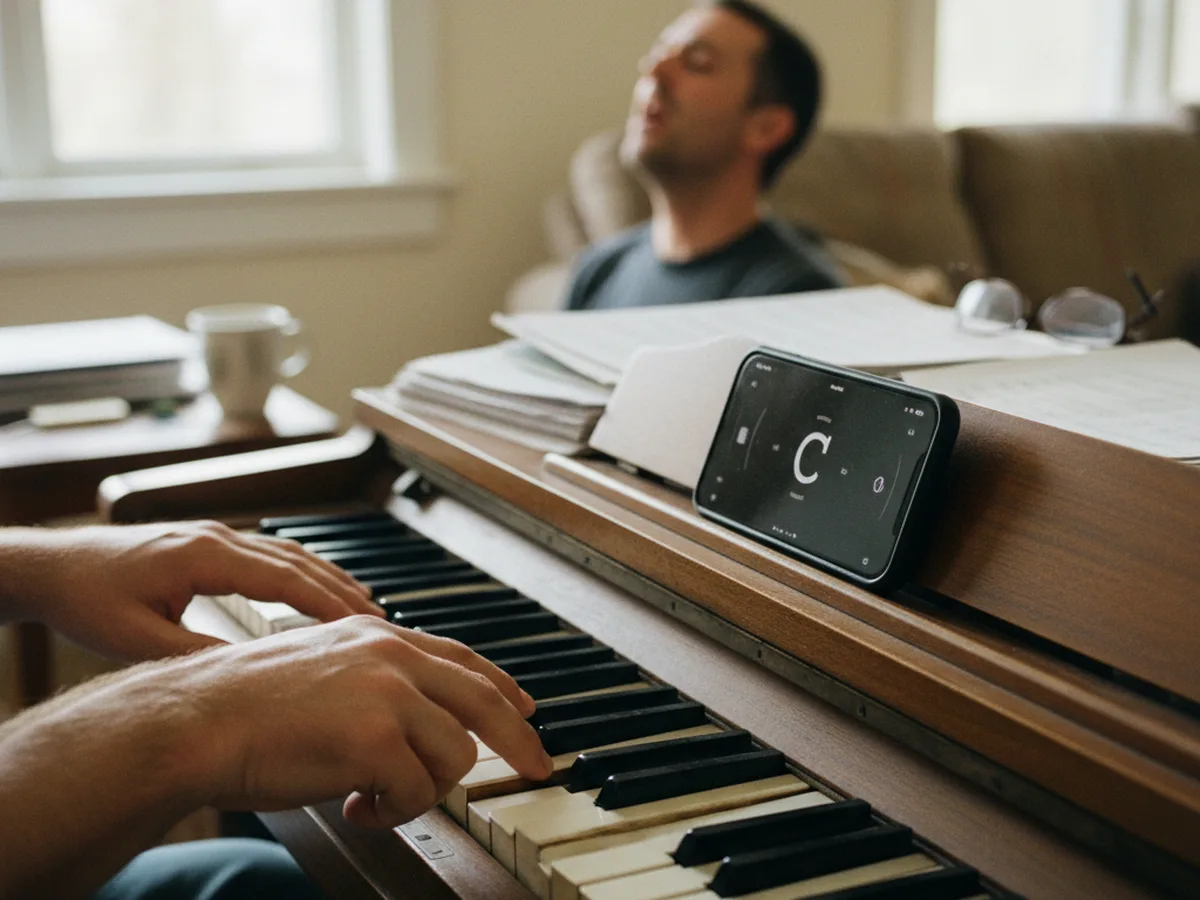
Hands pressing a key on an upright piano while a phone on the music stand shows the note C and a man sings in the background

Note frequency chart for singers

Every octave doubles the frequency: A3 is 220 Hz, A4 is 440 Hz and A5 is 880 Hz. The notes in the table are common landmarks for voices, so you can compare a reading from the detector with where it falls in a song.

Use the piano reference tone in the panel to hear any note from C2 to E6. Step up or down a semitone with the minus and plus buttons, press Play, and match the note with your voice while you watch the needle settle in the middle.

NoteFrequencyWhy it matters
E282.4 HzLow end of a bass
A2110.0 HzLow end of a baritone
C3130.8 HzLow end of a tenor
F3174.6 HzLow end of an alto
C4261.6 HzMiddle C
E4329.6 HzTop of a bass
A4440.0 HzTuning note A440
C5523.3 HzTenor high C
A5880.0 HzTop of a mezzo-soprano
C61046.5 HzSoprano high C
Frequencies use standard tuning, A4 = 440 Hz.

Singing range test tips

A few habits make the result more accurate and keep your voice comfortable.

Find my vocal range without straining

Stop at the last note that still sounds like singing. A squeak at the top or a croak at the bottom counts as an extreme, not as part of your usable range.

Warm up before a voice range test

Five minutes of lip trills, humming and gentle slides usually adds a note or two at each end. Test again after a warm-up to compare.

Quiet room, music off

Background music and TV confuse any pitch detector. Pause other audio and keep fans away from the microphone. The mic test checks the level and background noise of your microphone.

Chest voice and falsetto

Run the test once in chest voice and once including falsetto or head voice. Many singers note both numbers.

Pick songs in your key

Compare your range with the lowest and highest notes of a song. If the song goes higher than your top, move the key down by the difference in semitones.

Track your progress

Write down your result every few weeks. Regular practice tends to widen a comfortable range gradually, often by a few semitones over months.

Singing from lyrics? Read how to set up a lyrics prompter for singers, or follow the guide to record a song on iPhone.

Teleprompter Scrolling Scripts on iPhone, iPad and Mac, with the script scrolling over the camera

Next step

Know your range? Put your lyrics on screen

The free online teleprompter scrolls your lyrics in the browser at a pace you set, so you can rehearse a song without looking down at a sheet. On iPhone, iPad and Mac, Teleprompter Scrolling Scripts adds Voice mode, which records audio while your lyrics scroll. It is free, needs no account, and adds no watermark.

Frequently Asked Questions

How do I test my vocal range?

Press Start the vocal range test and allow the microphone. After you allow the microphone, slide slowly from the lowest note you can sing comfortably up to the highest, like a siren, and hold each end for a moment. The test picks up every note you hold, shows your range in note names and octaves, and suggests the closest voice type.

What is the average vocal range?

An average voice covers about two octaves, roughly 24 semitones. Trained singers can reach three octaves or more. Men typically sit somewhere between E2 and C5, and women between F3 and C6, depending on voice type.

What voice type am I?

The test compares your lowest and highest held notes with the typical ranges of bass (E2–E4), baritone (A2–A4), tenor (C3–C5), alto (F3–F5), mezzo-soprano (A3–A5) and soprano (C4–C6), and names the closest match. Tone color and where your voice feels easiest matter too, so a voice teacher may place you differently.

How accurate is this pitch detector?

For a clear, steady sung note the detector is accurate to within a few cents, which is finer than the ear can hear in a melody. Breathy notes, very low growls, background music and noisy rooms make readings jump, so test in a quiet room with headphones off and the music paused.

Why does the test show the wrong octave sometimes?

Very low or very breathy notes carry a strong overtone, and for a moment the detector may lock onto it. The test only counts notes you hold steadily for about a third of a second, which filters out most of these jumps. If a result looks an octave off, press Start over and sing that end again with a firmer tone.

Should I count falsetto in my vocal range?

Count it if you want your full range. Many choirs and voice teachers note both: the chest-voice range you can sing with power and the extended range including falsetto or head voice. Run the test twice, once in each, to see both numbers.

What do cents mean on a pitch detector?

A cent is one hundredth of a semitone. 0 cents means you are right on the note, +20 means slightly sharp and -20 slightly flat. Most listeners notice a sustained note that is off by more than about 10 to 20 cents.

Is my voice recorded or uploaded?

No. The pitch detector runs entirely in your browser using the Web Audio API. Nothing is recorded, stored or uploaded, and the microphone stops when you press Stop microphone or close the page.