Podcast Script Template With 3 Examples You Can Copy
 James Holloway · October 6, 2026 · 12 min read
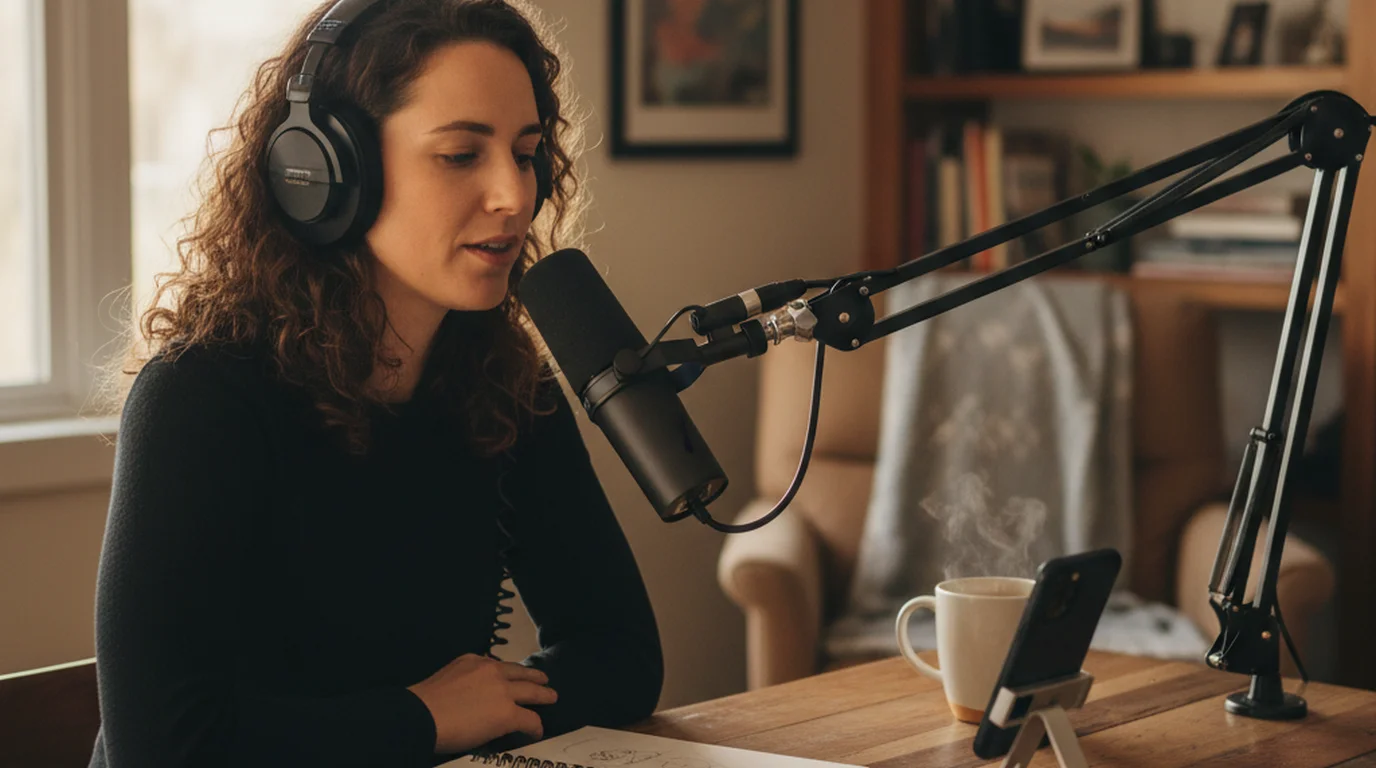
A podcast script decides whether an episode sounds prepared or sounds read. The same 25 minutes can come across as a confident host talking to a friend or as someone reciting a school report, and the difference is almost always in how the podcast script was written. Below is a podcast script template you can copy into any doc, followed by three complete podcast script examples: a solo episode, an interview, and a co-hosted show. Each one is written for the ear, with the lines that need to be exact written out and everything else left as talking points.
A podcast script is the written plan for an episode. It spells out the parts that must land exactly, such as the cold open, intro, transitions, sponsor reads, and outro, and keeps the rest as talking points so the conversation still sounds unrehearsed. Most hosts script about a quarter of an episode word for word and outline the remaining three quarters.
The podcast script template (copy this)
This podcast script template works for any format. Fill in the brackets, delete the segments you don't use, and keep the run-time targets: they stop a 20-minute episode from quietly turning into 45.
PODCAST SCRIPT TEMPLATE
Show: [Show name]   Episode: [#] – [Working title]
Target length: [20 min]   Host(s): [Names]   Guest: [Name, or none]

[COLD OPEN – 0:00 to 0:30]  Word for word
One surprising line, question, or 15-second clip from later in the episode.

[THEME MUSIC IN – 5 sec, then under]

[INTRO – 0:30 to 1:30]  Word for word
Welcome line + show name.
What this episode is about, in one sentence.
Why the listener should care today.
(Guest intro: name, one credential, one reason they're here.)

[SEGMENT 1 – 1:30 to 7:00]  Talking points
- Point:
- Example or story:
- Number or fact worth saying out loud:
TRANSITION (word for word): "..."

[SEGMENT 2 – 7:00 to 13:00]  Talking points
- Point:
- Example or story:
TRANSITION (word for word): "..."

[BREAK / SPONSOR / CALL TO ACTION – 30 sec]  Word for word

[SEGMENT 3 – 13:30 to 18:30]  Talking points
- Point:
- What the listener should try this week:

[RECAP – 18:30 to 19:30]  Word for word
The one takeaway, said in a single sentence.

[OUTRO – 19:30 to 20:00]  Word for word
Next episode tease + where to follow/subscribe + sign-off line.

[THEME MUSIC OUT]
Two rules make the template work. First, "word for word" sections stay short, rarely more than 90 words each, so you never read for longer than about 40 seconds at a stretch. Second, talking points are written as fragments, not sentences, which forces you to phrase them freshly on the mic instead of reciting.
Podcast script example 1: a solo episode
Solo shows need the most scripting, because there's no co-host to fill a pause. This podcast script example is for a 12-minute episode of a career-advice show. Notice that the scripted lines are short and the segments are prompts.
SHOW: The Next Rung   EPISODE 42 – "The 10-minute raise prep"
Target: 12 min   Host: Dana

[COLD OPEN]
DANA: Most people walk into a raise conversation with a feeling.
You're going to walk in with a number, three receipts, and a sentence
you've already said out loud. That's the whole episode.

[THEME IN, 5 SEC, UNDER]

[INTRO]
DANA: This is The Next Rung, I'm Dana. Today: the ten minutes of prep
that change how a raise conversation goes. If yours is coming up
this quarter, keep this one in your ears.

[SEGMENT 1 – THE NUMBER (3 MIN)]
- Pull two salary sources for your title + city
- Pick the number at the 60th percentile, not the middle
- Story: the time I asked for "a bit more" and got exactly that

TRANSITION: So you have a number. Now you need proof you're worth it.

[SEGMENT 2 – THE THREE RECEIPTS (4 MIN)]
- One result with a number attached
- One problem you solved that nobody assigned you
- One piece of praise in writing (email, Slack, review)

TRANSITION: Receipts are useless if they come out jumbled, which
brings us to the sentence.

[SEGMENT 3 – THE SENTENCE (3 MIN)]
- Formula: "Based on [receipt], I'm asking for [number]."
- Say it out loud five times before the meeting
- What to do if they say "not right now"

[RECAP]
DANA: One number, three receipts, one sentence. That's ten minutes,
and it's the best ten minutes you'll spend this month.

[OUTRO]
DANA: Next week: what to do when the answer is no. Follow The Next Rung
wherever you're listening so it shows up on Monday. I'm Dana.
Go get the rung.

[THEME OUT]
Read that cold open aloud and time it: it's 39 words, about 15 seconds at a normal pace. That's the right size for an opening hook. Anything longer and the listener is still waiting to find out what the show is.
Podcast script example 2: an interview episode
An interview podcast script is mostly questions. The guest's answers can't be written in advance, so the host's job on paper is to plan the order of questions, the follow-ups that dig deeper, and the transitions that keep the episode moving when an answer runs long.
SHOW: Small Shop Stories   EPISODE 18 – Guest: Priya Nair, ceramics studio owner
Target: 30 min   Host: Marcus

[COLD OPEN – CLIP FROM INTERVIEW, ADDED IN EDIT]
PRIYA: "The month I raised prices was the month I stopped being tired."

[THEME IN]

[INTRO]
MARCUS: Welcome to Small Shop Stories, where owners tell us the part
of the business they don't post about. I'm Marcus. My guest today runs
a ceramics studio that went from weekend hobby to six employees in
three years, and she raised her prices twice along the way.
Priya, welcome.

[WARM-UP – 3 MIN]
Q: What was on your wheel this morning?

[SEGMENT 1 – THE START (8 MIN)]
Q: When did the hobby stop being a hobby?
  Follow-up: Was there a single order that made it real?
Q: What did you get wrong in year one?
  Follow-up: How long before you noticed?

TRANSITION: Let's talk about the decision most owners put off for too
long: pricing.

[SEGMENT 2 – PRICING (10 MIN)]
Q: Walk me through the first price increase. What were you charging,
   and what did you change it to?
  Follow-up: How many customers did you actually lose?
Q: You said raising prices was the month you stopped being tired.
   What did you mean?

[SEGMENT 3 – NOW (6 MIN)]
Q: What does a normal Tuesday look like with six people?
Q: What would you tell someone at month six of their own shop?

[CLOSE]
MARCUS: Where can people find the studio?
MARCUS: Priya, thank you. This was the honest version I was hoping for.

[OUTRO]
MARCUS: If this one helped, share it with one person who's still
undercharging. Next week: a bakery that closed on purpose.
I'm Marcus. See you then.
The follow-ups are the most valuable lines on that page. First answers tend to be the polished version a guest has given before; the follow-up ("How many customers did you actually lose?") is where the real story lives. Write at least one for every main question.
Podcast script example 3: a co-hosted episode
Co-hosted shows fail in a specific way: both hosts talk over each other, or both wait for the other to start. The fix in the script is ownership. Every segment gets a lead host, and the other host's job is written down too.
SHOW: Two Screens   EPISODE 77 – "Is the remake ever better?"
Target: 25 min   Hosts: Leo (L), Sam (S)

[COLD OPEN]
L: Name one remake that's better than the original.
S: I have three.
L: You have one, and we'll fight about it for twenty minutes.

[THEME IN]

[INTRO – LEAD: S]
S: This is Two Screens, I'm Sam.
L: I'm Leo.
S: Today we each bring our best case for a remake that beat the
original, and the loser picks next week's movie.

[SEGMENT 1 – SAM'S CASE (8 MIN) – LEAD: S]
S: Pick + one-line pitch
S: Two things the remake did better (scene-specific)
L: Pushback: what the original still does better
L: Score it out of 10

TRANSITION – L: Fine. That was decent. Now let me show you
how it's done.

[SEGMENT 2 – LEO'S CASE (8 MIN) – LEAD: L]
L: Pick + one-line pitch
L: The scene that proves it
S: Pushback + score

[SEGMENT 3 – LISTENER PICKS (5 MIN) – LEAD: S]
S: Read two listener emails (names approved)
L: Rapid verdict on each

[VERDICT – WORD FOR WORD]
S: Final scores. Leo, yours was a [score]. Mine was a [score].
L: Which means [winner] picks next week.

[OUTRO – LEAD: L]
L: Send us your pick for the remake that beat the original.
Links in the show notes. I'm Leo.
S: I'm Sam. This was Two Screens.
The "LEAD:" tag on every segment does more for a co-hosted show than any amount of rehearsal. Each host knows when they're driving and when they're the reaction, so the conversation keeps a rhythm instead of collapsing into two people saying "no, you go."
How to write a podcast script in 5 steps
- Write the takeaway first. One sentence: what should a listener remember a day later? Every segment has to earn its place against that sentence.
- Outline three to five segments. Give each a run-time target. Three segments fit most 15–25 minute episodes; more than five usually means two episodes.
- Script the edges word for word. The cold open, intro, transitions, sponsor read, recap, and outro are where hosts ramble most, so these get exact wording.
- Turn the middle into talking points. Fragments, not sentences: "story: the 'a bit more' raise" instead of a full paragraph. You'll phrase it fresh on the mic.
- Read it aloud once, then cut. Every sentence you trip over gets shorter. Every sentence you'd never say to a friend gets rewritten in the words you would use.
If you want to go deeper on delivery once the script exists, the guide to using a teleprompter for podcast recording covers setup, scroll speed, and how to keep a read from sounding flat.
How long should a podcast script be?
Conversational podcast delivery usually lands between 130 and 150 words per minute. That gives a simple rule of thumb for any section you script word for word:
- Cold open: 30–60 words (about 15–25 seconds)
- Intro: 60–120 words (30–50 seconds)
- Transitions: 10–25 words each
- Fully scripted 10-minute solo episode: about 1,300–1,500 words
- Interview script for a 30-minute show: 400–700 words, since the guest does most of the talking
Your own pace is the number that matters, and it varies more than people expect. Paste a finished draft into the speech time calculator to see how long it will run before you record, then trim the segment that's furthest over its target.
Podcast listening is now a majority habit in the United States: Edison Research's Infinite Dial 2025 found that 55% of Americans age 12 and older are monthly podcast consumers. With that many shows competing for the same commute, the first 30 seconds of a script carry most of the weight, which is why the cold open and intro are the parts worth writing word for word.
Source: Edison Research, The Infinite Dial 2025 (via Podnews).
Write it for the ear, then record it
A podcast script is read by one person and heard by everyone else, so it should be formatted for speaking, not for reading on a page. Four habits make the biggest difference:
- One idea per line. Line breaks become breathing points. A paragraph you'd happily read silently becomes a run-on when spoken.
- Contractions everywhere. "You're going to" sounds like a person; "you are going to" sounds like a press release.
- Numbers written the way you say them. "Sixty percent" on the page if that's how you'll say it, so you don't have to translate mid-sentence.
- Cues in brackets. [MUSIC UNDER], [PAUSE], [CLIP]: anything that isn't spoken stays visually separate from what is.
Reading from paper or a laptop pulls your mouth away from the microphone every time you glance down, and the level drop is audible. A teleprompter keeps the script at eye level instead. In Teleprompter-Scrolling Scripts, Voice mode is built for exactly this: it records audio only while the script scrolls in front of you, at a speed set to your speaking pace. The app is free to download and use on iPhone, iPad, and Mac, with no account. When a talking-point segment runs long or short, tap the up or down button to jump three lines at a time instead of fighting the scroll. Hosts on a tight setup can also check the podcasting equipment list for beginners for a mic that suits a desk recording.
Scripted podcast sections sound read for a mechanical reason: written sentences are built for the eye, with long clauses and nested ideas that a listener can't scan back through. Breaking a script into one idea per line and adding contractions turns it into spoken language, which is why the same words sound natural once they are reformatted, even before any rehearsal.
Frequently Asked Questions
What is an example of a podcast script?
A podcast script example is a full episode plan with the intro, segments, transitions, and outro written out. For a solo show it might be a 90-word cold open, three talking-point segments, and a scripted outro. For an interview show it is mostly questions and transitions, with the guest's answers left unwritten. All three examples above follow that shape.
How do I write a podcast script?
Start with the one takeaway the episode should leave behind, then outline three to five segments that build toward it. Write the intro, transitions, and outro word for word, keep the middle as bullet points, and read the whole thing out loud once. Any sentence you stumble over gets shorter before you record.
How do I get the script of a podcast?
For someone else's show, check the episode page for a transcript, since many podcasts publish one, or use the transcript view in Apple Podcasts or Spotify where it is available. For your own show, the script is whatever you write before recording, and a transcript of the finished episode is a different document made after the edit.
How long should a podcast script be?
Plan on roughly 130 to 150 spoken words per minute for the parts you script word for word. A 20-minute solo episode that is fully scripted runs about 2,600 to 3,000 words. Interview scripts are much shorter, often 400 to 700 words, because the guest supplies most of the talking.
Should a podcast be fully scripted?
Usually not. Most shows script the intro, transitions, sponsor reads, and outro word for word, and keep everything else as talking points. Full scripts suit narrative shows, short daily episodes, and nervous first-time hosts. Interviews should never be fully scripted, because the guest's answers can't be written in advance.
What is the format of a podcast script?
A standard podcast script format runs top to bottom in recording order: cold open, intro and theme music cue, segments with talking points, sponsor or call-to-action break, recap, and outro. Speaker labels go in capitals, music and sound cues go in square brackets, and target run times sit next to each segment heading.
How do you make a scripted podcast sound natural?
Write the way you talk: contractions, short sentences, and the occasional unfinished thought. Put line breaks where you would breathe, script only the lines that need to be exact, and leave the rest as prompts. Then read it aloud at your normal pace, and let the script scroll rather than looking down at a page.
Start with the template, then make it yours
A good podcast script template is a skeleton, not a cage. Script the cold open, intro, transitions, and outro word for word; keep the middle as talking points; and read the whole thing aloud before you hit record. After three or four episodes the template will have bent to fit your show, which is exactly what it's for.
James HollowayJames Holloway coaches executives, founders, and professionals on scripted delivery and on-camera presence. His writing covers speech structure, words-per-minute pacing, and why most people's instincts about eye contact work against them.
Read your podcast script without looking down
Teleprompter-Scrolling Scripts scrolls your episode script at your speaking pace and records clean audio in Voice mode on iPhone, iPad, and Mac. No account needed.
Use Free Online Teleprompter Get the Free App