12 Elocution Exercises for Adults to Speak More Clearly
 James Holloway · July 30, 2026 · 8 min read

Most adults who want to speak more clearly don't need a speech therapist — they need a structured practice routine. Elocution exercises work by targeting the specific muscles, habits, and patterns that cause unclear speech: a tight jaw, lazy consonants, poor breath support, and a pace that outpaces articulation. These 12 exercises cover the full range of what elocution for adults actually requires, from the first warm-up through resonance and diction work.
Elocution exercises for adults improve speech clarity by training articulation, resonance, and pacing through daily 10–15 minute practice sessions. The most effective approach combines physical warm-ups (lip trills, jaw releases) with precision drills (tongue twisters, vowel isolation) and recorded self-review to track progress over 3–6 weeks.
1. Lip Trills — The Foundation Vocal Warm-Up
Lip trills — sometimes called "motorboat lips" — require you to blow air through relaxed, closed lips while phonating. The vibration loosens tension throughout the face and neck and establishes the breath support that every other exercise depends on. In my work with executives preparing for board presentations, lip trills are always the first two minutes of any session. Without them, diction drills tend to produce forced, effortful articulation rather than the relaxed precision you want.
Start with 30 seconds of trill on a steady pitch, then slide up and down your comfortable range for another 30 seconds. If you can't sustain the trill, your lips are too tense — try gently pressing the corners of your mouth inward with two fingers while you practice.
2. Jaw Release — Targeting the Root Cause of Mumbling
Most adult mumbling comes from a restricted jaw, not from poor intelligence or laziness. When the jaw doesn't open adequately, consonants collapse and vowels flatten. This is particularly common in speakers who grew up in cultural environments where quiet, restrained speech was the norm.
Place your fingertips lightly on your jaw joints (just in front of your ears) and open your mouth slowly. You're aiming for a two-finger gap between your upper and lower front teeth — measure it. Most people start at a one-finger gap. Practice sustained vowel sounds ("ah," "oh," "ee") with deliberate, exaggerated jaw openings for 3 minutes. The target is to make this open position feel normal, not theatrical.
According to the American Speech-Language-Hearing Association (ASHA), reduced jaw excursion — meaning insufficient mouth opening during speech — is one of the most frequently identified contributors to reduced speech intelligibility in adult speakers without a diagnosed speech disorder. Targeted jaw mobility exercises show measurable improvement in intelligibility scores within 4–6 weeks of consistent practice.
3. The Cork Exercise — Force Open Articulation
Place a wine cork horizontally between your front teeth and read aloud for 5 minutes. The cork prevents your jaw from closing fully, forcing your tongue and lips to do extra work to produce clear sounds. When you remove it, your articulators maintain that heightened engagement for 20–30 minutes. This is one of the fastest-acting pronunciation exercises I've used with clients who need results before an important presentation.
Use a clean cork or a clean pen cap in the same position. Read from a newspaper article or a prepared script rather than freestyle speaking — you want to hold challenging sentences, not choose easy words.
4. Tongue Twisters — Progressive Articulation Drilling
Tongue twisters are the most well-known of all elocution exercises, but most people use them wrong. The goal is not speed — it's precision at a controlled pace that you gradually increase. "She sells seashells by the seashore" isolates the sh/s distinction. "Peter Piper picked a peck of pickled peppers" works bilabial consonants (p, b). "Red lorry, yellow lorry" isolates the lateral-rhotic distinction that many adults collapse under pressure.
Start each twister at a pace where you can produce every consonant cleanly. Record yourself. Increase speed by 10% each day, only if the previous day's recording was crisp. Rush this process and you're just rehearsing sloppy articulation at higher speed.
5. Vowel Isolation — Extending Clarity Under Load
Sustained vowel production exercises the precise shaping of the oral cavity that gives speech its tonal clarity. Speak each of the five cardinal vowels (ah, eh, ee, oh, oo) for 5 full seconds each, focusing on a stable, consistent tone throughout. Then run through them in sequence without pausing — "ah-eh-ee-oh-oo" — at a slow, even pace. In my experience working with professionals who speak a second language, this is where the most significant breakthroughs happen: vowel quality is what listeners key on to determine how "clear" a speaker sounds.
A 2019 study published in the Journal of Voice found that adults who completed structured vocal exercises — including vowel extension drills — for eight weeks showed statistically significant gains in speech intelligibility scores, with improvements averaging 18% on standardized listening tests. Participants practiced for 15 minutes daily without professional supervision.
6. Humming — Building Resonance From the Inside
Resonance is why some voices carry clearly across a room while others sound muffled even at close range. Humming trains you to feel where your voice vibrates — ideally in your chest and the forward part of your face (the "mask"), rather than stuck in your throat. Hum a comfortable pitch with closed lips for 30 seconds and feel for vibration in your lips, nose bridge, and chest simultaneously. Then open to an "mm-ah" and see if that resonance carries forward into your vowel.
Most adults who sound "flat" or "monotone" are speaking from pure throat resonance. Three minutes of humming before a presentation, meeting, or recorded speech is the fastest way to shift this.
7. Diaphragmatic Breathing — Supporting Every Sound You Make
Breath is the engine of clear speech. When adults run out of breath mid-sentence, they tend to rush and swallow the final consonants — which is precisely where listeners lose the thread. Diaphragmatic breathing exercises train you to take fuller, lower breaths that give you more air for longer phrases.
Lie on your back and place a book on your stomach. Breathe in: the book should rise. Breathe out: it falls. That expansion-contraction pattern is diaphragmatic breathing. Practice it standing for 5 minutes — many people find they're actually chest breathing when vertical, which cuts their available air roughly in half. Once you can reliably feel your belly expand, read aloud and try to sustain each phrase on a single breath without rushing.
8. The "Mm-Hm" Resonance Check — Daily Calibration
This is a 60-second check you can do before any speaking situation. Say "mm-hm" as if genuinely agreeing with someone — a natural, relaxed affirmation. Notice where the vibration sits. Then speak a sentence in that same forward, resonant space. This exercise works because "mm-hm" is a sound most adults produce without tension, so it gives you an immediate reference point for what relaxed, resonant speech feels like. Comparing it to your habitual speaking voice often reveals a significant gap worth closing.
9. Pacing Drills — Speaking Clearly at Realistic Speeds
The speaking speed calculator can tell you exactly how many words per minute you're producing — and the number often surprises people. Most adults who are told they speak unclearly are actually speaking too fast, not too slowly. At 180+ words per minute, the articulators can't keep up with the pace and consonants get dropped or blurred.
Read a 150-word passage aloud and time yourself. If you finish in under 60 seconds, you're above 150 wpm — fast for clear articulation. Practice reading the same passage in exactly 75 seconds (120 wpm). That slower pace gives each word room to land. Record both versions and compare listener clarity.
10. "How Now Brown Cow" — Classic Vowel Placement Drill
This traditional elocution exercise trains the rounded "ow" diphthong, which is particularly useful for speakers whose vowels tend to flatten toward the center of the mouth. Say "how now brown cow" slowly, exaggerating the "ow" sound in each word. Focus on the lip rounding and the jaw drop at the start of each "ow." It sounds theatrical in isolation — that's the point. The over-articulation trains muscle memory that carries through into normal speech as appropriate (not theatrical) vowel precision.
Follow with the traditional extension: "How now, brown cow, walking through the town?" Then move through similar diphthong patterns: "mind my time," "go home slowly," "say the day." Each targets a different vowel shape.
11. Reading Aloud — Applied Articulation Practice
Five minutes of daily read-aloud practice consolidates the individual exercises into connected speech. Choose texts that are slightly more formal than your everyday speech — a news article, a speech transcript, a prepared script. The formality matters because it prevents you from defaulting to casual reduction patterns ("gonna," "wanna," "kinda") that undo the precision work from your other exercises.
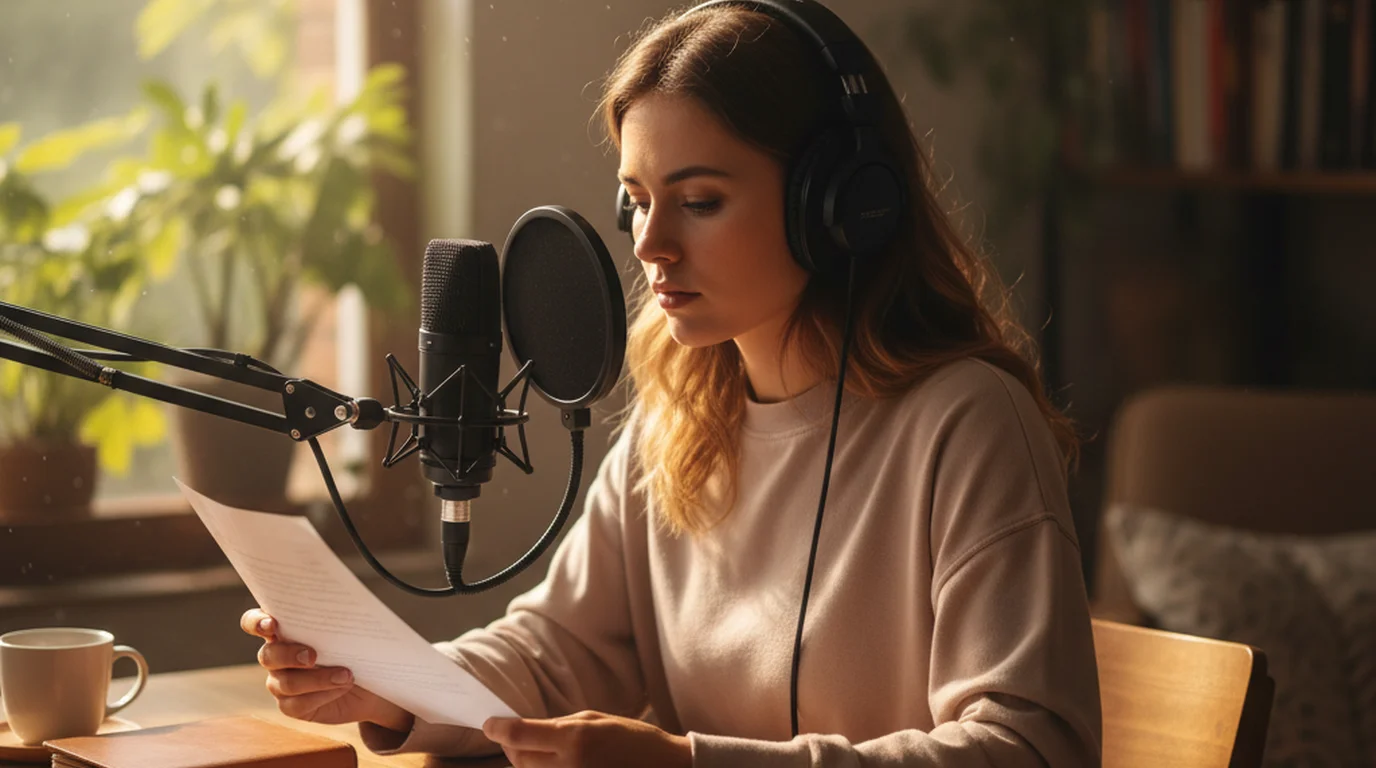
Record every session. Don't monitor yourself in real time — it creates self-consciousness that distorts your natural patterns. Listen back afterward and mark the specific words or transitions where clarity breaks down. Those are your targets for the next session's focused practice. If you're preparing scripted content for video or presentations, reading through your script with a public speaking framework applied is the fastest way to catch problem words before you're on camera.
12. Recording and Review — The Exercise That Ties It All Together
Consistent self-recording is not optional if you want real improvement. The gap between how we think we sound and how we actually sound is well-documented in communication research — most adults consistently underestimate both their speaking speed and the degree to which their consonants blur under load. In my work with executives and professionals, I've found that clients who review their recordings weekly improve roughly three times faster than those who rely on felt sense alone.
Record a 2-minute passage before you start your practice routine and the same passage after. Compare them at the end of each week. Specifically listen for: consonant endings (do your words end cleanly?), vowel consistency (do similar vowels sound the same across words?), and pacing (does your speed vary with your confidence in the material?). These three markers will tell you exactly which exercises to emphasize in the coming week.
How to Structure Your Daily Elocution Practice
A complete daily session should run 12–15 minutes and follow this order: 2 minutes of lip trills and jaw release (warm-up) → 5 minutes of targeted drills (tongue twisters, vowel isolation, or cork exercise, rotating daily) → 3 minutes of resonance work (humming, "mm-hm" check) → 5 minutes of read-aloud recording. That's it. Longer sessions aren't more effective — consistency over 4–6 weeks is what produces lasting change in your articulatory habits.
If you have a specific event coming up — a job interview, a presentation, a wedding speech — add 5 minutes of pacing drill with the specific script you'll be delivering. The goal isn't just clearer speech in isolation; it's clearer speech on the material that matters to you. Use the online teleprompter to practice reading your actual script at the controlled pace you've trained, which locks in the timing before you're in front of an audience.
Frequently Asked Questions
What are some common elocution exercises?
Common elocution exercises include tongue twisters for articulation, lip trills for vocal warm-up, vowel drills for clarity, humming for resonance, and jaw stretches to reduce tension. Practiced daily for 10–15 minutes, these exercises target the muscles most responsible for mumbling and unclear pronunciation in adult speakers.
How do I improve my elocution?
Improving elocution requires consistent daily practice targeting three areas: articulation (how precisely you form consonants), resonance (where your voice vibrates), and pacing (how fast you speak). Record yourself regularly to identify your weakest area, then spend 70% of your practice time on that specific element rather than drilling all exercises equally.
What are the 4 vocal function exercises?
The 4 Vocal Function Exercises (VFE), developed by speech-language pathologist Joseph Stemple, are: sustained phonation of 'whee' at a comfortable pitch, gliding from low to high pitch on 'whee', gliding from high to low, and sustained phonation of individual notes. They're designed to improve vocal fold strength and coordination, taking about 10 minutes twice daily.
How to enunciate better and stop mumbling?
To stop mumbling, you need to open your jaw more when speaking — most adults mumble because they keep their mouths nearly closed, which muffles consonants. The Cork Exercise involves placing a wine cork horizontally between your front teeth and reading aloud for 5 minutes. When you remove it, your muscles remember the open position. Pair this with deliberate over-articulation practice to train the habit.
How long does it take to see results from elocution exercises?
Most adults notice measurable improvement in speech clarity within 3–4 weeks of daily 15-minute practice sessions. Jaw tension and mumbling tend to improve fastest, often within 10 days. Deeper changes to resonance and pacing typically take 6–8 weeks because they require retraining habitual muscle patterns developed over years of speaking.
Can adults improve their pronunciation through elocution lessons?
Yes — the research evidence on adult speech improvement is encouraging. A 2019 study in the Journal of Voice found that adults who practiced structured vocal exercises for 8 weeks showed statistically significant gains in speech intelligibility scores. The key is structured, targeted practice rather than simply 'speaking more clearly' as a vague intention.
What is the difference between elocution and diction?
Diction refers specifically to the precision of consonant and vowel production — the physical accuracy of your sounds. Elocution is a broader term covering diction, pitch, pacing, emphasis, and overall delivery style. Think of diction as the mechanics and elocution as the full performance. Diction exercises build the foundation; elocution training applies that foundation to connected speech.
James HollowayJames Holloway coaches executives, founders, and professionals on scripted delivery and on-camera presence. His writing covers speech structure, words-per-minute pacing, and why most people's instincts about eye contact work against them.
Practice Your Elocution With Real Scripts
Once your articulation improves, put it to work. Use Teleprompter-Scrolling Scripts to read your actual script at the controlled pace you've trained — on iPhone, iPad, Mac, or in your browser, free.
Use Free Online Teleprompter Get the Free App