Is the iPhone Duo Worth It for Talking-Head Video?
 Maya Chen · September 10, 2026 · 10 min read
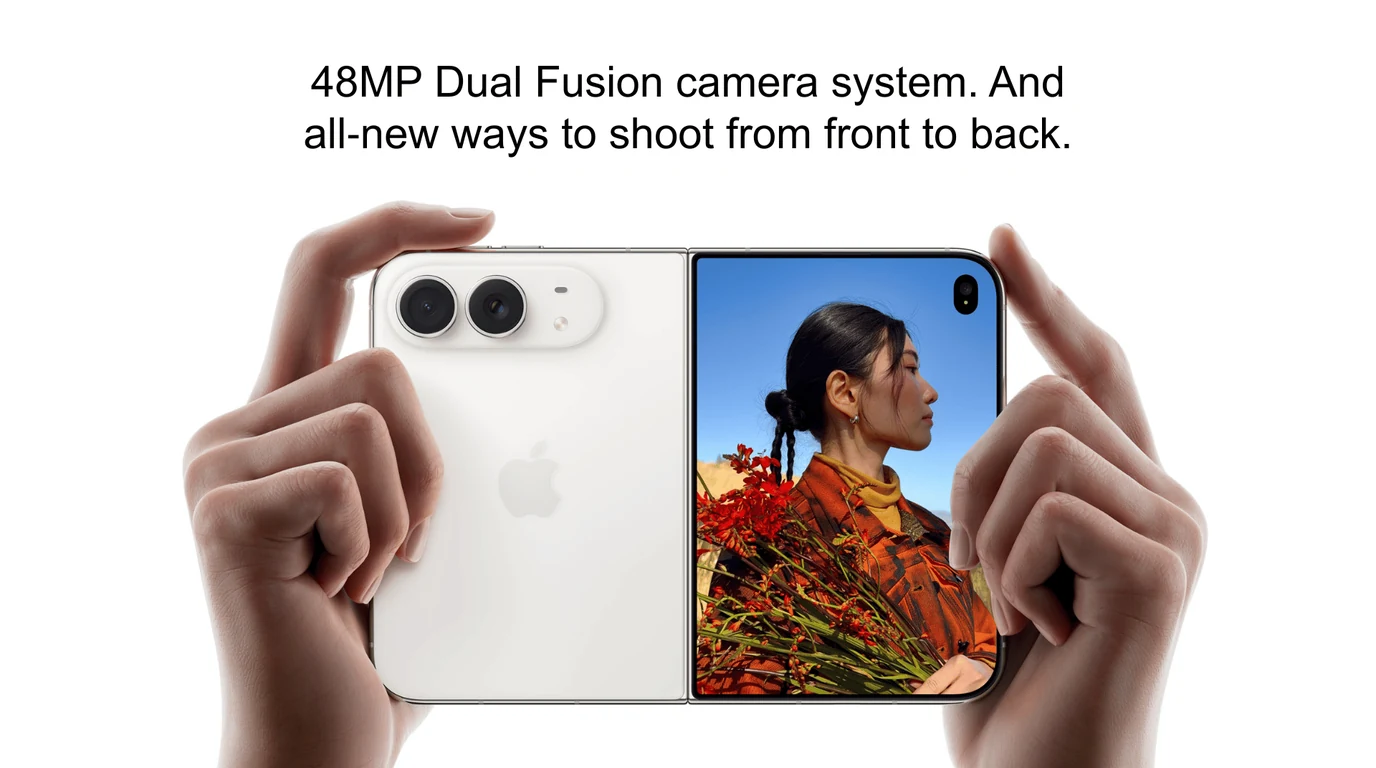
Apple announced the iPhone Duo on September 9, and for anyone who films themselves for a living, one detail stood out above the folding screen: the outer display can act as a viewfinder. That has been the missing piece in solo filming for a decade. The good rear cameras have always faced away from you.
The iPhone Duo's outer display finally lets you frame yourself while recording on the 48MP rear cameras, which is a genuine fix for solo work. But there's no dedicated telephoto lens, it weighs 254 grams, and apps that record you on the front-facing camera are capped at 1080p until developers update them.
The short answer, by what you actually film
If you film alone, facing the lens, and your footage is the product — course modules, YouTube explainers, client-facing UGC — the outer display solves a real problem and the iPhone Duo is worth watching closely. If you mostly film in vertical short-form where 1080p is the delivery ceiling anyway, the upgrade buys you very little. And if your work leans on tight, flattering headshots, the missing telephoto is a bigger deal than the folding screen is a benefit.
Apple announced the iPhone Duo on September 9, with retail availability from October 23. Every spec below comes from Apple's published tech sheet.
| Spec | iPhone Duo |
|---|---|
| Rear cameras | 48MP Fusion Main (26mm, f/1.6) + 48MP Fusion Ultra Wide (13mm, f/2.2) |
| Telephoto | None — the 2x option is a sensor crop at 52mm |
| Max video | 4K Dolby Vision up to 120 fps, sensor-shift stabilization |
| Outer front camera | 12MP Center Stage |
| Inner front camera | Under-display, f/1.8, 1080p at 30 or 60 fps |
| Third-party apps, selfie path | 1080p / 60 fps on the virtual front camera; 4K / 120 fps from the outer camera once an app adopts the new APIs |
| Third-party apps, rear path | 4K / 120 fps — unaffected, no update needed |
| Displays | 7.6-inch inner, 5.4-inch outer |
| Weight | 254 g |
| Battery (video playback) | Up to 31 hrs inner display, up to 44 hrs outer |
| Price and release | From $1,999 (256GB) · announced Sept 9 · on sale Oct 23, 2026 |
What the outer display actually fixes
Filming yourself has always forced a trade. Use the front camera and you can see your framing, but you're recording on the weaker sensor. Use the rear camera and you get the good glass, but you're guessing — checking the frame between takes, or propping up a mirror, or buying an external monitor. Our guide to filming a talking-head video on iPhone spends a whole section on workarounds for exactly this problem.
The Duo removes the trade. Folded, the 5.4-inch outer display sits on the same face as the rear cameras, so it can show you what the 48MP Fusion Main is seeing while it records. Apple calls the feature Duo Preview, and describes it as letting the person being photographed check their pose and framing on the outer display.
Read that sentence carefully, because the wording matters: Apple describes Duo Preview in terms of photography. Which brings us to the honest gap in what's been announced.
What Apple hasn't said about video
Across Apple's newsroom announcement and the iPhone Duo product pages, Duo Preview is consistently framed around stills — "whoever you're photographing," posing, framing a shot. There is no equivalent statement confirming that the outer display shows a live preview while the rear cameras are recording video.
That's not evidence it won't work. It's a gap in what's been confirmed, and it's the single most important gap for a talking-head creator to know about. One adjacent feature is confirmed: Dual Capture records the rear and front cameras simultaneously at up to 4K Dolby Vision 30 fps, which is a genuinely useful reaction-shot and dual-angle tool even if it isn't the same thing as monitoring yourself on the outer screen.
So if your plan is to self-record on the rear cameras, treat that as the one behaviour to confirm against Apple's own documentation rather than infer from the photo demos.
What apps can do is put their own content on the outer display while the cameras run. Teleprompter — Scrolling Scripts uses that for your script: open the Duo, start Camera Mode, and the script appears on the outer display, scrolling in step with the inner screen. You record on the rear 48MP Fusion Main and read from the screen beside the lens; our iPhone Duo teleprompter setup guide walks through it.
The cameras you actually get
The iPhone Duo carries two rear cameras rather than the three on Apple's Pro phones, and the one Apple dropped is the one that flatters faces most.
The iPhone Duo ships with a 48MP Fusion Main at 26mm f/1.6 and a 48MP Fusion Ultra Wide at 13mm f/2.2, according to Apple's iPhone Duo tech specs. There is no dedicated telephoto. The 2x option is a sensor crop from the main camera that lands at 52mm, which is a usable portrait length but short of the reach the Pro line offers.
For a seated talking head, 26mm is wider than ideal. Filling the frame at that focal length means moving the phone close to your face, which exaggerates the nose and forehead — the reason most portrait work happens between 50mm and 85mm. The 52mm crop is the more flattering option, and it costs you resolution because it's a crop rather than a separate lens.
Video capture itself is strong. The main camera records 4K Dolby Vision at 24, 25, 30, 60, 100 and 120 fps, with sensor-shift stabilization. For scripted delivery you'll likely stay at 30 — our breakdown of the best frame rate for YouTube covers why the higher rates work against a stationary presenter rather than for them.
The two front cameras are less impressive by design. The outer one is a 12MP Center Stage camera; the inner one sits under the display at f/1.8 and tops out at 1080p, 30 or 60 fps. Unfolded selfie video is the weakest capture path on the phone — the same front-versus-rear gap covered in our webcam vs iPhone camera comparison.
The 1080p ceiling on the selfie camera
This is the part that hasn't shown up in the launch coverage, and it changes what the phone does on day one.
The Duo has four cameras pointing in different directions depending on whether it's open or closed, which creates a problem for every camera app already on the App Store: those apps were written for phones with one front camera and one rear camera. Apple's solution is an abstraction layer.
In Apple's developer session on building camera experiences for iPhone Duo, an app that discovers a front-facing camera receives a Virtual Front Camera, which switches automatically between the inner and outer sensors as the phone opens and closes. That virtual device is capped at 1080p and 60 fps, with no depth support. Reaching the outer camera's full 4K and 120 fps means addressing the physical device directly.
In practice it depends which camera your app asks for. Request the rear cameras and nothing changes — those are real devices, and 4K at up to 120 fps behaves as it does on any iPhone. Request a front-facing camera and you get the virtual one, so an app offering a 4K selfie mode may show that option as unavailable. It isn't a setting you can change from your side.
A developer update lifts part of this, but not all of it. Addressing the physical cameras directly unlocks 4K and 120 fps from the outer camera. The inner camera under the folding display tops out at 1080p 60 fps in hardware, so no amount of updating raises that one. The trade for leaving the virtual device behind is that the app then has to handle the fold transitions itself, switching cameras as the phone opens and closes.
The same gate applies to the outer display. Apple has a dedicated API for pairing content on the outer screen with the main interface on the inner one, and its own sample code names a teleprompter view as the example use case. That's a strong signal about where Apple expects this hardware to go for creators, but it stays theoretical until individual apps adopt it. If your workflow depends on a specific recording or teleprompter app, it's worth asking the developer whether Duo support is on the roadmap.
Weight, price, and what else $1,999 buys
The iPhone Duo starts at $1,999 for 256GB. That's $800 more than an iPhone 18 Pro at the same 256GB tier, and the folding chassis costs you something in handling too: 254 grams, against 201 grams for Samsung's Galaxy Z Fold 8. Held at arm's length through a two-minute take, that difference is real — and it's an argument for putting any foldable on a tripod built for phone video rather than shooting handheld.
The comparison worth running isn't Duo versus Pro. It's Duo versus a Pro phone plus the gear that solves the same problem. An external monitor or a decent tripod-and-mirror setup addresses self-framing for a fraction of $1,999, and leaves you with a telephoto lens. Our roundup of the best cameras for YouTube videos puts the price bands side by side.
Battery is a genuine strength. Apple rates the Duo at up to 31 hours of video playback on the inner display and up to 44 hours on the outer one. Playback isn't recording, and 4K capture drains far faster than either figure suggests, but the outer-display number hints that folded shooting is the efficient mode.
Who it's for, and who it isn't
Buy it if most of your output is you, alone, talking to a lens, and you've been working around the front-camera compromise for years. The outer display is the first real answer to that, and it's built into the phone rather than bolted on.
Skip it if you publish mainly to TikTok, Reels or Shorts, where the delivery ceiling makes the sensor upgrade close to invisible. Same if you self-record on the front camera in a third-party app — that path sits at 1080p until those apps adopt the new APIs.
Probably not for you if flattering close-ups are your house style. No amount of screen cleverness compensates for a missing telephoto, and the Pro line keeps that advantage at a lower price.
Whichever way you go, our teleprompter setup guide for iPhone 18 Pro and iPhone Duo covers the settings and shooting distance that make a scripted take read as natural on either phone.
The bottom line
The iPhone Duo is the first phone that treats self-recording as a hardware problem rather than an accessory problem, and the outer display is a real answer to it. Three things temper that: Apple has confirmed Duo Preview for photos but not for video, there's no dedicated telephoto, and self-recording on the front camera in a third-party app stays at 1080p until that app is updated. Rear-camera recording is unaffected.
None of that makes it a bad phone. It makes it a specific one — worth the money if the outer display solves your particular problem, an expensive way to get two cameras if it doesn't. Check that the apps you rely on have Duo support on their roadmap. Whichever phone you shoot on, the part that makes a talking-head video work is still delivery — reading your script while looking at the lens does more for a finished video than any sensor upgrade.
Frequently Asked Questions
When does the iPhone Duo come out and how much does it cost?
The iPhone Duo starts at $1,999 for 256GB. Apple announced it on September 9 alongside the iPhone 18, and retail availability is October 23.
Can you record video with the rear camera and see yourself on the outer display?
Apple has confirmed this for stills, not for video. The feature is called Duo Preview, and Apple describes it in terms of photography — letting the person being photographed check their pose and framing on the outer display. Apple has separately confirmed Dual Capture, which records both rear and front cameras at once at up to 4K 30 fps.
Does the iPhone Duo have a telephoto lens?
No. The iPhone Duo has a 48MP Fusion Main at 26mm and a 48MP Fusion Ultra Wide at 13mm. The 2x option is a sensor crop from the main camera that lands at 52mm, not a separate optical telephoto. Apple left the dedicated telephoto out because the folding chassis doesn't have room for the lens stack.
Is the iPhone Duo better than the iPhone 18 Pro for talking-head video?
For image quality alone, the Pro line keeps the advantage because it has a dedicated telephoto and the Duo doesn't. The Duo's argument is the outer display, which turns the better rear cameras into self-recording cameras. Whether that's worth the extra $800 depends on how much of your work is filmed alone, facing the lens.
How heavy is the iPhone Duo compared to a regular iPhone?
The iPhone Duo weighs 254 grams. For comparison, Samsung's Galaxy Z Fold 8 comes in at 201 grams. That extra mass matters more for handheld filming than for pocket carry — a 254-gram phone held at arm's length for a two-minute take is noticeably harder to keep steady than a standard iPhone.
Will my current camera or teleprompter app work properly on the iPhone Duo?
It runs, but it doesn't automatically use the new hardware. Recording on the rear cameras is unaffected and still reaches 4K. An app requesting a front-facing camera receives a Virtual Front Camera capped at 1080p and 60 fps. Getting 4K from the outer camera, or putting anything on the outer display, requires the developer to adopt the new APIs first. Teleprompter — Scrolling Scripts has adopted them: on an open Duo it shows your script on the outer display while the rear cameras record.
Does the crease show up on camera?
The crease affects what you see on the inner display, not what the cameras record — the lenses sit on the outside of the chassis. It can matter while you're monitoring a shot on the inner screen, but it never reaches the footage itself.
How long can the iPhone Duo record before the battery runs out?
Apple rates the iPhone Duo at up to 31 hours of video playback on the inner display and up to 44 hours on the outer display. Playback figures are not recording figures — 4K capture at high frame rates drains a battery far faster — but the gap between the two numbers shows how much power the larger inner display consumes.
Maya ChenMaya Chen is a content creator who films on iPhone and coaches solo creators on mobile-first video production for TikTok, Reels, and Shorts. Her work focuses on the part most people skip: how to actually sound natural once the camera is rolling.
Read your script while looking straight at the lens
Teleprompter — Scrolling Scripts is free for iPhone. Camera mode overlays your script on the live camera view so your eyes stay on the lens — whichever iPhone you end up filming on.
Use Free Online Teleprompter Get the Free App