What Is a Keynote Address? Definition, Structure, and Delivery
 James Holloway · June 12, 2026 · 6 min read
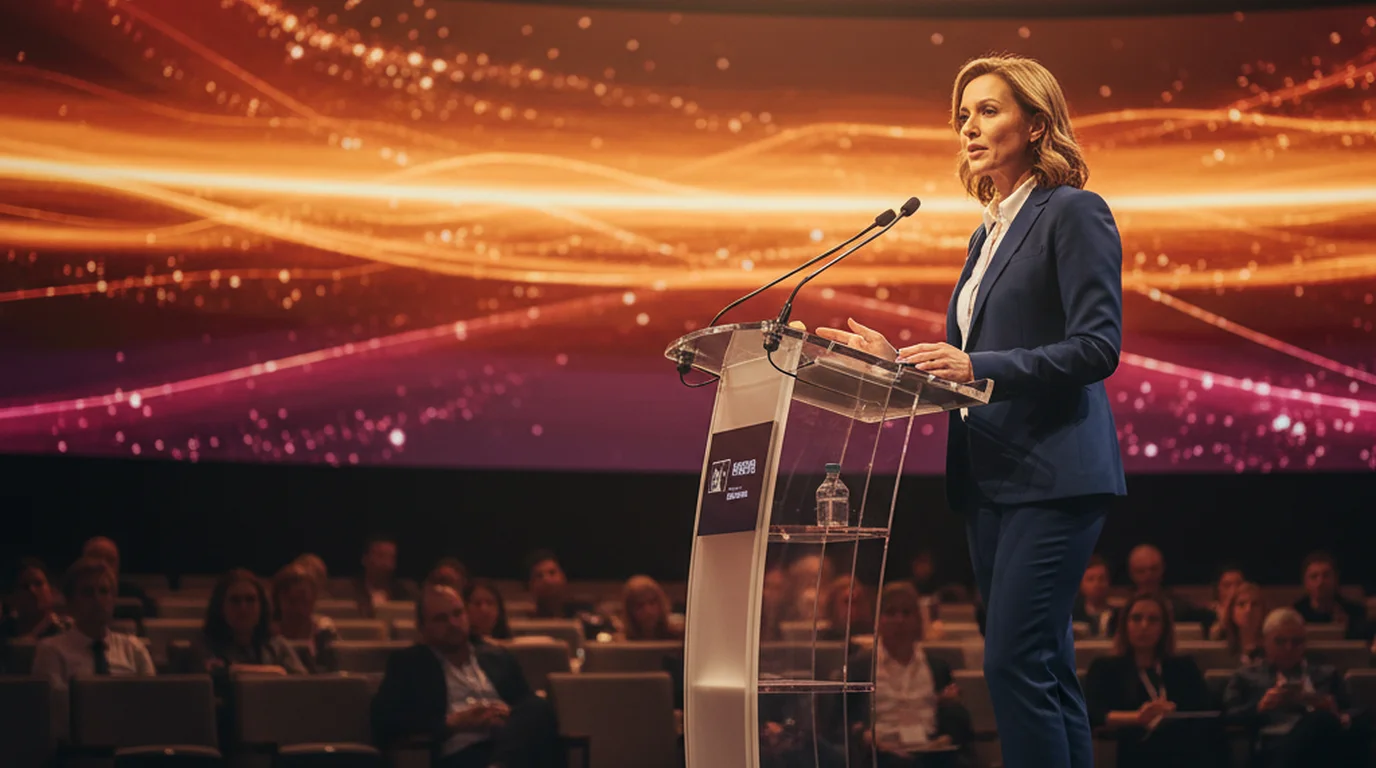
Over 20 years coaching speakers, I've watched talented professionals freeze when they hear they've been asked to give "the keynote." They assume it's just a longer version of any other presentation. It isn't. A keynote address carries a specific structural and relational responsibility that most speeches don't — and understanding what that means changes how you prepare, write, and deliver it. Let me break down exactly what this type of speech is and how to approach one effectively.
A keynote address is the opening or featured speech at a conference, ceremony, or major event that establishes the central theme and sets the tone for everything that follows. Unlike topic-specific presentations, it provides the unifying narrative that frames the entire event for all attendees.
What Makes a Keynote Different from a Regular Speech
The word "keynote" comes from music — it's the note that establishes the key signature for a piece. Every other part of the performance relates back to it. The address does the same thing for an event.
Where a panel session might debate a specific question, or a breakout session might teach a technical skill, this type of speech exists to answer a larger question: Why are we all here, and why does this matter? It's the moment an audience of strangers becomes a temporary community with shared purpose. For a broader look at how it compares to other formats, see our types of speeches guide.
This is why these speakers are paid so much more than other conference presenters. You're not compensated primarily for the information you deliver — you're compensated for the emotional and intellectual reframing you produce in the audience.
Who Gives the Keynote Address?
Keynote speakers typically fall into one of three categories. The first is recognized authority: a researcher whose work is central to the field, an author who's defined a conversation, or an industry leader whose company embodies the conference's themes. The second is accomplished practitioner: someone who has done the thing the audience wants to do, at a scale that commands attention. The third is compelling outsider: a speaker from an adjacent field whose perspective reframes the audience's usual assumptions.
According to the National Speakers Association, the professional speaking market for this format was valued at over $1.9 billion in the United States in 2023. Top-tier speakers — those with major book deals, TED Talk views above 5 million, or C-suite titles at Fortune 500 companies — routinely command $50,000–$100,000 per appearance. Mid-tier professional speakers typically earn $10,000–$30,000 per engagement.
For internal corporate events, these addresses are often delivered by the CEO or a senior executive. For industry conferences, they're more likely to come from someone external — a fresh voice who can say things an insider can't.
How to Structure a Keynote Address
In my coaching practice, I use a five-part structure that works for addresses ranging from 20 minutes to 90 minutes. The proportions shift based on total time, but the sequence holds.
- Open with tension (5–10% of total time): A story, statistic, or question that creates urgency. Not "thank you for having me" — the audience's attention is highest in the first 90 seconds, and most speakers waste it on pleasantries.
- Establish stakes (10–15%): Why this topic matters right now, to this specific audience. Addresses that feel generic almost always fail this section — they explain why the topic matters to everyone, which means it matters to no one in particular.
- Deliver the central argument (50–60%): Two to three big ideas, each with a story, evidence, and a memorable phrase or image. This is the substantive middle of the speech.
- Address objections or counterarguments (10–15%): What the skeptic in the room is thinking. Acknowledging it directly builds credibility and keeps the audience with you.
- Close with a call to action or forward vision (10–15%): Not a summary — audiences tune out recaps. A forward-facing image of what becomes possible if they act on what they've heard.
For scripted delivery — which most formal presentations require — a teleprompter allows you to maintain this structure precisely without the cognitive load of memorization.
Writing the Keynote Script
The first thing I ask any speaker I'm coaching to write before a single word of the speech: one clear theme sentence. Not "I'm going to talk about leadership" — that's a topic, not a theme. A theme sentence sounds more like: "The leaders who transformed their industries were not the ones who planned the best — they were the ones who responded to failure the fastest." That sentence tells you what the speech is about, what claim it makes, and what direction all the evidence needs to point. Everything else in the script either serves that sentence or doesn't belong.
Once you have the theme sentence, write the opening hook — before the body, before anything else. This feels counterintuitive. Most writers want to write the introduction first. But writing the hook before the body forces you to find the most arresting entry point into your theme. A strong hook that connects directly to the theme makes every subsequent section easier to write, because the whole speech is already pulling in one direction.
Write for the ear, not the eye. Keynote scripts are structurally different from essays. Short sentences. Active voice. Repetition used for effect, not variety. Concrete nouns and strong verbs over abstract constructions. Every sentence I write for a keynote, I read aloud before moving to the next one. If I can't say it naturally in a single breath, it needs to be shortened or restructured. What reads cleanly on the page can still be a stumbling block when spoken at pace in front of a room.
Use anecdotes, statistics, and analogies as the supporting material for each main point — but always treat them as tools for illustration, not the point itself. The story doesn't replace the argument; it makes the argument memorable. Statistics establish credibility; stories create belief.
Famous Keynote Structures Worth Studying
One of the fastest ways I know to internalize what good keynote structure feels like is to study three models that have proven themselves in front of real audiences at scale.
Steve Jobs' Apple product launch keynotes used a strict rule of three throughout — three products, three features, three reasons. Each product was introduced with a story about the problem it solved, not a list of specifications. The "And one more thing..." reveal was a structural device that trained audiences to expect a surprise, sustaining engagement across a two-hour presentation. The closing always circled back to the opening theme, creating a complete narrative arc. In my coaching practice, I show this structure to executives who think they need to cover everything — Jobs never did, and the speeches are still referenced twenty years later.
TED and TEDx talks follow the "one idea worth spreading" principle. Every talk has one central idea that can be stated in a sentence, and every story, statistic, and argument in the 18 minutes supports that idea alone. The constraint of a single idea is what gives TED talks their clarity and memorability. Most mediocre keynotes I've seen fail for precisely the opposite reason: they try to say too many things and end up landing none of them.
Political convention keynotes follow a recognizable three-part structure: a statement of the central theme (what we believe), a personal story or testimonial that embodies that theme (why it matters to real people), and a vision statement for the future (what becomes possible if we act). The personal story is almost always the section that gets quoted afterward. It is the emotional anchor for the whole speech, and without it the argument floats without weight. I use this structure with non-political speakers all the time — the format works because the psychology behind it is universal.
What all three models share: the structure is invisible to the audience but essential to the speaker. The best keynotes feel like an experience, not a framework. Getting the structure right is what makes that experience possible.
Keynote Length: How Long Should It Be?
Most professional conferences schedule keynotes for 45–60 minutes including Q&A. The speech itself typically runs 30–40 minutes. TED Talks — a specific format with its own rules — cap at 18 minutes. Corporate annual meetings often run 20–30 minutes for executive addresses.
The right length is determined by two constraints: what the event schedule requires and how much material you have that genuinely earns its place. I've coached speakers to cut the speech from 60 minutes to 35 minutes and watch audience satisfaction scores go up. Every minute you hold an audience's attention is attention they're lending you — don't waste it.
A 2024 analysis of 200 professional conference addresses by Presentation Guru found that 45-minute presentations received the highest post-event satisfaction ratings, with 30-minute slots in second place. Addresses over 60 minutes showed a significant drop in satisfaction scores regardless of speaker quality, suggesting audience attention capacity is the binding constraint, not content quality.
The Difference Between a Keynote Address and a Presentation
The clearest way to distinguish them: a presentation teaches, a keynote inspires. A presentation might walk you through a 10-step process with slides, data, and takeaways you can implement tomorrow. The opening remarks shift how you see the problem in the first place.
This isn't a quality difference — both formats serve important purposes. But confusing them creates problems. I've seen highly accomplished professionals deliver outstanding presentations when they were asked for the opening address, and the audience left impressed but unmoved. The missing ingredient was the emotional and thematic reframing that only this format delivers.
If you're preparing the address, the test is simple: could a well-prepared topic expert give this speech? If yes, it's a presentation. A true keynote talk requires your specific perspective, experience, and authority — it couldn't be delivered by anyone else.
How to Prepare and Deliver a Keynote
Preparation for a keynote is different from preparing a standard presentation. The script matters more — the language is more carefully crafted, because each phrase carries more weight. Most speakers I work with write a full script first, then work to internalize it rather than memorize it word-for-word.
For delivery, the tool that matters most at this level is eye contact. Presidential-style teleprompters, which use two glass panels flanking the stage, allow speakers to maintain true eye contact while reading a precise script. For smaller venues, a single on-camera prompter setup or a confidence monitor positioned below sight-line gives the same benefit.
Practice the opening minute until it's effortless. That's when your nerves are highest and your audience is forming their first impression — you cannot afford to feel uncertain in the first 60 seconds. Our public speaking skills guide covers the rehearsal techniques that work best at this level.
Eye Contact and Movement During a Keynote
Eye contact is one of the most powerful tools in live keynote delivery, and it's the one I spend the most time on with speakers who are new to this format. Audiences feel addressed, seen, and engaged when a speaker makes genuine eye contact. The challenge of any scripted delivery — notes, slides, or teleprompter — is maintaining that quality of connection while managing the text.
For dual-glass teleprompter setups at live events, the technique I teach is a slow, natural arc: move the gaze between the two glass panels in a sweep that crosses the audience, pausing on one side of the room for three to five seconds before moving to the other. That pause creates the impression of looking at individuals rather than scanning. It takes practice, and ideally you run through it on the actual stage setup before the event — but it becomes natural quickly, and audiences can't tell you're reading.
For app-based keynotes recorded on camera, position the teleprompter device as close to the camera lens as possible — directly below it, mounted above it, or placed so the text sits within a few inches of the lens center. The closer the text is to the lens, the more natural the eye contact appears on screen. A gap of more than two to three inches between where you're reading and where the lens is becomes visible in close-up shots and gives away the script. I tell speakers: if you can cover both the lens and the text with your thumb at arm's length, you're close enough.
Movement on stage should be deliberate and purposeful. In my coaching work, I use a simple rule: move toward the audience during an emotional appeal, return to a neutral position during a transition, and stay still when you're making a key argument. Nervous pacing — moving without purpose — undermines authority even when the words are strong. If you're not sure what to do with your body during a particular section, the answer is almost always: stand still. Stillness reads as confidence, both on camera and in a live room.
Which Teleprompter Setup Fits Your Keynote
Two transparent panels on stands either side of the podium — the presidential-style glass rig — is still the standard for major political keynotes, corporate earnings presentations, and headline event speeches. The panels reflect text from monitors set below the speaker's sight line, so the speaker reads a full script while the room sees direct eye contact. It needs an operator scrolling to your pace, and it needs stage time to rig.
For recorded keynotes, virtual events, and solo-camera presentations, an app-based prompter does the same job without the hardware. An iPad at camera level carries the full script with no glass, no operator, and no stage call; the same setup runs on Mac for webcam keynotes recorded at a desk. This is now the usual arrangement for keynotes that are broadcast or distributed afterwards rather than delivered only to a room.
Between the two sits the lectern tablet: a device propped at a slight upward angle on the podium, visible to the front rows but accepted at smaller events where a glass rig is impractical. It costs you some eye contact with the first few rows and buys you a word-accurate script with no crew.
Frequently Asked Questions
What is the purpose of a keynote address?
A keynote address serves to unify an audience around a central theme, energize attendees, and set the intellectual or emotional tone for an entire event. Unlike panel discussions or breakout sessions, it provides a single cohesive narrative that gives the rest of the program its frame of reference.
Who gives the keynote address?
Keynote speakers are typically recognized authorities in the event's subject area — industry leaders, researchers, authors, or public figures whose perspective carries weight with the audience. Conferences often pay professional speakers between $10,000 and $100,000+. Some events use internal leaders or rising voices in a field instead.
What to say in a keynote address?
A strong keynote typically opens with a compelling story or surprising statistic, establishes why the topic matters now, delivers 2–3 central ideas with concrete evidence, and closes with a clear call to action or memorable image. A keynote talk is not a lecture — it inspires and reframes, rather than teaching step-by-step.
What is the difference between keynote and presentation?
A keynote is a high-stakes, single-speaker address designed to set the tone for an entire event — typically 30–60 minutes. A presentation is a more focused session that dives into specific information, research findings, or how-to content. The address frames; presentations teach.
How long is a keynote address?
Most keynote addresses run 30–60 minutes, with 45 minutes being the most common format at professional conferences. TEDx addresses are capped at 18 minutes. Corporate event presentations sometimes run up to 90 minutes when they include a Q&A segment.
James HollowayJames Holloway coaches executives, founders, and professionals on scripted delivery and on-camera presence. His writing covers speech structure, words-per-minute pacing, and why most people's instincts about eye contact work against them.
Deliver Your Keynote Without Losing Eye Contact
Teleprompter-Scrolling Scripts lets you read your full keynote script while looking directly at your audience. Works on iPhone, iPad, and Mac — free to download.
Use Free Online Teleprompter Get the Free App