Public speaking skills: 5 that actually move the needle
 James Holloway · June 7, 2026 · 8 min read

Most public speaking advice covers the same ground: slow down, breathe, make eye contact, practice. That's all accurate. But it's not specific enough to act on the day before a presentation, a recording session, or a pitch. This guide focuses on five skills that produce a measurable improvement in delivery quality — defined as audience attention and message retention — and explains what each skill actually requires to develop.
The five most impactful public speaking skills are pacing (speaking at 120–140 wpm with deliberate pauses), eye contact (sustained camera or audience connection without scanning), vocal variety (using pitch and volume to signal structure), message structure (opening with the conclusion), and script fluency (delivering written content naturally). Each can be practiced in isolation before a presentation and measured in a practice recording. Pacing is easier to control when you know your target: the speaking time calculator converts word count to speaking time.
Skill 1: pacing and the deliberate pause
Pacing is the public speaking skill most people think they've mastered but haven't measured. The problem isn't speaking too fast — it's speaking at an uneven rhythm that signals anxiety. In public speaking, an audience processes fast speech fine if it's consistent. What disrupts comprehension is irregular speed: rushed through complex information, then slowed awkwardly at the end of a point, then rushed again. If you struggle with nerves behind uneven pacing, see how monitoring your confidence during presentations can help you reset in real time.
The standard for prepared spoken delivery is 120–140 words per minute. Below 100 wpm feels slow and condescending to most audiences. Above 160 wpm is where comprehension starts dropping for complex content, though broadcast journalists routinely deliver news at 150–170 wpm because the content structure is predictable.
The deliberate pause is more valuable than pacing itself. A two-second pause after a key statement does three things: it gives the audience time to absorb what you just said, it makes what follows feel more significant, and it signals confidence. Speakers who never pause are harder to follow than speakers who pause too much. In your next practice session, put a period character at every pause point in your script and hold it for a full two-count before continuing.
Research published in the Journal of Experimental Psychology found that strategically placed pauses (1.5–2 seconds) after key statements increased audience recall of those statements by 28% compared to continuous delivery at the same speaking rate. For any scripted message where specific takeaways matter, the pause is the highest-ROI single technique available.
Skill 2: eye contact that doesn't look like scanning
Eye contact is one of the most immediately readable public speaking skills an audience judges from the first few seconds. For live presentations, it means holding your gaze on a single person for a complete thought — typically one sentence or clause — before moving to someone else. Three to five seconds is right. Less looks like scanning; more feels like staring. The common mistake is sweeping the room rhythmically, which audiences read as a practiced technique rather than genuine engagement.
For on-camera delivery, eye contact means looking into the lens. This is uncomfortable because you're looking at a piece of glass rather than a human face, but it's what registers as eye contact in the recording. The technique that helps: think of the camera as a specific person, not a machine. Name them. Look at that lens the way you'd look at that person across a table.
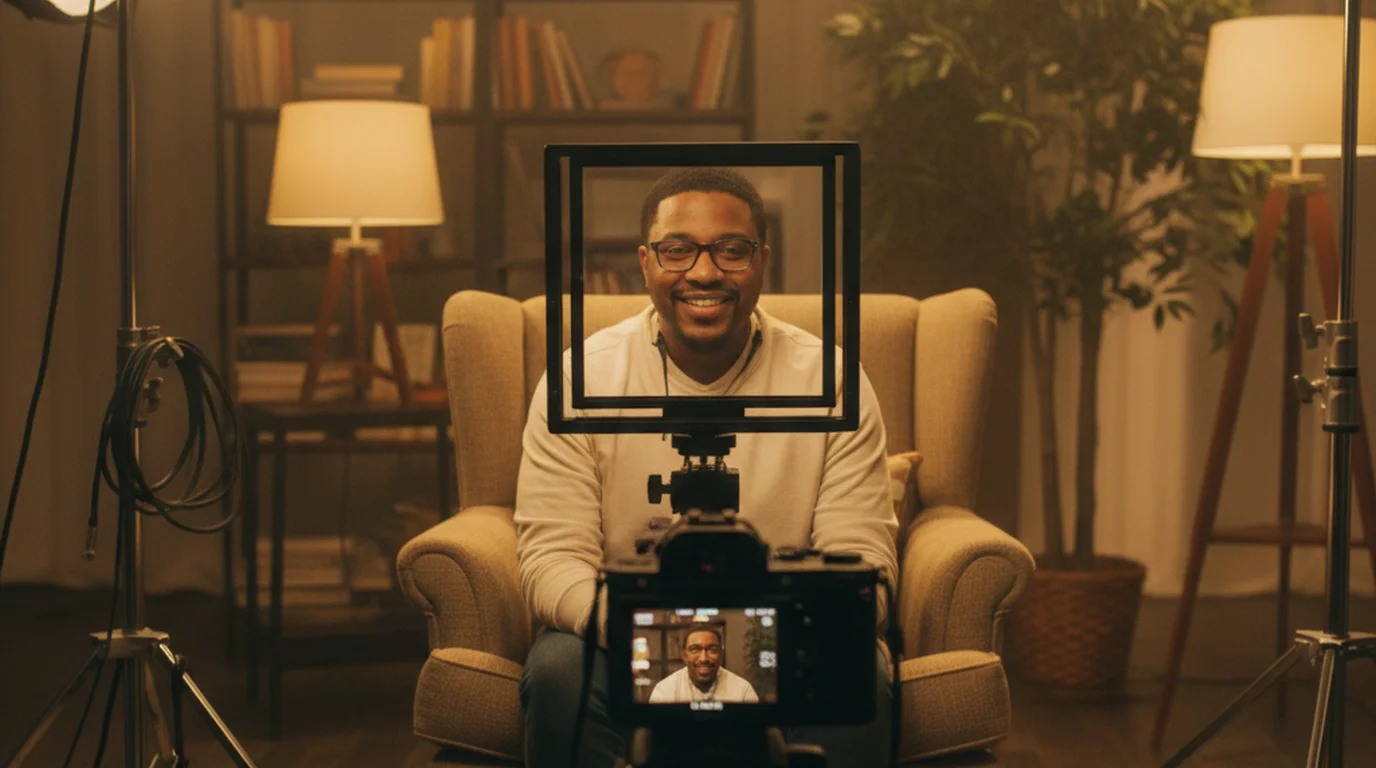
Using a teleprompter app on iPhone or Mac helps close the gap between where your script is and where the camera is. Positioning text near the lens means small eye movements to check your script are nearly indistinguishable from camera-directed eye contact in the final recording. We've compared recordings from speakers using a script propped below the camera versus reading from a teleprompter positioned near the lens — the difference in apparent eye contact is visible at normal viewing distance.
Skill 3: vocal variety as a structural tool
Vocal variety isn't about sounding more interesting — it's about giving your audience cues about what matters. It's a core speech delivery skill that separates effective public speaking from flat, forgettable presentations. Pitch drops at the end of a sentence signal a complete thought. Volume increase signals "this is the main point." A slowing of pace before a key statistic signals "pay attention to this number." Without these cues, audiences have to work harder to identify what to retain. For a deeper look at the mechanics, this guide to voice modulation covers pitch, resonance, and breath control in detail.
Three vocal dimensions to practice independently: pitch range (the distance between your highest and lowest speaking pitch in a single passage), volume dynamics (the contrast between your baseline volume and your peaks), and speed variation (the difference between your fastest and slowest passages). Record a 60-second passage from your script and listen back for flatness — if pitch, volume, and speed are all constant throughout, the vocal variety is missing even if your content is strong. This is one of the public speaking skills that benefits most from recorded self-review, because speakers rarely hear their own monotone in the moment.
The specific technique: mark every key statement in your script with a "slow + louder" indicator. Mark section transitions with a pause marker. Mark questions with a pitch-up marker. Read through once following only those markers, ignoring the content. That single pass usually produces more variation than a speaker achieves in 10 natural read-throughs.
Skill 4: structure that audiences can follow without effort
The most common structural mistake in public speaking is burying the conclusion. Speakers build to their main point at the end because that's how arguments feel logical in writing. Audiences need the opposite: give them the conclusion first, then the evidence. This is why news lede structure — the most important information in the first sentence — has survived for 150 years across every medium. Strong audience engagement in public speaking depends on giving listeners a map before the journey, not after.
For a 5-minute presentation or video: open with your single main point in one sentence, spend the body on the three strongest supporting pieces of evidence, and close by restating the main point in a slightly different form. That structure requires your audience to do almost no work to extract your message. They can lose attention for 30 seconds and still get back on track because they know where you're going. How you end matters as much as how you open — this breakdown of how to end a speech covers closing techniques that make the final impression stick.
The 3-2-1 rule is a practical constraint: three key points, two minutes maximum per point, one call to action. It forces cuts that improve the presentation rather than just making it shorter. Every element you cut was either supporting material the audience didn't need, or repetition they'd already absorbed. For speeches specifically designed to change minds, the guide to persuasive speeches covers structure and argument sequencing in more detail.
Skill 5: delivering a script so it doesn't sound like one
Script fluency is the hardest public speaking skill because it requires two things simultaneously: reading accurately and sounding spontaneous. Most speakers achieve one or the other, not both. They either improvise (natural but drifts off message) or read (on message but sounds read). In public speaking coaching, this is the tension that takes the longest to resolve — and it's why scripted delivery practice is a separate discipline from general presentation skills.
The technique that bridges this: write scripts in spoken syntax, not written syntax. Written sentences are longer, more complex, and use subordinate clauses. Spoken sentences are shorter, use active verbs, and let the listener finish the thought. "The reason this matters is that users who encounter the product without prior context tend to require significantly more time to complete the onboarding flow" becomes "New users take longer to set up. That's a real problem." Write the second version, record it, and compare delivery quality on playback.
A teleprompter handles the accuracy side — you don't have to memorize. Your job is to deliver the scripted words as if you thought of them just now. Practice saying the same line three times, each with different emphasis on a different word. Pick the version that sounds most natural. That's the version you mark in your script and deliver in the recording. For speakers preparing a formal event address, the guide to what a keynote address is covers how these delivery principles apply to high-stakes live formats.
In a 2023 study on presenter credibility by the National Communication Association, audiences rated speakers who used teleprompters correctly — natural delivery with a scripted text — as more credible than speakers who improvised, because improvised content contained more filler words, hesitations, and factual imprecision. The problem isn't the script; it's the audible evidence of reading.
Frequently Asked Questions
What are the 5 most important skills in public speaking?
The five highest-impact skills are pacing (120–140 wpm with deliberate pauses), eye contact (sustained lens or audience contact without scanning), vocal variety (pitch and volume shifts as structural signals), structure (conclusion-first, evidence second), and script fluency (delivering written content so it sounds spontaneous). All five can be practiced in isolation and measured in a practice recording before any live presentation or video shoot.
What are the 5 C's of public speaking?
The 5 C's are Clarity (one clear idea per statement), Conciseness (no words that don't add meaning), Confidence (controlled pacing and sustained eye contact), Connection (referencing something the specific audience recognizes), and Credibility (using specific numbers instead of general claims). These aren't personality traits — they're technique categories that can be checked in a script before delivering it.
What is the 3 2 1 rule in speaking?
The 3-2-1 rule is a presentation structure: three key points, two minutes maximum per point, one call to action at the end. It forces you to cut everything that doesn't directly support your three main points. The rule works for live presentations, recorded videos, and any format where you write the script in advance. It prevents the common mistake of covering six points at two minutes each — which leaves audiences remembering roughly one.
What are the 7 elements of public speaking?
From communication theory, the seven elements are speaker, message, channel (the medium: live, video, audio), audience, feedback (audience response during delivery), interference (distractions, technical issues, background noise), and context (the occasion, setting, and expectations). For content creators and presenters using video, the three most controllable and highest-impact elements are message clarity, channel optimization (adjusting delivery for video versus live), and interference reduction (controlling audio, lighting, and background before recording).
James HollowayJames Holloway coaches executives, founders, and professionals on scripted delivery and on-camera presence. His writing covers speech structure, words-per-minute pacing, and why most people's instincts about eye contact work against them.
Practice script delivery with a free teleprompter
Teleprompter-Scrolling Scripts helps you deliver scripted content naturally. Camera mode records your delivery so you can review it. Free on iPhone, iPad, and Mac.
Use Free Online Teleprompter Get the Free App