How to End a Speech: 7 Closing Techniques That Leave an Impression
 James Holloway · June 12, 2026 · 6 min read
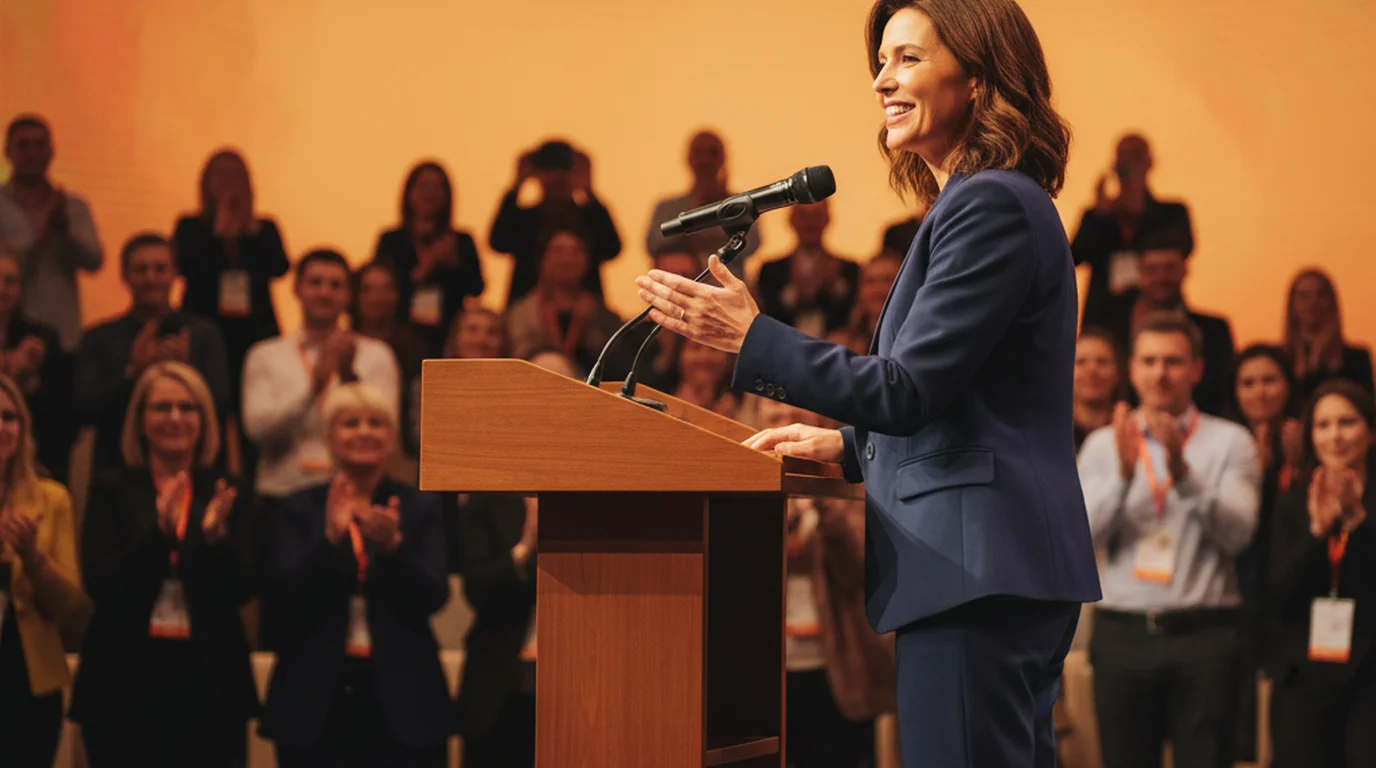
The most common mistake I correct in coaching sessions isn't the opening — it's the close. Most speakers spend weeks crafting their middle sections and then trail off at the end, finishing with something like "so... that's all I have, thanks." After coaching over 400 professional speakers, I've found that the final 60 seconds of a speech do more to determine how the audience remembers the entire talk than the preceding 20 minutes. Here's how to end a speech so it actually lands.
To end a speech effectively, script your final sentence word-for-word and deliver it while holding direct eye contact. The strongest closings use one of these approaches: a callback to your opening, a call to action, a memorable quote that crystallizes your theme, or a forward-looking vision statement. Avoid summary recaps and trailing thank-yous — they drain the energy you built. Before you rehearse the close, confirm the whole speech fits your slot with the speech time calculator.
Why Most Speech Endings Fail
Speakers typically ad-lib their closing because they've run out of prepared material and assume the audience will carry them home on applause. They don't. Without a scripted final line, the ending becomes a trailing-off rather than a landing — the audience starts checking their phones before you've technically finished.
The other common failure is the summary recap: "In conclusion, today we covered X, Y, and Z." Your audience just heard X, Y, and Z. They don't need to hear them again in abbreviated form. A summary recap signals that you've run out of ideas, not that you're closing with authority.
Research published in the Journal of Memory and Language identifies a "recency effect" — audiences remember the last thing they heard more vividly than content from the middle of a presentation, regardless of content quality. This neurological pattern means the final 60–90 seconds of a speech carry disproportionate influence on audience takeaways and speaker evaluations.
7 Techniques to End a Speech Memorably
1. The Callback
Return to the story, image, or question you used to open the speech and resolve it with the insight you've built. This creates a satisfying narrative arc. If you opened with "the moment I almost quit," close with what you know now that you didn't know then. The callback is the most emotionally satisfying close because it gives the audience a complete story.
2. The Call to Action
Give the audience one specific next step. Not "I encourage you to think about these ideas" — that's vague and forgettable. Instead: "This week, have one honest conversation you've been avoiding." Specific, actionable, and time-bound. The call to action works best when it's singular — multiple asks divide attention and reduce follow-through. The call-to-action close is especially important in persuasive speeches, where the goal is action rather than just understanding.
3. The Vision Statement
Paint a picture of what becomes possible if the audience acts on your message. "Imagine a workplace where every meeting starts with someone asking what we got wrong last quarter — not to assign blame, but to learn faster. That's the culture we're building. It starts here." Forward-looking language creates hope and agency, which audiences associate positively with the speaker.
4. The Memorable Quote
A well-chosen quote from someone your audience respects can crystallize your entire theme in a single sentence. The key is selecting a quote that does something your words can't do — lends external authority, expresses the idea more elegantly, or connects your message to a larger legacy. Don't end with a quote that could apply to any speech on any topic.
5. The Bookend
Similar to the callback, but more structural: open and close with the same phrase, image, or line. The audience hears it differently the second time because of everything you've built in between. This technique is particularly effective for emotional speeches where you want the audience to experience a shift in perspective.
6. The Question That Stays
End with a question you don't answer — one that you want the audience to carry with them. This works when your goal is to shift thinking rather than direct action. "What would you attempt if you knew no one was watching?" leaves the room thinking rather than waiting for permission to applaud.
7. The Declarative Final Line
The simplest technique: write one strong declarative sentence and deliver it with conviction as your last words. "The choice is yours. It always has been." "That's what courage looks like in the real world." No trailing off, no "thank you," just a complete thought delivered with eye contact and a pause. Then stop talking.
What to Say When Closing: Transitional Phrases That Signal the End
Your audience needs to know you're closing before you deliver the final line. A brief transitional signal — "Let me leave you with this..." / "I want to close with one thought..." / "Before I sit down..." — cues the audience to pay attention and stores focus for what follows. Don't overuse "in conclusion," but a clean transition is not a weakness.
For on-camera content or scripted videos, the same principle applies: signal the transition to your close, then deliver your final line with deliberate pacing and a pause before your outro or CTA appears.
A 2022 study from the University of Michigan's Communication Studies department found that speeches with explicit verbal closing signals — phrases announcing the end was near — received 23% higher clarity ratings from audiences than speeches that ended abruptly, even when the final content was identical. The signal prepares attention, and prepared attention retains more.
How to Deliver the Final Line
Script it word-for-word. Practice it until you can say it without thinking. Then, when you reach it in your speech, do three things: slow down slightly, make eye contact with a single person in the audience (not the whole room — a single person), and pause for two full beats after you finish.
The two-beat pause is where most speakers fail. The instinct is to immediately say "thank you" or step away from the podium. That impulse kills the impact. Let the final line sit. The applause — or the silence — follows the pause, not the words.
For scripted delivery through a teleprompter, I recommend marking your closing transition and final line in your script with a visual cue (bold text or a separator line) so you know exactly when you've reached the end. This removes the uncertainty that leads to trailing off. Before your final rehearsal, use a script timer to confirm your total running time — including the closing section — matches your slot. If your word count is off, the speech word count calculator lets you find the right target length for your available time.
Frequently Asked Questions
How do you end a speech example?
A strong closing example: return to an image or story from your opening, then deliver a single forward-looking statement. For instance, if you opened with a story about a difficult decision, close with: "That moment taught me that every meaningful change starts with one person deciding to go first. Today, that person is you." End on a declarative sentence, not a question or a thank-you.
What is a good ending to a speech?
A good speech ending does three things: signals clearly that you're closing, delivers one final memorable idea or image, and ends on a complete thought — not a trailing "so, yeah..." or "that's about it." The closing should feel like a landing, not a crash.
What is a good closing for a speech?
The most effective speech closings use one of these techniques: a callback to the opening story, a call to action with a specific next step, a memorable quote that crystallizes your theme, or a forward-looking vision statement. The weakest closings are summary recaps and gratitude endings.
How do you end off a good speech?
Scripting your final line word-for-word is the single most effective way to end a speech confidently. Most speakers ad-lib the close, which is why it tends to trail off. Write the last sentence exactly as you want it to land, practice it until it's effortless, and deliver it while making direct eye contact with one person in the audience.
James HollowayJames Holloway coaches executives, founders, and professionals on scripted delivery and on-camera presence. His writing covers speech structure, words-per-minute pacing, and why most people's instincts about eye contact work against them.
Script and Deliver Your Closing Line With Confidence
Teleprompter-Scrolling Scripts lets you mark your closing section and deliver it precisely — on iPhone, iPad, and Mac. Free to download.
Use Free Online Teleprompter Get the Free App