Non-Reverse Mirror — What It Is and Why Teleprompters Depend on One
 Maya Chen · June 25, 2026 · 5 min read
You've seen your reflection your entire life and it's been wrong the whole time. A standard bathroom mirror reverses your image left-to-right — your right hand appears on the left side of the reflection, and vice versa. A non-reversing mirror corrects this, showing you as others actually see you. This same optical principle is what makes teleprompter hardware work: the beam splitter glass in front of a broadcast camera is, in effect, a non-reverse mirror for text. Understanding how it works explains a lot about why teleprompters look the way they do.
A non-reverse mirror (or true mirror) is an optical device that reflects an image without the left-right reversal produced by a standard flat mirror. The most common design joins two flat mirrors at a 90-degree angle. Teleprompter hardware uses a related component — a beam splitter glass panel — that reflects horizontally flipped text from a monitor below, making it appear correctly readable to the presenter while remaining transparent to the camera behind it.
Why Normal Mirrors Reverse Your Image
A flat mirror doesn't actually flip your image left-to-right in a geometric sense — it reverses it front-to-back. When you raise your right hand, the mirror image raises its right hand too. But because we're used to seeing other people face us (where their left is on our right), we perceive the reflection as left-right reversed.
This is purely a perceptual convention, not a physical reversal. But the practical consequence is real: text reflected in a flat mirror appears backwards and unreadable. Hold a piece of paper with writing up to a bathroom mirror and the letters appear reversed. This is exactly the problem teleprompter engineers had to solve — how do you display readable text on a reflective surface in front of a camera without the text appearing backwards to the presenter?
How the Teleprompter Beam Splitter Works
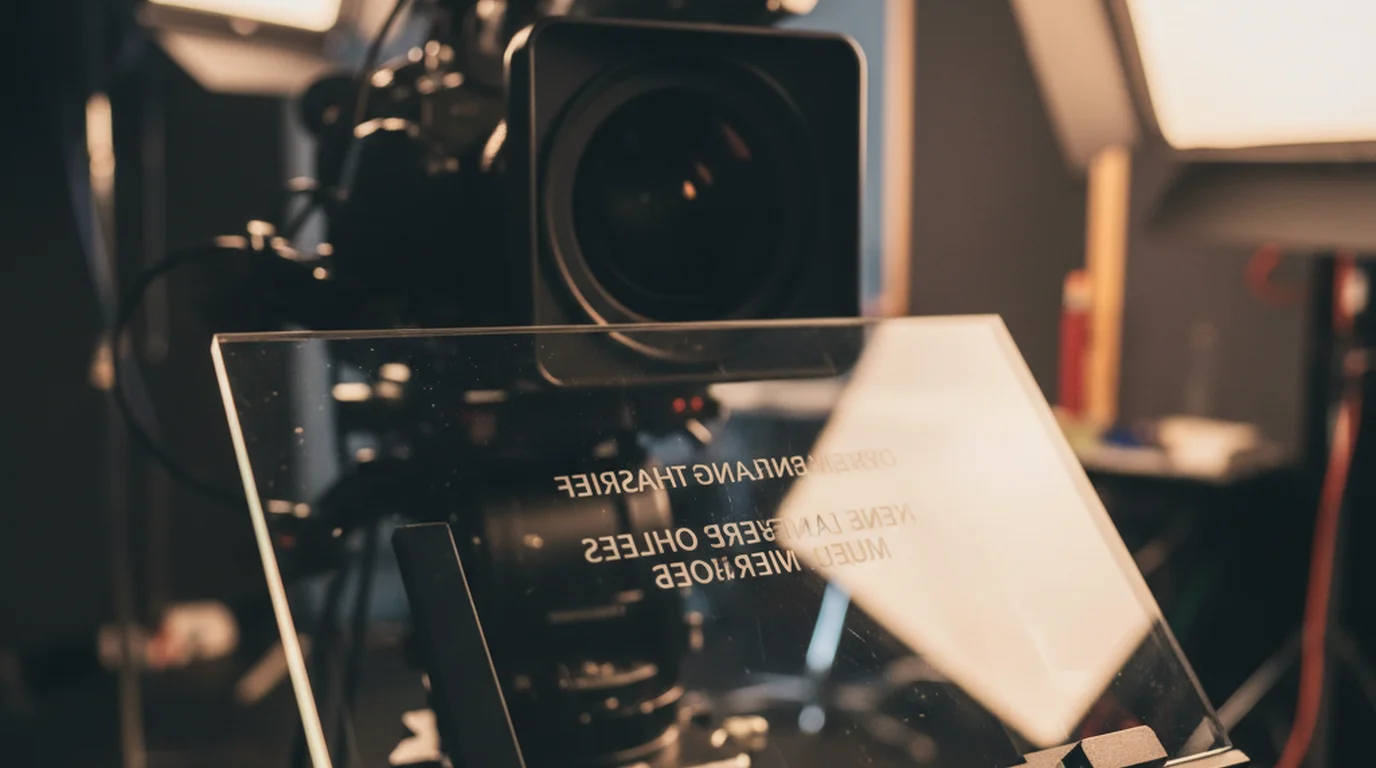
The teleprompter glass — formally called a beam splitter — is a half-silvered glass panel positioned at approximately 45 degrees in front of the camera lens. A monitor sits below the glass, facing upward, displaying the script text. The text on this monitor is horizontally flipped (mirrored) by the teleprompter software before display.
When the flipped text reflects off the 45-degree beam splitter toward the presenter's eyes, the reflection un-reverses the horizontal flip — and the text appears correctly readable. The presenter reads normally while looking straight at the glass, which is directly in front of the camera lens.
The camera behind the glass sees through it clearly because the glass is only partially silvered — typically a 70/30 split (70% transmitted light for the camera, 30% reflected for the text). The presenter doesn't see the camera behind the glass because the lighting setup keeps the front of the glass bright (the presenter's face and the text reflection) and the area behind the glass relatively dark.
The beam splitter principle used in teleprompter hardware is based on half-silvered mirror technology developed in the early 20th century for optical instruments and rangefinders. The first commercial teleprompter, patented by Hubert Schlafly at TelePrompTer Corporation in 1952, used a paper scroll rather than a beam splitter. The glass beam splitter design, which allows the camera to shoot directly through the reflective surface without obstruction, was developed in the late 1950s and became standard in broadcast studios by the early 1960s. Modern teleprompter glass uses anti-reflection coatings to minimize glare and maximize the 70/30 transmission ratio.
Non-Reversing Mirrors vs. Teleprompter Glass: What's Different
A consumer non-reversing mirror (like the True Mirror product or a 90-degree two-mirror setup) is designed to show a person their own reflection without left-right reversal. The goal is a self-image that matches how others see you.
Teleprompter beam splitter glass serves a different purpose: it's not designed to give you a non-reversed self-reflection. It's designed to let a monitor display text toward a presenter while simultaneously letting a camera shoot through the same glass. The partial transparency (the "half-silvered" property) is what makes it useful for teleprompters — a solid non-reversing mirror would block the camera entirely.
What they share is the reversal-correction principle. In both cases, an optical arrangement corrects for the inherent left-right reversal of flat mirror reflection. The teleprompter does this by pre-flipping the text on the source monitor, so the reflection of the flipped text reads correctly. A 90-degree non-reversing mirror does this geometrically, using two reflection steps that each flip the image, canceling each other out.
Why This Matters for Video Creators Without Hardware Teleprompters
Broadcast teleprompter hardware — the physical glass-and-monitor unit — costs between $200 for basic consumer models and $5,000+ for professional units. Most video creators don't own one. But the beam splitter isn't the only way to deliver a teleprompter script on camera.
Teleprompter apps on a phone or tablet position the scrolling script directly below or beside the camera lens. The app handles text display, scroll speed, and font size — without the beam splitter optics. The presenter looks down slightly to read, which registers on camera as a slight downward glance rather than an obvious reading motion, especially when the device is placed close to the lens axis.
Understanding the beam splitter principle explains why lens proximity matters: the closer the script is to the lens axis, the smaller the apparent eye-line deviation when reading. The beam splitter in hardware teleprompters achieves zero deviation because the script is literally on the same axis as the lens. A phone below the lens is a practical compromise — imperfect but workable for most content creation uses, as covered in the teleprompter glass guide.
Research by the International Broadcasting Convention (IBC) has documented that viewers judge on-camera credibility partly by eye contact — presenters who maintain consistent eye contact with the camera lens are rated as more authoritative and trustworthy than those who visibly look down or sideways at notes. In their viewer research analysis, the deviation angle threshold below which most viewers don't consciously notice a reading motion is approximately 8–12 degrees from the camera axis. Hardware teleprompters achieve 0 degrees. Phone-below-lens setups typically achieve 5–15 degrees depending on phone placement — within the undetectable range when properly positioned.
Frequently Asked Questions
Is there a mirror that doesn't reverse?
Yes. A non-reversing mirror (true mirror) combines two flat mirrors at a 90-degree angle to show your reflection without left-right reversal. Teleprompter glass uses a related principle: a half-silvered beam splitter reflects pre-flipped text from a monitor below, making it appear correctly readable while remaining transparent to the camera behind.
Are there non-reversible mirrors?
Yes — called true mirrors or non-reversing mirrors. The common design joins two flat mirrors at 90 degrees along a vertical center line. The two reflections combine into a single non-reversed image. These are used in fitting rooms, psychological research, and in specialist form as teleprompter beam splitter glass for broadcast production.
How does a teleprompter use a non-reverse mirror?
A teleprompter uses a beam splitter — a partially silvered glass panel at 45 degrees in front of the camera lens. A monitor below displays the script with text horizontally flipped. The flipped text reflects off the glass and appears correctly readable to the presenter. The camera shoots through the glass normally because it's only partially silvered (typically 70/30 transmission ratio).
Can you buy a non-reversing mirror?
Yes. True Mirror sells consumer versions, and beam splitter panels are available from teleprompter hardware manufacturers including Autocue, ikan, and Prompter People. For teleprompter use, you need a half-silvered or 70/30 beam splitter glass panel in a frame that mounts in front of your camera lens, with a monitor below displaying horizontally flipped text.
No Beam Splitter Required — Read Scripts Naturally on Any Device
Teleprompter-Scrolling Scripts handles the text display and scroll — free on iPhone, iPad, Mac, and online. No hardware needed.
Use Free Online Teleprompter Get the Free AppComplete guide: What Is a Teleprompter? How It Works, Types, and When to Use One — history, hardware vs software, types, cost, and free options for every platform.
Maya ChenMaya Chen is a content creator who films on iPhone and coaches solo creators on mobile-first video production for TikTok, Reels, and Shorts. Her work focuses on the part most people skip: how to actually sound natural once the camera is rolling.