How to Write a TikTok Script That Gets Views — Framework, Template, and Delivery Tips
 Lauren Mercer · June 25, 2026 · 7 min read
I've written scripts for over 300 TikTok videos across 30-plus brands, and the most common mistake I see is treating a TikTok script like a written document. It's not. A TikTok script is a pacing plan — it tells you what to say, when to pause, when to cut, and how to deliver the hook before the viewer swipes. If your TikTok videos feel flat or don't hold watch time past the first few seconds, the problem is almost always in the script structure, not the camera angle or the music.
A TikTok script is a short-form video writing structure that maps the hook, body content, and call to action within a 15–60 second time budget. An effective TikTok script uses a pattern-interrupt hook in the first 1–2 seconds, delivers value in 3–4 short punchy segments, and ends with a CTA or open loop that drives comments, saves, or shares.
Why TikTok Scripts Work Differently Than Other Video Scripts
YouTube scripts, course videos, and webinar scripts are built around comprehensiveness. TikTok scripts are built around retention. TikTok's algorithm distributes content based on completion rate and engagement signals — a video that 80% of viewers finish gets pushed far more aggressively than a video with high initial impressions but 20% completion. This means every line in a TikTok script has to earn its place or the viewer swipes.
The second difference is delivery speed. TikTok's most successful educational creators speak at 160–180 words per minute — faster than a typical presentation, close to a podcast interview pace. A script that reads slowly on paper often plays as flat and slow on camera. When I write TikTok scripts for brands, I always read them aloud at recording speed before finalizing, because the rhythm that works on the platform feels rushed when reading silently.
The third difference is the role of the hook. In a YouTube video, the first 30 seconds can be broad setup. In a TikTok, the hook has to work in the first 1.5 seconds — before the viewer's thumb even consciously decides to swipe. This makes the opening line the most important part of the script.
The 4-Part TikTok Script Framework
This framework applies to educational TikToks, product demonstrations, storytelling content, and opinion-based videos. The proportions shift slightly by format, but all four parts are always present.
Part 1: The Hook (0–2 seconds)
The hook's job is to stop the scroll. It has to create an information gap — a reason to stay — before the viewer processes that they're watching an ad or a creator they don't know. The most effective hooks are counterintuitive statements, direct challenges, or specific numbers the viewer hasn't seen before.
- Counterintuitive hook: "The thing that killed my TikTok growth was posting every day."
- Direct challenge hook: "You're using the wrong hook format for your niche."
- Specific number hook: "I analyzed 500 viral TikToks — the same hook format appeared in 73% of them."
What doesn't work: "Hi, I'm Lauren and today I'm going to talk about..." — this is a YouTube intro. On TikTok, the person's identity is established through the content, not a self-introduction.
Part 2: The Proof or Context (2–8 seconds)
Immediately after the hook, you have 5–6 seconds to establish credibility and set up the value. This is one or two sentences: why you have the right to say what you just said, and what the viewer is about to get. Keep it fast. "I've run 47 split tests on hook formats across 12 different accounts — here's what the data actually shows." That's it. Don't linger on credentials.
Part 3: The Value Delivery (8–50 seconds)
This is the main content of the TikTok script — the teaching, the story, the demonstration, or the argument. It should be structured in 2–4 short punchy segments, each 1–3 sentences long. Transitions between segments are short — "second," "here's the part most people miss," "and this is the one that changed everything for me."
One of the most important things I tell the creators I coach: each segment should be complete and valuable on its own. If a viewer drops off after segment two, they still got something. This keeps the completion rate higher because the content has delivered value before the ending rather than holding all the value for a payoff at the end.
According to TikTok's Creator Insights research, videos that deliver a concrete value point within the first 8 seconds have a 27% higher average watch time than videos that build to a value delivery later in the clip. The research, published in TikTok's internal creator playbook, analyzed over 10 million videos across educational, entertainment, and lifestyle categories. Structuring your TikTok script to frontload at least one complete takeaway in the first third is the single highest-leverage pacing change most creators can make.
Part 4: The Close (last 3–5 seconds)
The close does one of two things: delivers a call to action (follow, save, comment, try this) or plants an open loop (a question or incomplete idea that drives comments). The open loop close works especially well for building engagement: "Drop your niche in the comments and I'll tell you which hook format to use." The CTA close works better for commercial content or newsletter/course funnels: "Link in bio for the full template."
What kills a TikTok close: a generic "don't forget to like and follow." This signals low-quality content to both the algorithm and the viewer. The close should feel like a natural continuation of the conversation the script just started — not a transactional ask bolted on at the end.
TikTok Script Template (Copy-Paste Ready)
TIKTOK SCRIPT TEMPLATE (60 seconds / ~150 words)

HOOK (0–2s):
[Counterintuitive statement / Direct challenge / Specific number]
Target: 10–15 words, spoken fast.

PROOF/CONTEXT (2–8s):
[Your credential or the setup in 1–2 sentences]
Target: 20–30 words.

VALUE — SEGMENT 1 (8–20s):
[First point. Short sentences. Active verbs.]
Target: 30–40 words.

VALUE — SEGMENT 2 (20–35s):
[Second point. Concrete example or number.]
Target: 30–40 words.

VALUE — SEGMENT 3 (35–50s, optional):
[Third point or the twist/reversal.]
Target: 20–30 words.

CLOSE (50–60s):
[CTA or open loop. One sentence max.]
Target: 10–15 words.

TOTAL TARGET: 120–160 words for 60s video.
Read aloud at recording speed before shooting.
How to Deliver a TikTok Script Without Looking Like You're Reading
Scripts improve quality but create a new delivery challenge: how do you sound natural when you're reading? I've helped over 30 creators get comfortable with scripted delivery on TikTok and the answer isn't to hide the script — it's to internalize it well enough that the camera doesn't catch you reading.
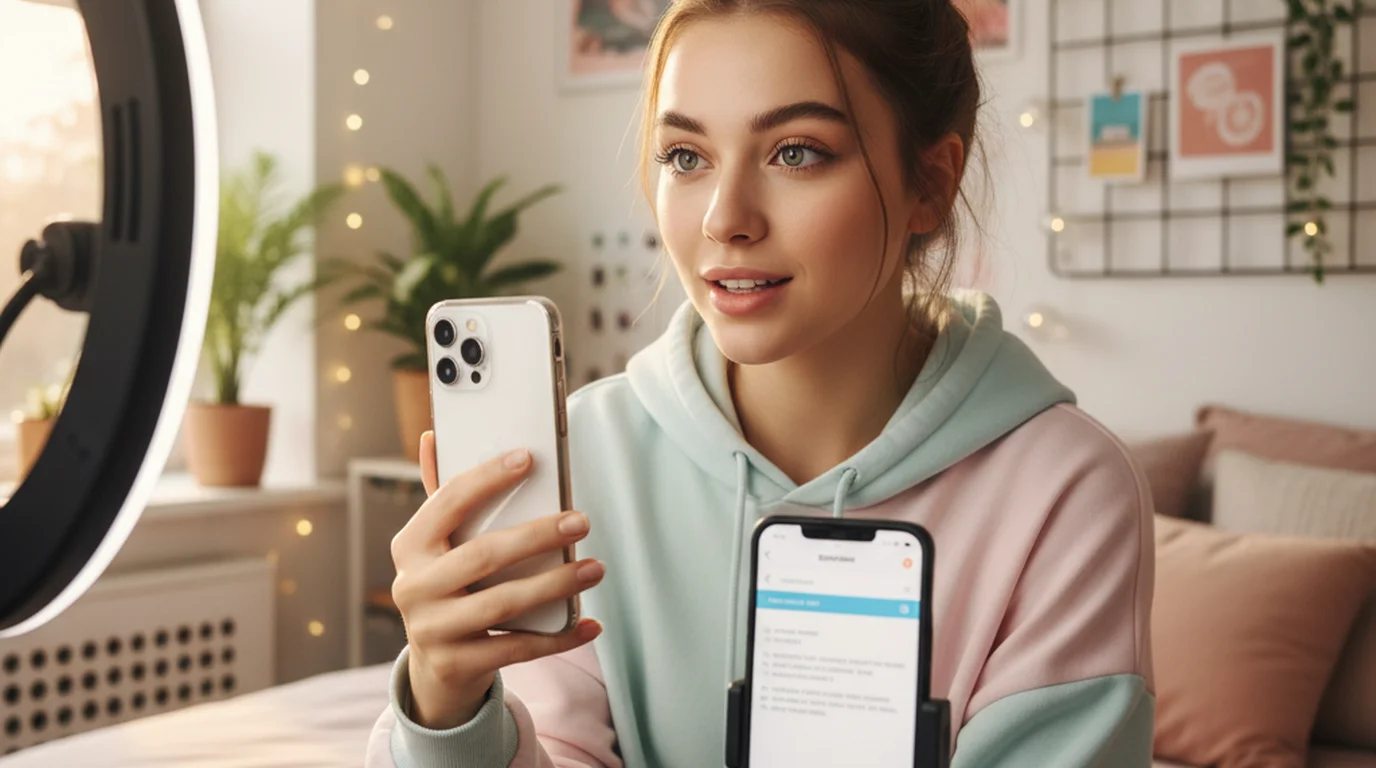
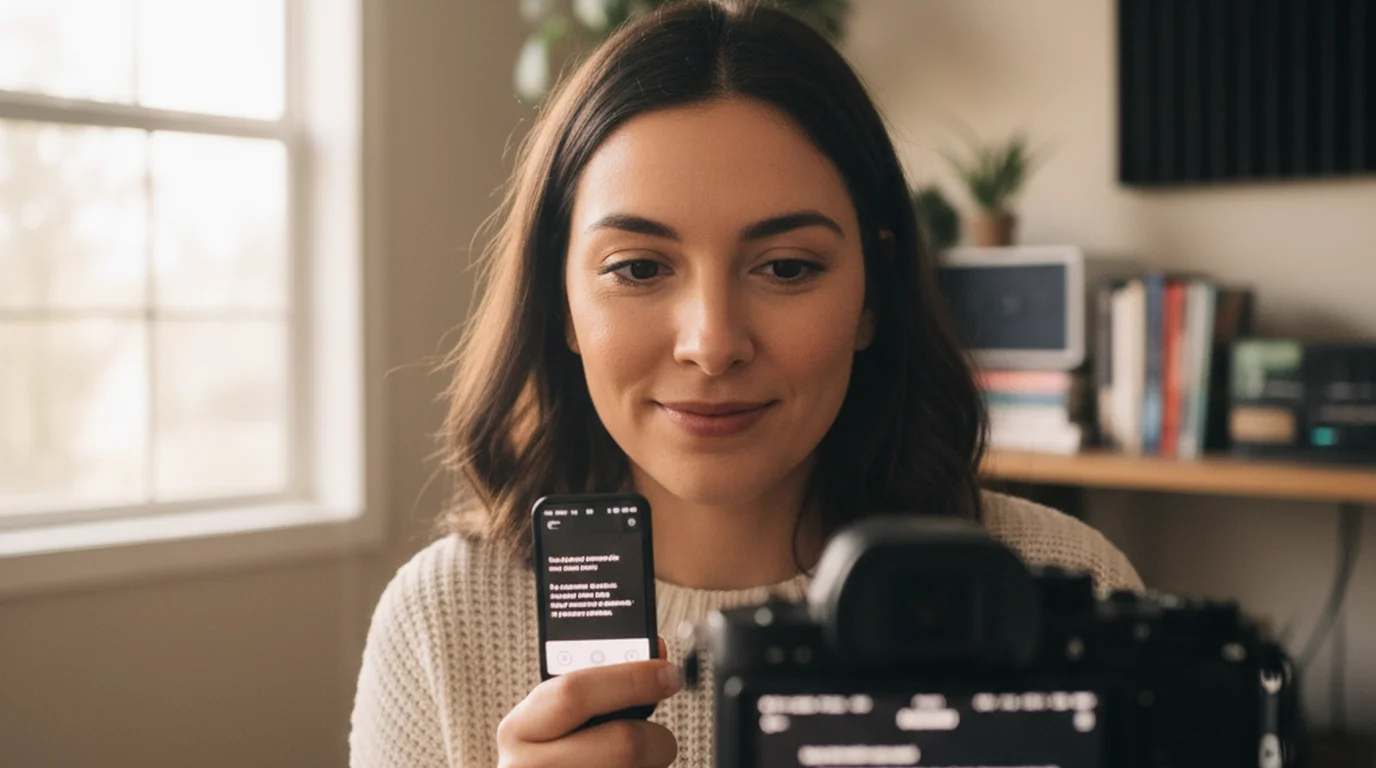
The most effective method is a teleprompter app on your iPhone positioned directly below the front camera. Not to the side — below the lens. When your eyes drop to read, the movement looks like thinking. When your eyes shift left or right to read, it looks like reading. The vertical plane is much less noticeable on camera.
Three setup rules that work in my experience: large font (32pt minimum on a 6-inch phone screen), slow scroll (you should feel slightly ahead of the words, not catching up), and a read-through before you record. The read-through is the step most creators skip and the one that makes the biggest difference. When the words are slightly familiar, your delivery speeds up naturally and the pauses land in the right places.
A study on content creator video production workflows by the Reuters Institute for the Study of Journalism (2024) found that 41% of solo video creators who produce educational or tutorial content use some form of text prompting during recording — ranging from full teleprompter apps to notes apps and physical cue cards. Among creators who had used teleprompters for at least six months, 78% reported improved take efficiency (fewer retakes) and 65% reported faster script finalization because they knew the script would be delivered as written rather than improvised from notes.
Frequently Asked Questions
How long should a TikTok script be?
For a 30-second TikTok, your script should be approximately 75–90 words. For a 60-second video, aim for 150–180 words. Scripts longer than 300 words tend to produce videos that lose viewer retention after the first third. TikTok's own data shows videos under 60 seconds have 30–40% higher completion rates than longer videos, which directly affects algorithm distribution.
Do successful TikTok creators use scripts?
Most high-view TikTok creators use some form of script — from full word-for-word teleprompter scripts to bullet-point outlines. Fully ad-libbed TikToks work for personality-driven creators who've mastered spontaneous delivery. For educational and how-to content, scripting improves accuracy, pacing, and the chance of making a clear point within 60 seconds.
What is a good hook for a TikTok script?
The best TikTok hooks create an instant information gap — a question, a contradiction, or a promise the viewer hasn't heard. Effective formats: a counterintuitive statement ("The advice that doubled my views was to post less"), a direct challenge, or a specific number ("I tested 47 posting schedules"). The hook must fit in the first 1–2 seconds and set up a payoff the viewer stays to receive.
How do I deliver a TikTok script without looking like I'm reading?
Use a teleprompter app on your phone positioned directly below the camera lens. Keep the font large and scroll slow so you read ahead rather than word-for-word. Practice the script once before recording so the words feel familiar. Natural eye contact, varying pace, and pausing for emphasis all help scripted delivery sound natural.
Deliver Your TikTok Script Naturally on iPhone
Teleprompter-Scrolling Scripts keeps your script scrolling at exactly your speaking pace — so you look at the camera, not the notes. Free on iPhone, iPad, and online.
Use Free Online Teleprompter Get the Free App
Lauren MercerLauren Mercer builds and sells online courses on scriptwriting, on-camera delivery, and video production workflows. She writes about the full path from script to screen — AI writing tools, recording setups, and the friction points that slow down solo educators.