How Many Words Is a 20 Minute Speech?
 Lauren Mercer · August 30, 2026 · 8 min read
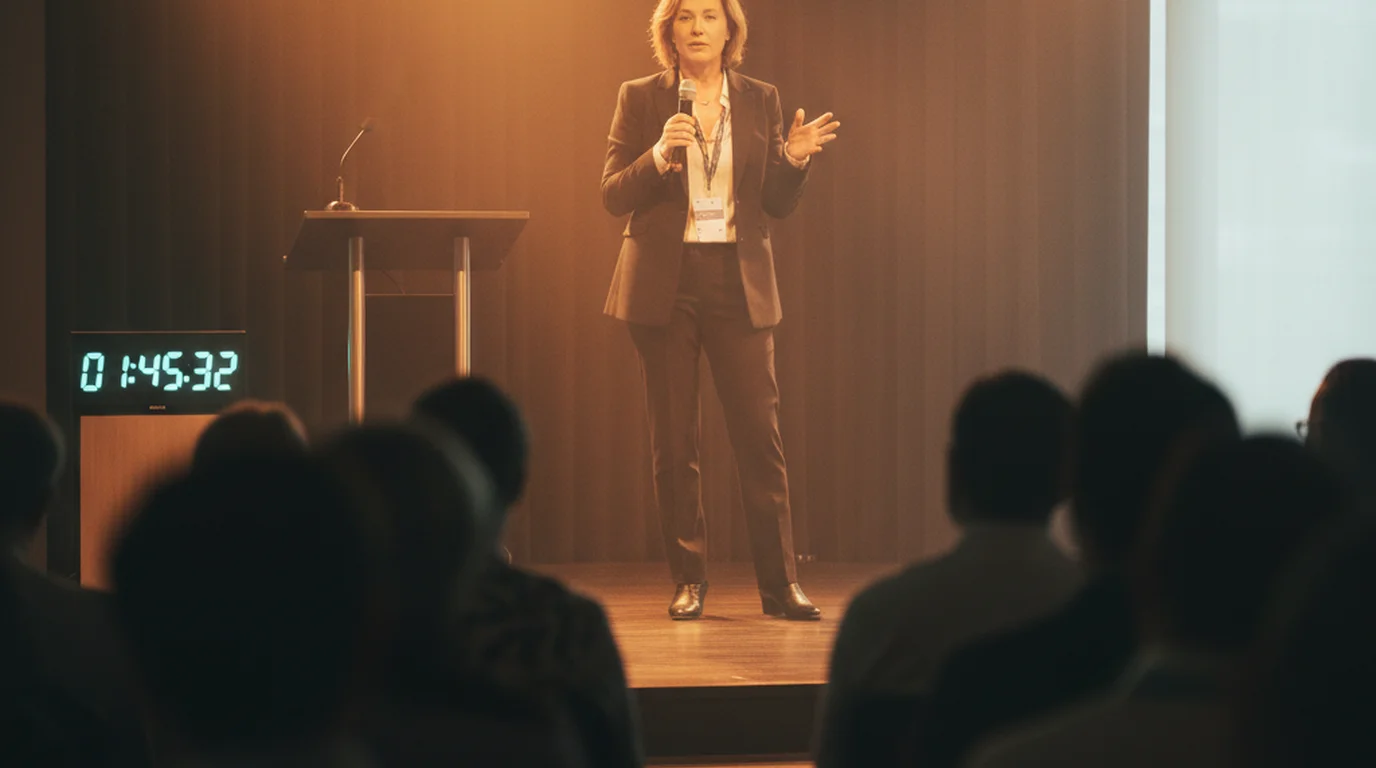
A 20-minute speech is 2,000–3,200 words depending on speaking pace. At the standard prepared-delivery rate of 130 words per minute, the target is 2,600 words. Most speakers should script closer to 2,340 words and let the remaining two minutes absorb pauses, audience reaction, and the natural slowdown that arrives in the second half of a long talk.
A 20 minute speech is the length where word-count discipline stops being optional. A five-minute talk can be improvised from an outline and still land on time. At twenty minutes, a 10% pacing drift costs two full minutes, which is usually the difference between finishing your conclusion and being cut off during it. For a script this long, paste the full text into the speech time calculator rather than estimating from a table.
20 minute speech word count by speaking pace
| Pace | Words per minute | 20-minute word count | Pages (double-spaced) |
|---|---|---|---|
| Slow / deliberate | 100 wpm | ~2,000 words | ~8 pages |
| Average / prepared | 130 wpm | ~2,600 words | ~10.4 pages |
| Conversational | 150 wpm | ~3,000 words | ~12 pages |
| Fast / broadcaster | 160 wpm | ~3,200 words | ~12.8 pages |
The same table answers the phrasing people use when they are working backwards from a draft rather than forwards from a slot: how many words is 20 minutes of speaking depends entirely on which row describes you. Time yourself reading 300 words aloud once and the answer stops being a guess.
The public speaking course text hosted by Lumen Learning cites the National Center for Voice and Speech figure of around 150 words per minute as the average speaking rate for U.S. English speakers, and recommends that public speakers deliberately slow to 125–150 words per minute. That gap matters at length: the difference between 150 wpm and 130 wpm across twenty minutes is 400 words, or roughly a page and a half of script.
Where 20-minute speeches appear
Conference breakout sessions. The standard breakout slot is 20 to 25 minutes of content plus 5 minutes of questions. Scripting to 2,340 words leaves room for the transitions between slides that always take longer live than in rehearsal.
University lecture segments. A 20-minute segment is the common building block of a 50-minute class: concept, worked example, then discussion. At 130 wpm that segment is 2,600 words, which comfortably holds one concept with two examples — and will not hold three.
Sales and investor presentations. Twenty minutes is the typical pitch window before questions. The word budget is tighter than it looks here, because demo time and slide transitions come out of the same twenty minutes as the words.
Recorded training modules and webinars. For recorded content the buffer works differently — there is no applause and no room noise, so a 2,600-word script really does land at twenty minutes. Recorded modules are the one place where the full theoretical word count is safe to use.
Slide count for a 20-minute presentation
Fifteen to twenty slides is the working range. At 15 slides you get 80 seconds each, which is enough to make a point and let it settle. At 20 slides you are down to 60 seconds each, and that only works if the slides are visual rather than dense.
A structure that survives contact with a live room: 1 title, 1 agenda, 12 to 16 content slides carrying one idea apiece, 1 summary, 1 closing prompt. The failure pattern is adding slides to fit more material — every extra slide costs a transition, and transitions are where a 20 minute speech silently becomes a 23-minute one.
Why a 20 minute speech is harder to hold than a 15-minute one
Twenty minutes sits just past the point where a single narrative arc carries an audience unaided. A 15-minute talk can run on one idea and a build. A 20-minute talk usually cannot, which is why the format tends to sprawl: speakers add a fourth section to fill the extra five minutes, and the fourth section is the one that runs long.
The fix is structural rather than verbal. Build a 20 minute speech as three sections plus a deliberate reset — a question to the room, a short demo, a slide with nothing but a number on it — placed at roughly the twelve-minute mark. The reset costs 30 seconds of your word budget and buys back attention for the closing third.
Pace drift compounds with duration, which is why a 20 minute speech has so little tolerance for it. A speaker who rehearses at 130 words per minute and delivers at 120 — a 7.7% slowdown, well inside normal nerves — turns a 2,600-word script into a talk that runs 21 minutes 40 seconds. The identical drift applied to a 5-minute talk costs only 25 seconds, which is why short-format instincts fail at length.
In our work with course creators recording long-form modules, the pattern is consistent: scripts that hit 2,300–2,400 words land inside twenty minutes on nearly every take, while scripts written to the full 2,600 come in over time whenever anything unscripted happens. The buffer is not padding. It is the part of the script that absorbs reality.
Frequently Asked Questions
How many words is a 20 minute speech?
A 20-minute speech is approximately 2,000 to 3,200 words depending on pace. At the standard prepared-delivery rate of 130 words per minute, the target is 2,600 words. Most speakers should script to about 2,340 words instead, leaving roughly two minutes of buffer for pauses, audience reaction, and the slowdown that happens naturally in the second half of a longer talk.
How long is a 2500 word speech?
A 2,500-word speech runs about 19 minutes at a prepared pace of 130 words per minute, 17 minutes at a conversational 150 wpm, and 25 minutes at a slow, deliberate 100 wpm. For a 20-minute slot, 2,500 words is a comfortable target that leaves a small margin. For an 18-minute slot it is slightly long, and trimming 150 to 200 words is easier than trying to speed up delivery on the day.
How long is a 200 word speech?
A 200-word speech runs about 90 seconds at a prepared pace of 130 words per minute, or roughly 80 seconds at a conversational 150 wpm. That length works for a toast, an introduction of another speaker, or an elevator pitch. It is far too short for a 20-minute slot — a 20-minute talk needs roughly thirteen times that many words.
Can I write 1000 words in 20 minutes?
Writing speed and speaking speed are different measurements and are often confused. Typing 1,000 words in 20 minutes requires 50 words per minute of sustained composition, which is fast but achievable for familiar material. Speaking 1,000 words takes only about 7.5 minutes at a prepared pace. When planning a 20-minute speech, use the speaking figure — roughly 2,600 words — not a typing rate.
Is 700 words a 5 minute speech?
Roughly, yes. At 130 words per minute, 700 words runs about 5 minutes 24 seconds; at a faster 150 wpm it is closer to 4 minutes 40 seconds. For a strict 5-minute limit, 650 words is the safer target. The same ratio scales upward: multiply by four and a 20-minute speech lands at approximately 2,600 words.
How many pages is a 20 minute speech double spaced?
At 2,600 words, a 20-minute speech is approximately 10 to 11 pages of double-spaced 12pt text, or about 5 pages single-spaced. Page count is unreliable as a planning target for teleprompter scripts, because font size and line spacing change the layout dramatically. Count words rather than pages when you need to hit a time limit.
How many slides should a 20 minute presentation have?
Fifteen to twenty slides is the practical range for a 20-minute presentation, averaging 60 to 80 seconds per slide. A workable structure is 1 title slide, 1 agenda slide, 12 to 16 content slides carrying one idea each, 1 summary, and 1 closing or Q&A prompt. More than 20 slides forces a pace that prevents the audience from processing one point before the next arrives.
How to practice timing your 20 minute speech
Knowing how many words is a 20 minute speech only sets the target. Confirming that your delivery matches it takes three timed read-throughs, with the clock stopped at every section break rather than only at the end. A talk that finishes at 20:10 overall can still be badly balanced — section two running 90 seconds long and section four running 80 seconds short averages out on paper and falls apart when the room reacts differently than rehearsal did.
Record the first full run and listen for two things: filler words, which inflate the real 20 minute speech word count without adding meaning, and the pauses you did not plan. Both are invisible while speaking and obvious on playback. Once the read time is stable, check your actual rate against the reference table in our full words-per-speech-length guide and adjust the script rather than the delivery. Speeding up to save time is the change that never survives an audience.
If twenty minutes is longer than the slot you usually work in, the shorter formats scale predictably from the same arithmetic — compare against a 15-minute speech to see how the buffer rule tightens as duration drops, or a 30-minute speech to see where a single script has to become a segmented one.
Common pacing mistakes in a 20 minute speech
Unbudgeted openings. Acknowledgments, housekeeping, and a joke about the room routinely eat two to three minutes before the scripted first line. At twenty minutes that is 15% of the slot spent on material nobody timed. Script the opening minute as tightly as the rest.
Accelerating through data. Speakers slow down inside familiar stories and speed up through numbers, which is exactly backwards. Dense sections need the slower pace so the figures land; narrative sections can move.
Treating Q&A as free time. If the slot is 20 minutes including questions, the talk is 15 minutes and the word budget is 1,950 — not 2,600. Confirm which number the organizer means before writing a single line.
Using a teleprompter to hold pace in a 20 minute speech
A scrolling script sets a floor under your delivery rate, and across a 20 minute speech that floor is worth more than any amount of willpower. Set the scroll to your rehearsed words per minute — typically 120 to 130 for prepared delivery — and the script physically prevents the acceleration that shows up around minute twelve when adrenaline peaks.
The free online teleprompter runs in any browser for desk rehearsal and virtual presentations, with the scroll speed adjustable while you read. For recording the talk on iPhone or iPad, Camera mode overlays the scrolling script on the live camera view so your eye line stays on the lens for the full twenty minutes rather than dropping to notes every few sentences.
One habit is worth the setup time: rehearse at the scroll speed you will actually use, not faster. A script rehearsed at 145 wpm and delivered at 125 wpm runs three minutes long, and nothing about the room will tell you that until it is too late to fix.
Lauren MercerLauren Mercer builds and sells online courses on scriptwriting, on-camera delivery, and video production workflows. She writes about the full path from script to screen — AI writing tools, recording setups, and the friction points that slow down solo educators.
Hold Your Pace for the Full Twenty Minutes
Long talks drift because delivery speeds up and nobody notices until the clock does. Teleprompter-Scrolling Scripts scrolls at the words-per-minute rate you set, keeping a 2,600-word script on schedule from the first line to the last. Free on iPhone, iPad, Mac, and web.
Use Free Online Teleprompter Get the Free App