Raw storytelling on camera
Raw storytelling on camera is the practice of sharing a personal story directly to the camera lens without a fully written script — relying on the authenticity of real emotion, lived experience, and unpolished delivery to connect with viewers.
What is raw storytelling on camera?
Raw storytelling on camera is a style of direct-to-camera content where the presenter speaks from personal experience rather than from a prepared script. It is associated with viral emotional content on social media, founder story videos, personal testimony, and confessional-style vlogs. The "rawness" comes from visible imperfection — pauses, emotional moments, unpolished word choice — which signals authenticity to the viewer.
This is distinct from both fully scripted video (where every word is written and read from a teleprompter) and from simply being unprepared. Raw storytelling is an intentional style choice. The presenter has a story to tell and knows its emotional core; what they choose not to do is script every sentence and deliver it with broadcast polish. The imperfection is not an accident — it is part of the message. It communicates: this person is speaking from experience, not performing a presentation.
Why raw storytelling works
Research on parasocial connection — the bond viewers form with on-screen personalities — consistently shows that audiences respond more strongly to vulnerable, imperfect content than to polished presentations. Eye contact, emotional tone, and first-person framing trigger empathy. The viewer feels they are being spoken to directly, not performed at. That distinction is not subtle; most viewers feel it immediately even if they cannot articulate it.
The mechanism is trust signaling. A perfectly scripted and produced video signals professional competence. Raw storytelling signals something different and in many contexts more valuable: honesty. A slight stumble over a word, a pause to collect emotion, a self-correction mid-sentence — these are signals that the speaker is thinking in real time, not reciting something pre-approved. For content where the goal is personal connection and trust rather than information transfer, that honesty signal outweighs the polish deficit every time.
The core technique
Effective raw storytelling is built on a single story told with one clear emotional arc. The structure: set the scene (where and when the story happens), describe what occurred (the moment of change, realization, or decision), share what you felt (the honest emotional experience, not the sanitized version), and arrive at the lesson or impact (what changed, what you would tell someone in the same situation). That is the complete framework. No bullet points. No transitions. Just narrative flow.
The most important technical element is specificity. General statements do not create connection. "It was a difficult time" tells a viewer nothing. "I was sitting in my car outside the building at 11pm, and I just could not make myself go back in" creates an image the viewer can inhabit. Specificity signals memory, and memory signals truth. The more concrete the detail, the more the story feels real — and the more real it feels, the more the viewer trusts the person telling it.
When raw storytelling is appropriate
Raw storytelling earns its place in content where the presenter's personal experience is the primary value. Founder story videos — why you built something, what it cost you, what you learned — are the clearest use case. Personal testimony, advocacy content, and mental health content where lived experience is the credential. Community-building content where the goal is to make viewers feel they know you. Behind-the-scenes content where the unpolished reality is more compelling than any produced version would be.
It is not appropriate for instructional content, technical tutorials, corporate announcements, product demos, or any content where word accuracy and completeness are the primary value. A tutorial where the presenter forgets a critical step is less useful than one delivered from a teleprompter. A corporate announcement delivered in emotional, unpolished narrative style would read as unprofessional. Raw storytelling is a strong tool used in the right context; applied to the wrong content type, it produces confusion rather than connection.
Preparing for raw storytelling
Raw does not mean unprepared. Effective raw storytelling requires substantial preparation — just not the kind that shows up as a polished script. Before recording, spend time with the story: identify the scene, name the key moment, sit with the feeling, and find the single most important thing the viewer should take from it. These are not writing exercises; they are thinking exercises. The preparation happens in your head and in repeated out-loud tellings, not on the page.
Write a 3–5 bullet point map — not a script — that captures the story's key structural moments: the setup, the moment of change, the emotional core, the takeaway. This map anchors the delivery without scripting the words. Put it where you can glance at it before recording, then set it aside. When you record, speak from memory and feeling, not from the map. If you lose the thread, pause, look at the map, reconnect with where you are, and continue. The edit will take care of the gap; the authenticity in the rest of the take is what matters.
The role of a light teleprompter script
For creators who lose their thread under camera pressure — and this is more common than most admit, because recording yourself is inherently more stressful than speaking in a room — a very loose teleprompter script can anchor a raw storytelling session without killing the authenticity. The key word is loose: emotional beats and brief cue phrases rather than full sentences, loaded into Teleprompter-Scrolling Scripts on iPhone or iPad and set to scroll slowly in the background.
Think of it as a story map that scrolls gently while you speak. "Parking lot, 11pm" is a cue that prompts the memory and emotion without scripting the words. "The email I almost did not send" is a beat that tells you where you are in the story without dictating how you say it. The teleprompter becomes a structural safety net rather than a reading device. The delivery stays spontaneous; the structure stays intact. For creators who have experienced the frustration of a raw storytelling take that rambled into incoherence, this approach produces the best of both formats.
Combining raw storytelling with structured video
Many successful creators do not choose between raw storytelling and scripted video — they use both within the same content strategy and sometimes within the same video. Raw storytelling segments establish personal connection and trust. Scripted teleprompter segments deliver information, instructions, or structured arguments with accuracy and pace. Neither format alone is as effective as both together across a content library.
A useful pattern: open a video with 60–90 seconds of raw storytelling to establish why the topic matters personally, then transition into scripted delivery for the instructional content. The raw opening earns the viewer's attention and emotional investment. The scripted section delivers the value they came for. This combination works because the viewer gets both things they are looking for: a reason to care (the story) and something actionable (the information). A scroller like the free online teleprompter at teleprompter.works/online works well for the scripted segments when recording from a desktop setup, while the native app handles the iPhone and iPad recording workflow.
Technical setup for raw storytelling
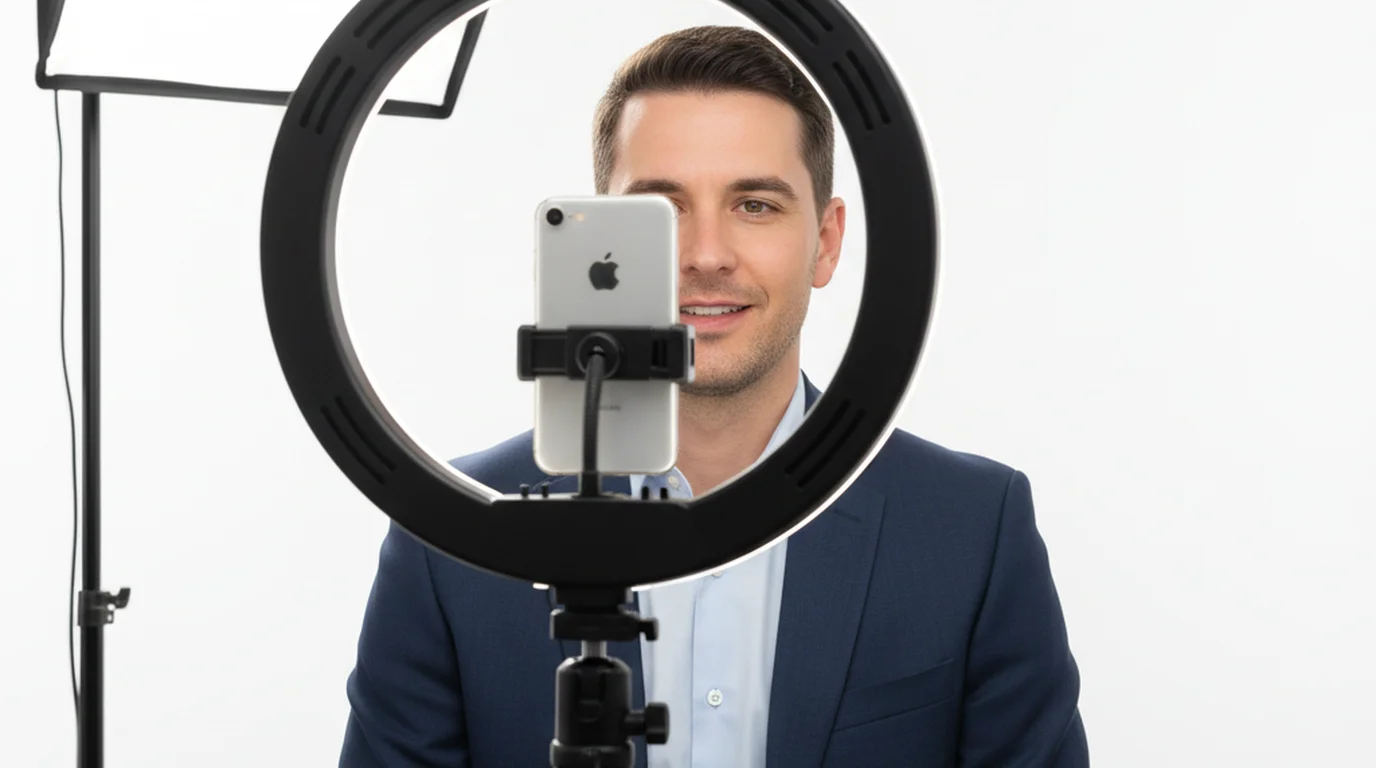
The technical requirements for raw storytelling are minimal by design — the authenticity of the content is not helped by elaborate production. A phone propped at eye level is the standard setup: it keeps the lens at face height, which means the presenter's natural forward gaze is close to on-axis. Good lighting — a window in front of the presenter or a simple ring light — is more important than a sophisticated camera. Quiet environment, no distracting background clutter, and stable mounting are the only other requirements.
Target 2–3 minutes for most raw storytelling content. Long-form raw storytelling works for high-trust audiences who have invested in the creator's journey; for most use cases, brevity sharpens the emotional impact. Press record and speak. If you lose the thread, pause visibly, reconnect with the feeling, and continue — do not restart from the top. The edit removes gaps and stumbles; it cannot add the emotional authenticity that a continuous take captures. Record the whole story, even imperfectly, and edit from there.
Use a light teleprompter script to keep your raw storytelling on track — load your story beats into Teleprompter-Scrolling Scripts and record with the confidence of structure and the feel of authentic delivery.
Use Free Online Teleprompter Get the Free App