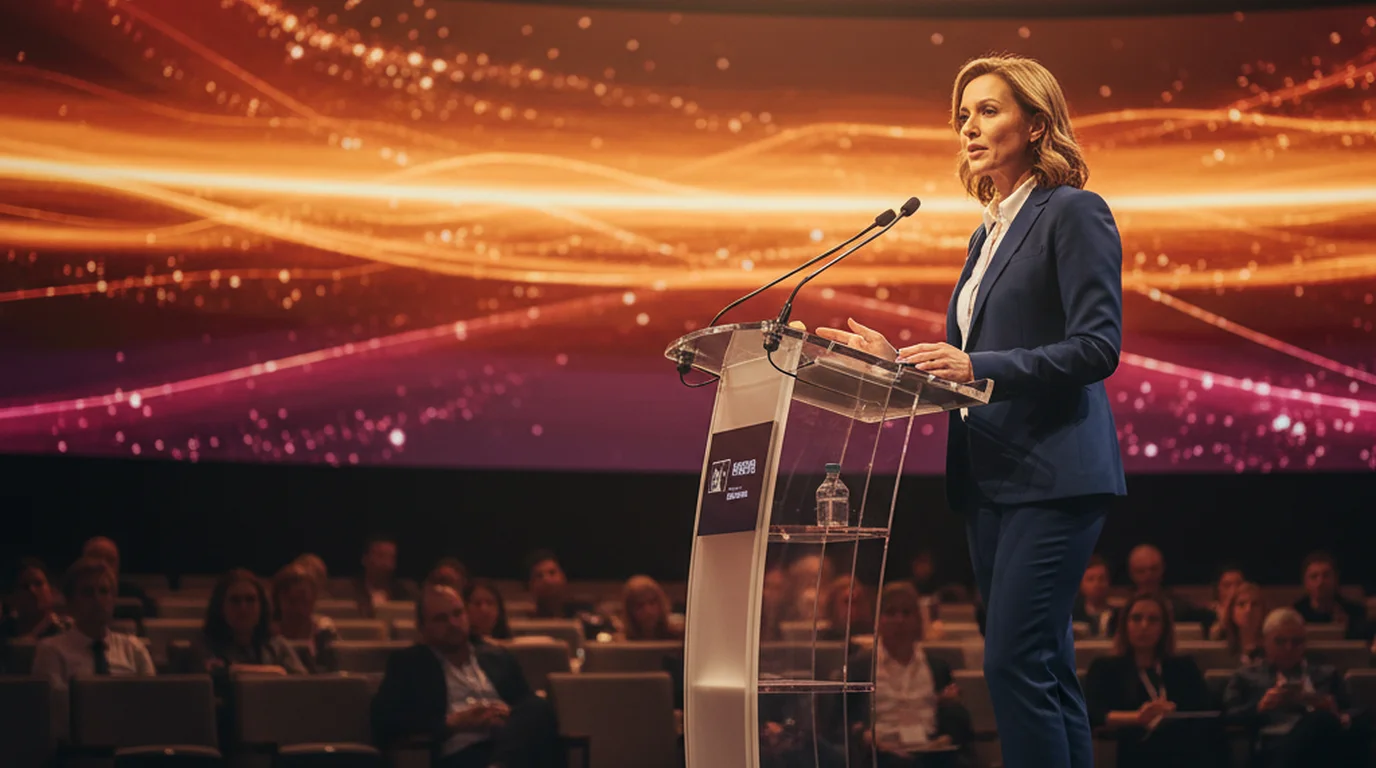
What is a keynote address?
This is a quick-answer overview. For the complete guide, see What Is a Keynote Address? — Full Guide.
A keynote address is the featured speech at a conference, ceremony, or large event. It is typically delivered by a prominent speaker and sets the intellectual and emotional tone for everything that follows. Unlike regular conference talks, which teach specific skills or share research findings, a keynote is designed to inspire, reframe thinking, and unify an audience around a central idea. Understanding the structure — and how to prepare one — makes the difference between a speech that people talk about afterward and one that is forgotten by lunch.
What a keynote address is — and what it is not
A keynote address (also called a keynote speech or opening address) is the featured speech that defines the theme and tone of an entire event. It is typically placed at the opening or closing of a conference, ceremony, graduation, or summit, and it is delivered by a speaker chosen for their authority, vision, or relevance to the event's central theme.
What distinguishes a keynote from a regular conference presentation is its scope and intent. A regular presentation might teach a specific technique, share research results, or walk through a case study. A keynote operates at a higher level — it asks the audience to see their field, their challenge, or their moment in a new way. It uses story, metaphor, and emotional arc to make ideas memorable, not just informative.
A keynote is not a lecture. It does not proceed through a syllabus or cover material comprehensively. It is not an executive summary of a report. It is not a product demo. It is, at its best, a guided experience that changes how the audience thinks about something by the time they leave the room. The most remembered keynotes do not just inform — they shift perspective.
The word "keynote" itself comes from music: the keynote of a scale is the foundational tone that everything else in the composition relates to. A keynote speech plays the same role in a conference program. It establishes the central frequency that the other sessions, workshops, and conversations resonate with.
The structure of a keynote address
Most effective keynote addresses follow a recognizable structure, even when the content and style vary widely. Understanding this structure helps both in writing a keynote and in evaluating one.
Opening hook or story (2–3 minutes): The keynote opens with something that demands attention — a surprising statistic, a provocative question, a short personal story, or a vivid scene. The purpose is to establish emotional engagement before the central theme is stated. Audiences decide within the first 60 seconds whether they are going to pay attention, and the opening hook is what secures that attention.
Statement of the central theme (1 minute): Once the audience is engaged, the speaker states the central idea of the speech explicitly. This is the "one sentence" version of the whole talk — the thesis that everything else supports. Stating it clearly early gives the audience a frame for processing everything that follows.
Main arguments with supporting evidence and stories (3–5 minutes each): The body of the keynote develops two to four main arguments, insights, or perspectives that support the central theme. Each argument is typically developed with evidence (data, research, expert opinion) and illustrated with a story or concrete example. The stories are what audiences remember long after the statistics fade.
Call to action and close (2–3 minutes): The keynote closes with a specific, actionable call to action — what should the audience do, think, or change as a result of this speech? The final lines should be crafted with particular care, because what speakers say last is what audiences remember most. A memorable closing line, delivered well, can become the phrase the event is remembered by.
Total length for a typical conference keynote is 20 to 30 minutes. Major political and corporate keynotes run 30 to 60 minutes. TEDx talks are capped at 18 minutes. Each format rewards tight structure — the time constraint is not a limitation but a discipline that strengthens the speech.
What makes a keynote different from a regular presentation
The most important distinction between a keynote and a regular presentation is the relationship between content and audience. A presentation transfers information. A keynote changes perspective.
Regular presentations are structured around the content: here is what we found, here is how it works, here is what you should do. Keynotes are structured around the audience: here is how I want you to feel and think differently after hearing this. The best keynotes start with the audience's existing beliefs and challenges, and by the end have shifted those beliefs through story, evidence, and emotional resonance.
Keynotes use narrative arc in a way that most presentations do not. There is a beginning (the world as it is), a middle (the challenge or insight that changes things), and an end (the world as it could be). This story structure is not decorative — it is how the brain organizes and retains complex ideas. Presentations that skip the narrative and go directly to conclusions are technically efficient but emotionally unmemorable.
Keynotes also use repetition and rhythm deliberately. The rule of three — presenting ideas in groups of three — appears in nearly every successful keynote because it is memorable, balanced, and complete. Repeated phrases, refrains, and structural callbacks ("What I am saying is...") give the audience anchors in the speech that help them follow the argument and remember where they are.
Writing the keynote script
The most effective way to write a keynote script is to start with one sentence. Before writing a single word of the actual speech, write the central theme in one clear, specific sentence. Not "I am going to talk about leadership" — that is a topic. A theme sentence sounds more like: "The leaders who transformed their industries were not the ones who planned the best — they were the ones who responded to failure the fastest." That sentence tells you what the speech is about, what claim it makes, and what direction the evidence needs to point.
Once you have the theme sentence, write the opening hook. This is counterintuitive — most writers want to start at the beginning, which means writing the introduction first. But writing the hook before the body of the speech forces you to find the most arresting entry point into your theme. A strong hook that connects directly to the theme makes the rest of the speech easier to write because every section is pulling toward the same central idea.
Write for the ear, not the eye. Keynote scripts are different from written essays in their sentence structure, vocabulary, and rhythm. Short sentences. Active voice. Repetition for effect, not variety. Concrete nouns and strong verbs over abstract nouns and passive constructions. Read every sentence aloud as you write it. If you cannot say it naturally in one breath, it needs to be shortened or restructured.
Use anecdotes, statistics, and analogies as the supporting material for each main point — but treat them as tools for illustration, not the point itself. The story is not the argument; the story makes the argument memorable. Statistics establish credibility; stories create belief.
Rehearsal and delivery
Keynotes require more rehearsal than most speakers expect. A 20-minute keynote benefits from at least five to eight full run-throughs before delivery; a 45-minute keynote should have ten or more. Rehearsal is not about memorizing words — it is about internalizing the structure so thoroughly that you can deliver it with presence and authority rather than searching for the next line.
For high-stakes keynotes where word accuracy matters — broadcast events, commencement addresses, earnings calls, major announcements — a full manuscript delivered via teleprompter is the safest approach. The teleprompter provides every word at eye level, allowing you to deliver the speech exactly as written while maintaining natural eye contact with the audience or camera.
For conversational keynotes where flexibility and responsiveness to the room matter, an outline-based approach with talking points and a memorized opening and closing gives more freedom. The risk is that content may expand or contract unpredictably, making time management difficult. Many experienced keynote speakers use a hybrid: a fully scripted opening and closing (the highest-stakes parts of the speech), with an outline for the body sections where natural storytelling can vary.
Record yourself during rehearsal. Watch the recording with the sound off first — body language, facial expression, and movement communicate as much as words. Then watch again with the sound on and focus on pacing, tone variation, and whether the emotional arc of the speech lands as intended.
Using a teleprompter for keynote delivery
Presidential-style glass teleprompters — two transparent panels mounted on stands on either side of the podium — are the standard setup for major political keynotes, corporate earnings presentations, and high-profile event speeches. The glass panels reflect text from monitors positioned below the speaker's sight line, creating the appearance of direct eye contact with the audience while the speaker reads the full script.
For recorded keynotes, virtual events, and solo-camera presentations, app-based teleprompters are the practical alternative. An iPad positioned at camera level delivers the full script with scrolling text, no glass hardware required, no operator needed, and no stage setup. The speaker reads from the device while the camera captures natural eye contact. The same setup works on Mac for webcam-based keynotes recorded at a desk.
App-based teleprompters are increasingly common for virtual keynotes that are broadcast or recorded for later distribution. Speakers can deliver a fully scripted, word-accurate keynote from a home or office setup with the same confidence as a stage delivery. The key is positioning the device close to the camera lens so the eye-line gap between reading the text and looking at the lens is minimal.
For live event keynotes where a teleprompter operator is not available, some speakers use a tablet positioned on the podium or lectern in a slight upward angle — a visible but professionally accepted solution for smaller events where the glass setup is impractical.
Eye contact and movement during a keynote
Eye contact is one of the most powerful tools in live keynote delivery. Audiences feel addressed, seen, and engaged when a speaker makes genuine eye contact. The challenge of any scripted delivery — notes, slides, or teleprompter — is maintaining that quality of contact while managing the text.
For dual-glass teleprompter setups at live events, the standard technique is to move the gaze between the two panels in a slow, natural arc that sweeps across the audience. Pausing the gaze on one side of the room for three to five seconds before moving to the other creates the impression of looking at individuals rather than scanning. This technique takes practice but becomes natural after a few run-throughs on the actual stage setup.
For app-based keynotes recorded on camera, position the teleprompter device as close to the camera lens as possible — either directly below it, mounted above it, or positioned so the text appears within a few inches of the lens. The closer the text is to the lens, the more natural the eye contact appears on camera. A gap of more than two to three inches between the text and the lens becomes noticeable in close-up shots.
Movement on stage should be deliberate and purposeful. Moving toward the audience during an emotional appeal, moving back to a neutral position during a transition, and staying still during a key argument all communicate intention. Nervous pacing — moving without purpose — undermines authority. If you are not sure what to do with your body during a section, stand still. Stillness reads as confidence on camera and on stage.
Famous keynote structures worth studying
Studying successful keynote speeches is one of the fastest ways to internalize what the structure feels like in practice. Three models are particularly instructive.
Steve Jobs' Apple product launch keynotes used a strict rule of three throughout — three products, three features, three reasons. Each product was introduced with a story about the problem it solved, not a list of specifications. The reveal moment ("And one more thing...") was a structural device that trained audiences to expect a surprise, creating sustained engagement across a two-hour presentation. The closing always circled back to the opening theme, creating a complete narrative arc.
TED and TEDx talks follow the "one idea worth spreading" principle. Every talk has one central idea that can be stated in a sentence, and every story, statistic, and argument in the 18 minutes supports that idea. The constraint of a single idea is what gives TED talks their clarity and memorability. Most mediocre keynotes fail because they try to say too many things.
Political convention keynotes follow a recognizable three-part structure: a statement of the party or candidate's central theme (what we believe), a personal story or testimonial that embodies that theme (why it matters to real people), and a vision statement for the future (what becomes possible if we act). The personal story is almost always the section that gets quoted afterward — it is the emotional anchor for the whole speech.
All three models share a common principle: the structure is invisible to the audience but essential to the speaker. The best keynotes feel like an experience, not a framework. Getting the structure right is what makes that experience possible.
Deliver your next keynote with confidence. Teleprompter-Scrolling Scripts keeps your full script at eye level on iPhone, iPad, or Mac — no operator, no glass panels, no memorization required.
Use Free Online Teleprompter Get the Free App